
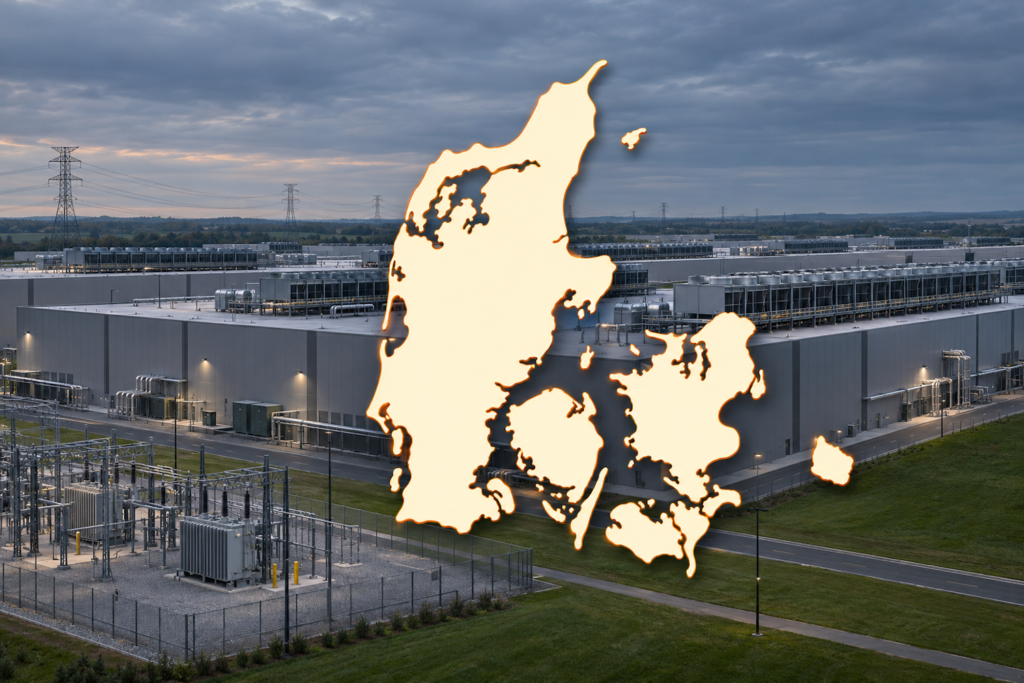
Four hundred and three large American data centers alone are associated with 25.7 million tons of CO₂ in just one year. A quantity comparable to the annual emissions of Denmark, a country of around six million inhabitants. And all to power part of the United States’ digital infrastructure, those that host cloud services, online platforms and artificial intelligence systems. Behind the algorithms capable of responding to our requests in a few seconds there is therefore a huge infrastructure, which consumes electricity and continues to depend to a large extent on fossil fuels.
The calculations are made by a study coordinated by the Harvard TH Chan School of Public Health, published on November 16, 2026 in the scientific journal Nature Sustainability. The researchers analyzed 403 large data centers, called hyperscaleoperational between May 2024 and April 2025. The result is quite eloquent: these facilities consumed approximately 82 terawatt hours of electricity, equal to 1.8% of the entire US electricity demand. And more than half of the energy used came from gas and coal.
How much energy do large American data centers consume
Eighty-two terawatt hours equals 82 billion kilowatt hours. An amount sufficient to power millions of homes for a year and which, in the case of data centers, serves to keep servers, processors, storage systems and cooling equipment running. Because these enormous computer complexes must work continuously, process increasing quantities of information and disperse the heat produced by computers. In short, artificial intelligence may seem like something immaterial, but it needs buildings, cables, electrical systems and a lot of energy.
To estimate this consumption, the research group led by Gianluca Guidi, a researcher at Harvard, used satellite images, information on the structures and data relating to the electrical capacity of the plants. The results were then cross-referenced with those of the Environmental Protection Agency (EPA), the American environmental protection agency, to reconstruct the energy sources of the networks to which the data centers are connected. These are therefore estimates developed through models, with a consumption of between 68 and 99 terawatt hours in the different scenarios considered. The figure of 82 terawatt hours represents the central scenario.
Emissions also change depending on operating conditions: according to the study, they range between 21 and 31 million tonnes of CO₂, with a central estimate of 25.7 million. An already considerable figure, especially since it only concerns the structures analyzed and a period ending in April 2025. In the meantime, the construction of new data centers continues, driven above all by the growing demand for services based on artificial intelligence.
Over half of electricity still comes from gas and coal
Perhaps the most interesting fact concerns the origin of energy. According to the researchers, approximately 54% of the electricity attributed to the 403 data centers came from fossil fuels. Natural gas accounted for 38% and coal about 15%. A dependence that directly impacts the emissions associated with their consumption. Computer systems are becoming more and more sophisticated, but a large part of the electricity needed continues to be produced by burning fossil fuels.
There is also a geographical question. Data centers do not all have the same environmental impact: a lot depends on the electricity grid to which they are connected. A facility powered in an area where low-emission sources prevail has a different carbon footprint than one that consumes electricity produced primarily from gas and coal. The study found that approximately a quarter of the consumption analyzed is concentrated in regions where electricity production has emissions higher than the national average. The location of a data center, therefore, can make a considerable difference.
And the consequences of electricity production do not stop at CO₂. Power plants powered by fossil fuels also emit pollutants, including nitrogen oxides, sulfur dioxide and particulate matter, with possible repercussions on the health of the communities living in the affected areas. As the Harvard researchers themselves point out, the effects can also affect people who live far from data centers, but close to the power plants used to produce the necessary electricity.
Artificial intelligence will consume even more electricity
The study considers large infrastructures hosting different digital services, so the 25.7 million tons of CO₂ cannot be attributed solely to artificial intelligence. The latter, however, is becoming one of the main drivers of growth in the sector. Training increasingly complex models, generating images and videos, processing requests, and keeping millions of systems operational requires growing computing capacity. A demand destined to increase further in the coming years.
According to the report Key Questions on Energy and AI According to the International Energy Agency, global data center electricity consumption could nearly double by 2030, from 485 terawatt hours recorded in 2025 to around 950 terawatt hours per year. For facilities dedicated specifically to artificial intelligence, the expected growth is even faster: consumption could triple in the same period. And this while electricity networks already have to respond to the growing electrification of transport, homes and industrial activities.
Of course, the efficiency of computer systems is also improving. New processors can perform certain tasks while consuming less power than previous generations. But in the meantime, users, applications and the complexity of requests are increasing. Generating a video, for example, can require many more resources than a simple text response. The result is that the consumption of a single operation can decrease while the overall consumption of the infrastructure continues to grow. More efficient computers, therefore, do not automatically guarantee lower energy bills for the entire industry.
The problem also affects water, cooling and new infrastructure
Electricity accounts for only part of the environmental impact of data centers. These complexes require large quantities of construction materials, electronic components and systems capable of maintaining temperatures adequate for server operation. Some cooling technologies also use water, a resource that can become particularly delicate in regions already exposed to drought. The Harvard study focuses on emissions associated with electricity generation, so it does not quantify the full environmental cost of this infrastructure.
Meanwhile, the growing demand for electricity is also creating new difficulties for networks. In the United States, some operators are evaluating the construction of gas systems directly at data centers, to ensure a constant supply without waiting the time necessary to obtain new connections. A solution that could accelerate the opening of some facilities, but which risks further prolonging the dependence on fossil fuels. Artificial intelligence continues to race, while energy infrastructure must find a way to keep up.
How to reduce data center emissions
The research also indicates where to intervene. Powering data centers with a greater share of electricity produced from renewable sources, improving the efficiency of servers and cooling systems and choosing more carefully the areas in which to build new plants could help reduce their environmental impact. The availability of adequate electricity networks and storage systems also becomes fundamental, especially to prevent the increase in demand from being satisfied mainly through new fossil power plants.
Then there is the problem of transparency. Knowing the actual consumption of individual facilities and the associated emissions would allow us to better evaluate the impact of digital services and the environmental commitments of technology companies. Today, much information remains incomplete or difficult to compare, which is why researchers have had to reconstruct the data through satellite images and models. An industry that invests billions in the development of systems capable of analyzing enormous quantities of information should be able to provide equally precise data on its consumption.
Artificial intelligence can certainly contribute to improving energy efficiency, optimizing electricity networks and developing useful tools for scientific research. But to do this it needs physical infrastructure, which consumes resources and produces emissions. And those 25.7 million tons of CO₂ associated with 403 data centers tell how challenging it already is to power part of the American digital revolution. Responses arrive within seconds. The electricity needed to produce them, however, has to come from somewhere.
