
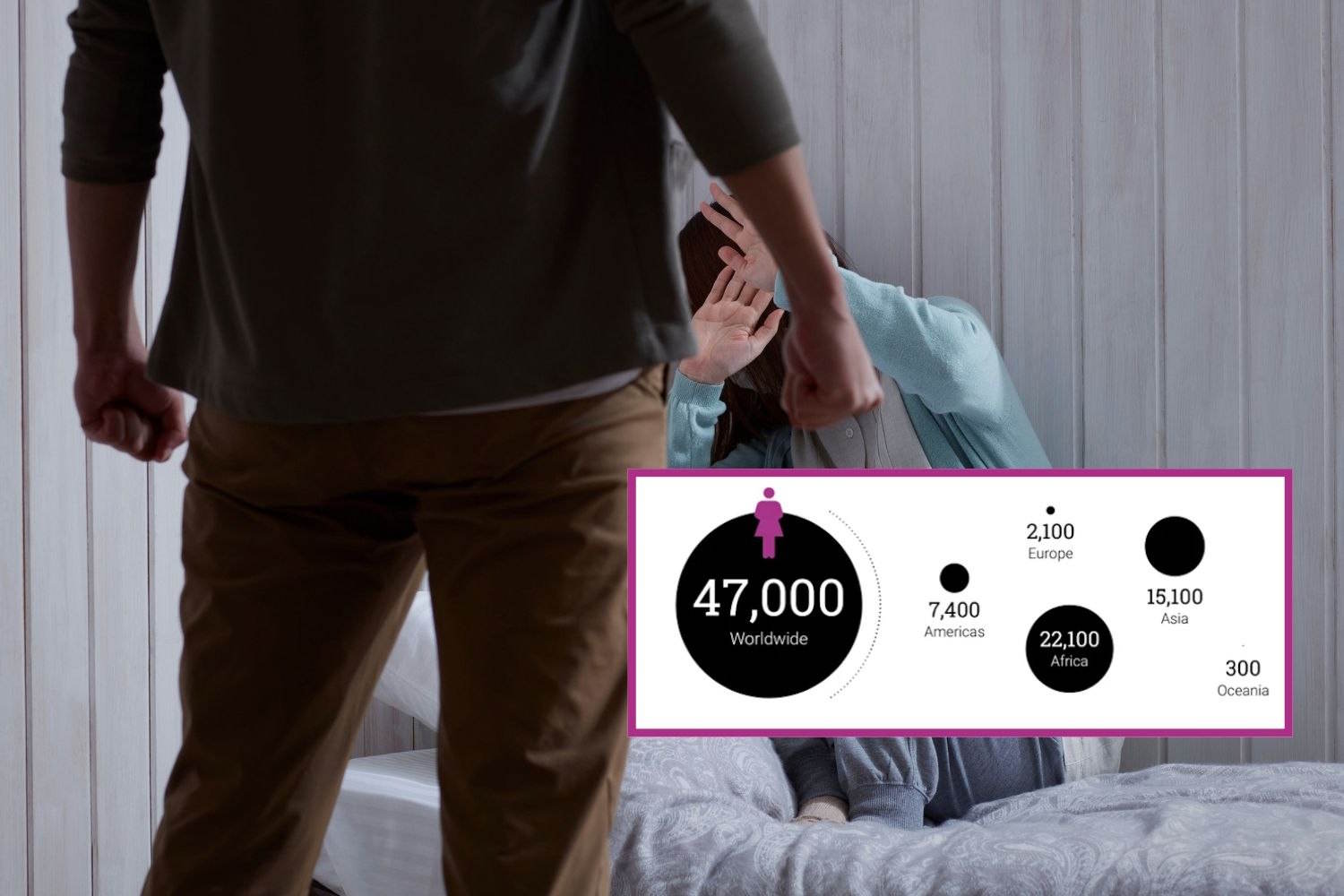
Repeat in chorus with me: femicide is not simply the killing of a woman, but her killing in a context of hatred, discrimination, abuse, control or domination linked to gender, or as a consequence of the rejection of an emotional relationship or as an act of denial of her individual freedom.
Since December 2025, in Italy, femicide has constituted an independent crime in the Italian criminal system, governed by article 577-bis of the Criminal Code.
Yet, under our posts, for example, comments like “So why not call it murder? How much misogyny in this feminism…” As if to say that, yes, there is still a lot of work to do.
Why does it need to be repeated? Because while it doesn’t occur to many people that not all murders that have a woman as the victim are, legally, feminicides, but that the crime is characterized by the presence of the elements we were talking about, the numbers of women killed by their partners or exes are increasing. Even now, even in this moment.
The new UN report says it clearly. According to estimates by UN Women and the United Nations Office on Drugs and Crime (UNODC), in recent years the number of women and girls killed by a partner or family member has fluctuated between 45,000 and 51,000.
The UN report
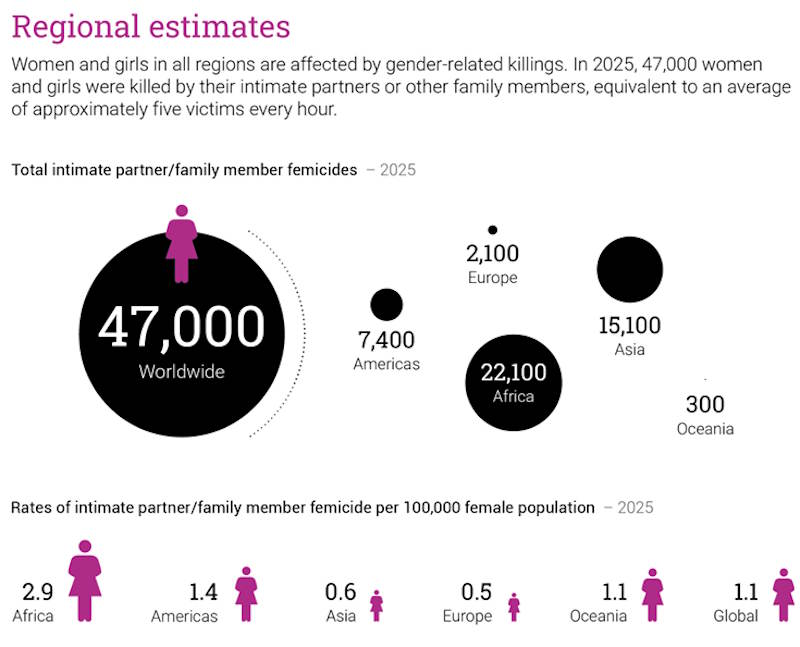
In 2025, approximately 47,000 women and girls were killed worldwide by their partner, ex-partner or family member. On average, 129 per day, over five every hour. People from whom they should have felt protected and who, instead, became their killers.
The new report says so Femicide Brief 2026published by the United Nations Office on Drugs and Crime (UNODC) and UN Women, on the eve of the International Day for the Elimination of Violence against Women, which is celebrated today 25 November. According to United Nations estimates, a total of around 78,000 women and girls were intentionally killed during 2025. In 60% of cases, a partner or family member committed the murder.
A figure that confirms how lethal violence against women has a very strong domestic and family component.
No region of the world is immune from the phenomenon, even if the incidence of femicides committed by partners or family members varies significantly from one continent to another. Africa records the highest rate, with 2.9 victims per 100,000 women and girls, followed by the Americas, Oceania, Asia and Europe.
In detail, these are the rates recorded in 2025:
Despite the geographical differences, one clear fact emerges from the report: the domestic environment continues to represent the context of greatest risk for women and girls with respect to the possibility of being killed.
@UN Women
One of the most significant aspects that emerges from the report concerns the trend of the phenomenon over the last 15 years. While homicide rates have decreased globally, family and couple femicide rates have decreased more slowly. Between 2010 and 2025, the overall homicide rate in the Americas decreased by 23%, while the femicide rate decreased by 12%. Even in Europe the general rate of homicides has fallen at a rate approximately one and a half times higher than that of feminicides.
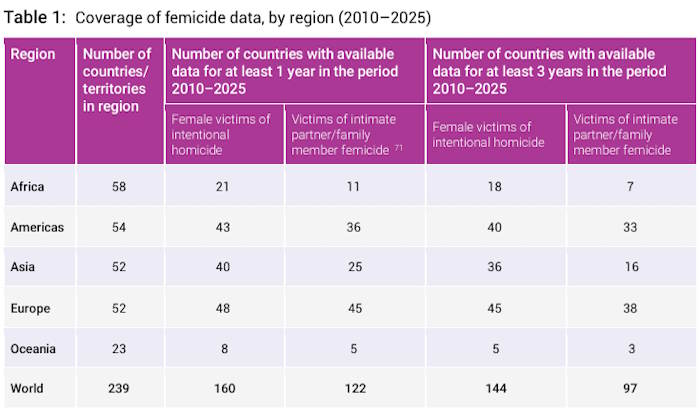
@UN Women
The overall reduction in homicidal violence, therefore, does not automatically translate into an equivalent improvement in women’s safety.
Furthermore, it is important not to interpret the difference between the estimates of the individual annual editions of the report as evidence of an actual decrease in the phenomenon: the availability and quality of the data provided by the different countries can vary from one year to the next.
The real number of feminicides could be higher
The 47 thousand victims estimated by the UN concern murders committed by intimate partners or other family members, but do not exhaust all possible forms of femicide.
Femicide, in the definition adopted by the United Nations, is the killing of women and girls for gender-related reasons. This definition also includes crimes committed outside of family or romantic relationships. However, the lack of sufficiently detailed data on the circumstances of the murders makes it difficult to quantify all manifestations of lethal gender violence on a global level.
The figure of 47 thousand victims therefore represents a measure of the dimension of the phenomenon in the domestic and family context, not its overall toll.
At the origin of feminicides, the United Nations underlines, there are also discriminatory social norms, attitudes that justify violence and deficiencies in institutional protection systems. UN Women and UNODC call on governments and institutions to strengthen prevention measures, ensure effective protection for women who suffer violence and ensure that those responsible are held accountable for their crimes.
Femicide represents the most extreme manifestation of gender violence and can be preceded by a history of mistreatment, threats, control and oppression. Recognizing these signs and intervening promptly is an integral part of prevention.
Behind those five victims every hour there are as many lives that did not necessarily have to be broken. And this is precisely the point that the United Nations continues to insist on: feminicides are not inevitable, they are preventable.
HERE is the full report.
