
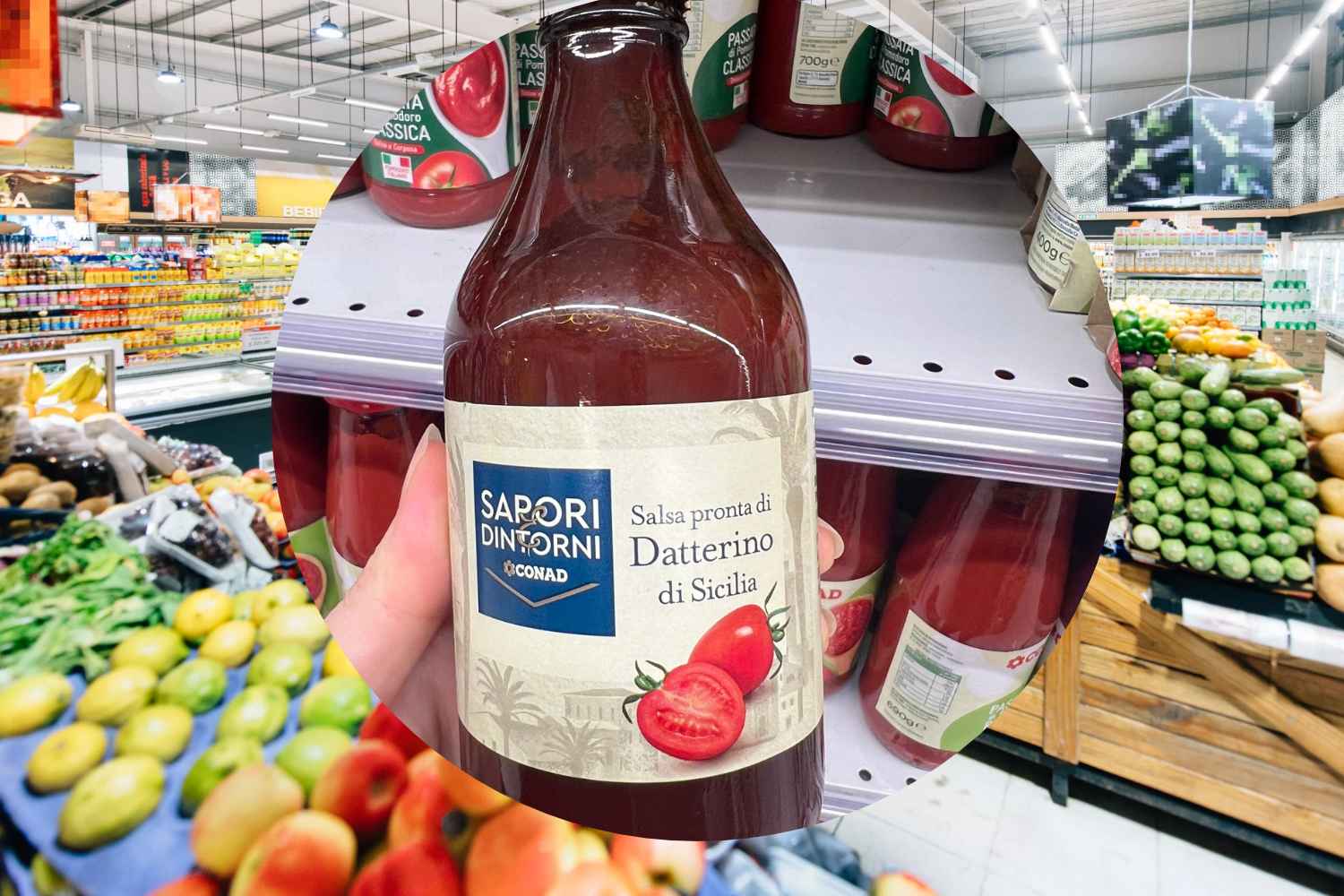
The ready-made Sicilian datterino datterino sauce from the Sapori & Dintorni Conad line contains 98% Italian tomatoes and only three ingredients. Reading the label we discovered that it is produced by a company from Ragusa that also makes preserves for other large-scale retail chains and markets products under its own brand.
Among the many purées and ready-made sauces that crowd the supermarket shelves, there are those small glass bottles with crown caps that recall the tomato preserves prepared at home by our grandmothers. What caught our attention, while shopping at the supermarket, was the 330 gram Sicilia Sapori & Dintorni Conad ready-made datterino sauce.
A particularly short list of ingredients, the reference to Sicilian tradition and a detail on the back of the bottle that intrigued us: the name of the company that produces it.
As happens with many supermarket brand products, in fact, this sauce is not made directly by Conad, but by a company specialized in the production of food preserves, which also works for other large-scale retail chains.
Who produces Conad datterino tomatoes sauce?
@Marco Crisciotti/GreenMe
On the back of the bottle we photographed we read:
Produced for Conad SC, Via Michelino, 59 Bologna, by Conserve di Sicilia G. Rosso SARL, Viale 24, n°8, III Phase, ZI Ragusa.
This sauce is therefore created by Conserve di Sicilia Giuseppe Rosso, a Sicilian company specialized in the processing of tomatoes and in the production of ready-made sauces and vegetable preserves.
Production takes place in the industrial area of Ragusa, in an area where tomato cultivation represents one of the main agricultural vocations.
The name of the manufacturer also appears in the sheet of the ready-made datterino sauce on the official Conad website.
The same company also produces for Coop and Pam
The name Conserve di Sicilia Giuseppe Rosso may not be familiar to many consumers, yet we may have purchased its products even while shopping in supermarkets other than Conad.
In fact, among the collaborations indicated by the company there are some large-scale retail lines:
An example is the organic datterino tomato sauce sold by Coop, associated with the same Sicilian producer.
The company also markets sauces and preserves under its own brand, Rosso di Sicilia, recognizable by the packages decorated with colorful motifs that recall the tradition of Sicilian carts.
It is one of the many examples of how, behind products sold under different commercial brands, there can be the same production companies.
Is Conad sauce the same as that sold under the Rosso di Sicilia brand?
Consulting the manufacturer’s catalogue, we also find a ready-made organic Datterino tomato sauce from Rosso di Sicilia, marketed in the same 330 gram format.
The recipe has several similarities with that of the Conad sauce: 98% datterino tomato, extra virgin olive oil and salt.
However, there is a first important difference: the Rosso di Sicilia sauce taken into consideration is organic, while this certification does not appear on the Conad packaging that we photographed.
Furthermore, even when the list of ingredients coincides, the characteristics of the raw materials, the proportions of the condiments and the nutritional values may change.
The same manufacturer, therefore, is not necessarily synonymous with the same product. Companies that work for large-scale retail trade can create different recipes based on the characteristics required by the individual brands.
It is a distinction to keep in mind when we compare a supermarket brand product with one marketed directly by the company that makes it.
Are the tomatoes in Conad sauce Italian?
On the front of the bottle appears the writing «Datterino di Sicilia», while on the back we find the indication:
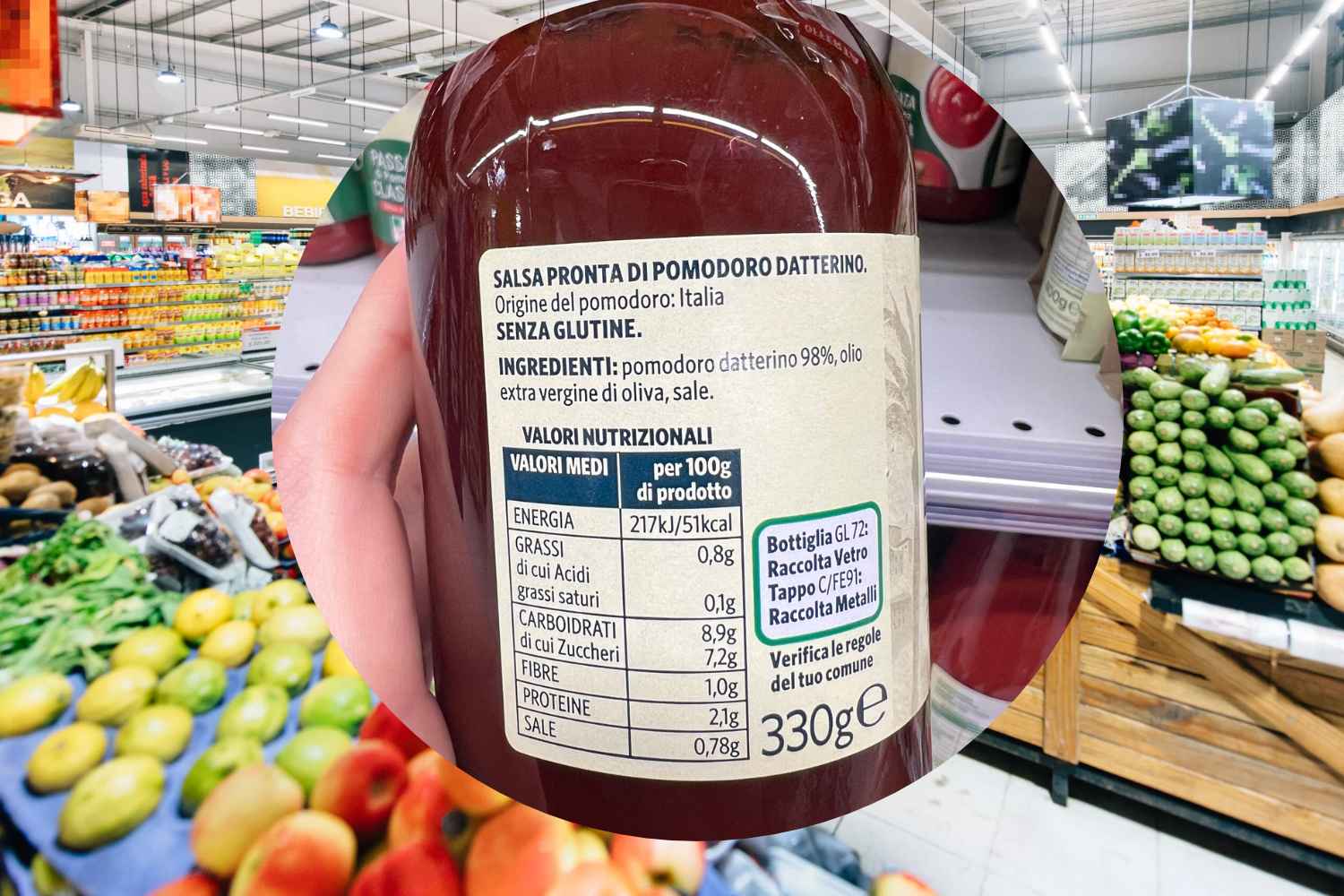
Origin of the tomato: Italy.
The Italian origin of the raw material is therefore explicitly declared, while the production plant is located in Ragusa.
However, the exact area in which the tomatoes are grown is not specified on the back of the package, nor is more detailed information on the agricultural supply chain provided.
The company, which has been producing ready-made preserves and sauces since 1997, declares on its official website that it valorises the raw materials and gastronomic traditions of the province of Ragusa and south-eastern Sicily.
What does Conad datterino sauce contain? Only three ingredients and no added sugar
What convinced us to focus on this bottle was also the list of ingredients, which was decidedly essential:
There are no added sugars, preservatives, flavourings, thickeners or tomato paste. A rather simple composition, considering that it is a ready-to-use condiment.
Reading the nutritional declaration, however, we find 7.2 grams of sugars per 100 grams of product. Why, if sugar doesn’t appear among the ingredients?
These are the sugars naturally present in the tomato, which in the case of datterino tomatoes contribute to the characteristic sweet flavor of this variety.
It is important to remember that the entry “of which sugars” in the nutritional declaration does not necessarily indicate the presence of added sugars. To understand if these have been used during the preparation of a food, you must above all check the list of ingredients.
How much salt does Conad ready-made sauce contain?
@Marco Crisciotti/GreenMe
One aspect to pay attention to is the salt content. Since it is an already seasoned sauce, and not a simple tomato puree, we must also take into account the salt present in the recipe.
The bottle we photographed contains, per 100 grams of product:
Of course, we are unlikely to use an entire bottle for just one portion of pasta, but it is still something to consider when we add salt to the cooking water or use other already tasty ingredients.
The strange difference between the nutritional values on the bottle and those on the Conad website
During our investigation we also discovered a detail that deserves attention.
Consulting the data sheet for datterino sauce on the official Conad website, we noticed that, although the format and the list of ingredients coincide, the nutritional values reported online are significantly different from those present on the bottle photographed in the supermarket.
The site indicates 71 calories per 100 grams, compared to 51 on the label. The fat content is also higher: 2.6 grams instead of 0.8. Sugars go from 7.2 to 9.1 grams, while proteins drop from 2.1 to 1.4 grams.
The most obvious difference, however, concerns the salt.
On the Conad website, 3.8 grams of salt per 100 grams of product are indicated, compared to the 0.78 grams reported on the bottle. An amount almost five times higher.
We also noticed another inconsistency: in the online commercial description there is reference to the presence of pepper, which however does not appear either in the list of ingredients published on the site or on the photographed label.
We don’t know if these discrepancies are due to an update to the recipe, outdated information or simple errors in filling out the online form.
Conad itself warns consumers of the possibility that the information published on its website differs from that present on the packages actually purchased. One more reason to always read the label of the product we put in the cart.
Is this a good tomato sauce to buy at the supermarket?
From a compositional point of view, the Sapori & Dintorni Conad ready-made datterino sauce has several interesting characteristics: a high percentage of Italian tomato, the use of extra virgin olive oil rather than other vegetable oils and a list of only three ingredients, with no added sugars. The packaging is also simple: a glass bottle with a metal cap, both recyclable according to the indications of your municipality.
Those who prefer to independently control the quantity of salt and oil to use can still opt for a tomato puree without added condiments.
As for the manufacturer, Conad sauce offers us another interesting example of the functioning of the so-called private labelsprivate label products made by companies that often supply multiple competing brands and also market food under their own brand.
Behind a Conad brand bottle we thus discovered a Sicilian company that has been producing ready-made preserves and sauces for almost thirty years and which we also find behind some of the excellent product lines of other Italian supermarkets.
Because when we go shopping, the brand we see on the front of the package is only part of the story. The rest, very often, is written on the back.
