
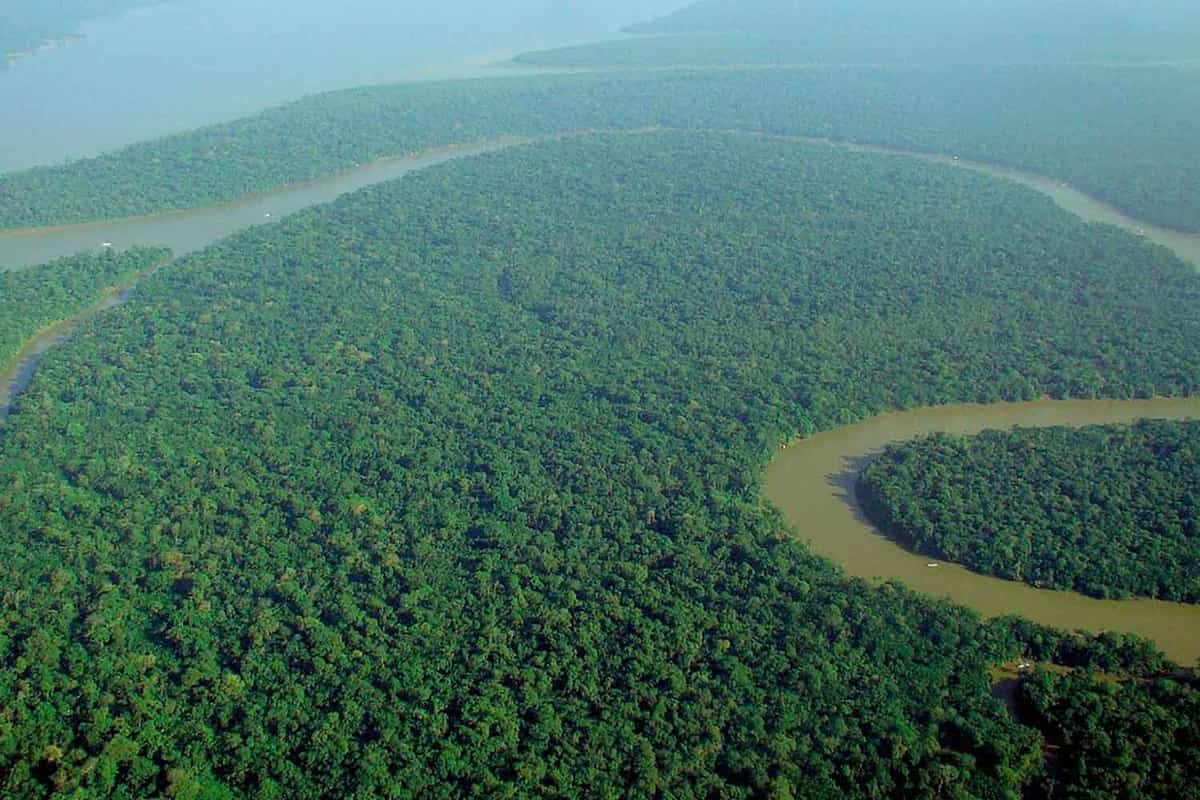
The “definitive” protection of the Colombian Amazon against new extractive activities lasted less than three months. The government of new president Abelardo De la Espriella canceled the resolution that prohibited new mining concessions and new contracts for the exploration and exploitation of oil and gas in the region. We are talking about over 48 million hectares, equivalent to 42% of the Colombian continental territory.
The decision dates back to 23 October 2026, when the Ministry of the Environment signed resolution 1405, revoking the measure adopted on 4 August by the previous government of Gustavo Petro. The reserve of renewable natural resources had been established with a “definitive” nature. Adjective which, apparently, had a rather tight deadline.
Colombia set a good example. Until October
On November 13, 2025, during the COP30 in Belém, Brazil, Colombia announced that it wanted to become the first Amazonian country to remove its portion of forest from the expansion of the extractive industry. The then Minister of the Environment, Irene Vélez Torres, had even invited other countries in the region to follow the Colombian example, promoting an international alliance for the protection of the Amazon.
Resolution 0961 arrived in August 2026, which prevented the issuance of new mining concessions, oil contracts and related environmental authorizations, respecting the rights already legitimately acquired. Colombia, Vélez Torres explained at the time, was telling the world that the Amazon was worth more than gold and oil. A year after the Belém conference, the country that invited others to renounce new extractions has canceled its own ban.
The forest is already protected, the minister reassures
The new Minister of the Environment, Fabio Arjona, justified the revocation with the failure to complete preventive consultations with the Afro-Colombian, Raizal and Palenquero communities. According to the Colombian Ministry of the Environment, the previous measure also generated economic and territorial uncertainty.
Arjona recalled that the other provisions protecting the forest remain in force, including those relating to national parks and forest reserves. The revocation does not automatically authorize new oil wells, but it eliminates the general ban that was supposed to prevent their expansion across the entire Amazon biome.
Greenpeace, Amazon Watch, Earth Insight and indigenous organizations contested the decision with a joint statement, calling for protections to be restored and consultations with Afro-descendant populations to be completed.
The Amazon is not a frontier for industrial expansion. It is a living heritage that belongs to everyone and whose protection cannot be compromised.
The consultations, therefore, remained incomplete. The organizations ask to complete them; the government chose to cancel the entire resolution.
Fourteen million hectares, many still looking for investors
To understand why the cancellation of that ban worries environmental organizations so much, just look at the maps developed by Earth Insight, the International Institute for Sustainable Development (IISD) and the National Organization of Indigenous Peoples of the Colombian Amazon (OPIAC).
Their August 2025 report documents the presence of oil and gas blocks across 14 million hectares, or 28% of the Colombian Amazon. Of these, 8 million overlap with still intact forests. Millions of hectares have been identified for possible mining and are still waiting to be allocated to companies.
One of the main recommendations of the authors of the report was to permanently withdraw from the market all the blocks not yet assigned. Also because an oil well, in the forest, rarely arrives alone. We need roads, pipelines and infrastructure that make previously isolated territories accessible, also exposing them to deforestation, agricultural expansion and mining activities.
And in the face of all this, even the economic convenience of new extractions appears anything but obvious. According to projections by Earth Insight and IISD, if previously announced international climate commitments are met, almost two-thirds of the blocks could be economically unsustainable. In a scenario compatible with limiting global warming to 1.5°C, 97% of new blocks could prove unprofitable. The risk is finding ourselves with portions of forest compromised and investments which, in the meantime, have lost their economic raison d’être.
Thirty years to recognize the rights of indigenous peoples
On December 16, 2025, more than thirty years after the adoption of the Colombian Constitution which provided for them, the first eight indigenous territorial entities of the Amazon were formalized. As the Gaia Amazonas Foundation documents, these communities govern over 7 million hectares, equivalent to 15% of the Colombian Amazon, and have obtained recognition of their political, administrative and fiscal autonomy, in coordination with national institutions.
In November 2026, a ninth indigenous territorial entity was also formalized, that of the united territories of the Isana and Surubí rivers, which extends for over 412 thousand hectares. It took indigenous populations decades to obtain institutional recognition of a form of territorial governance that they had already exercised for generations. Meanwhile, they continued to steward millions of hectares of forest. The future of Amazon protection will also depend on the possibility of concretely exercising that autonomy.
On November 12, during COP31, over 40 international organizations called on governments to establish zones free from new fossil fuel extraction. Among the precedents cited is that of Colombia, this time also as an example of the fragility of environmental protections in the face of changes in government. Months of work had been needed to transform the international promise into a national measure. 80 days passed between the signing of the resolution and its revocation.
