
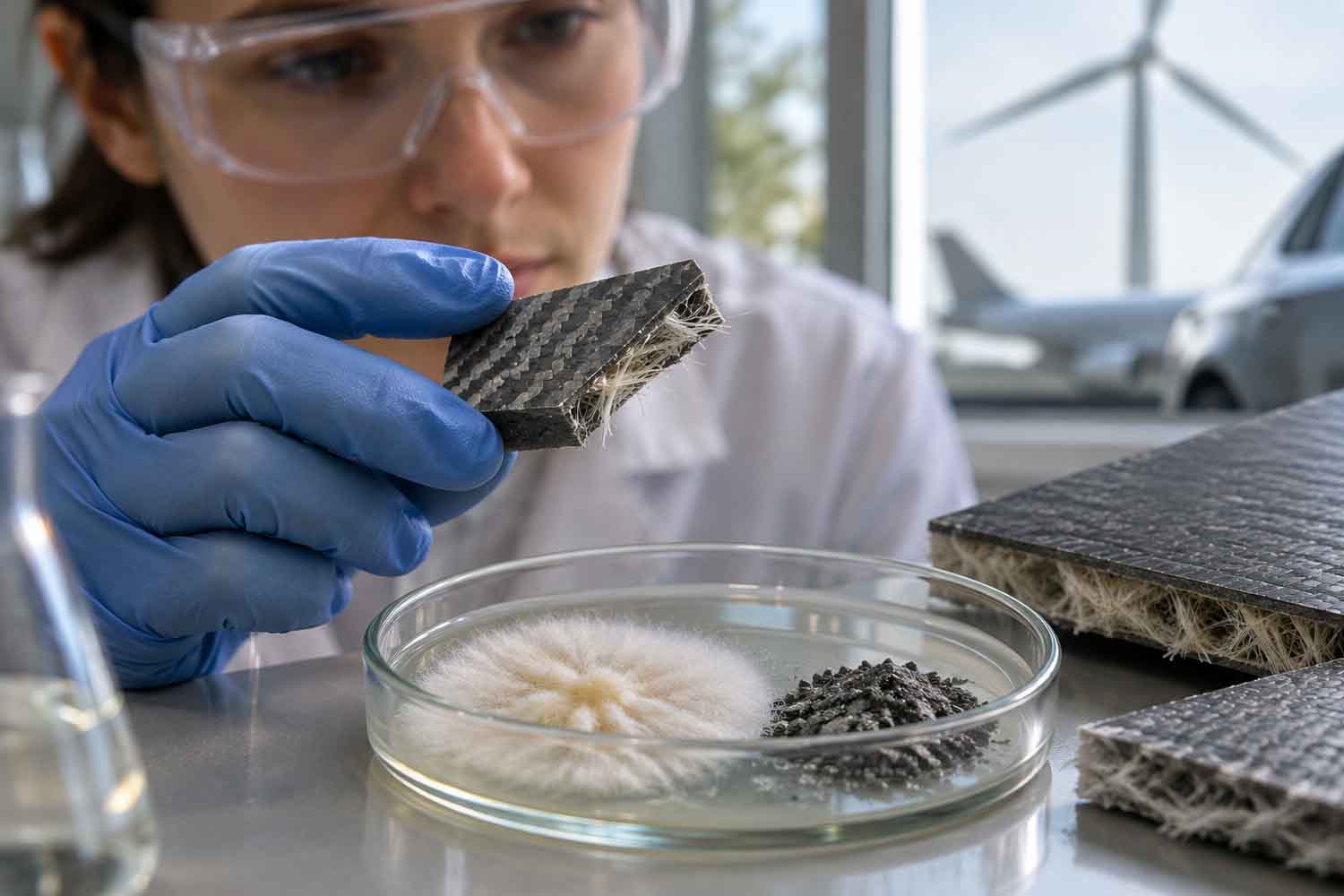
A PET bottle can be melted and reshaped, a thermosetting resin cannot. Yet we have scattered many of the latter in cars, airplanes, boats and buildings. We have designed them to resist impacts, heat and the passage of years, obtaining materials so durable that they create quite a few problems when they become waste. Landfills and incinerators know something about this.
Now comes research from Spain that tries to tackle the problem by intervening on two fronts: modifying an enzyme obtained from a mushroom and changing the way in which the plastic itself is produced.
The study, published on Science Advanceswas led by Miguel Alcalde, researcher from the Spanish Higher Scientific Research Council (CSIC), in collaboration with several industrial partners. Scientists have managed to obtain an enzyme capable of breaking down part of a specially redesigned plastic resin, working at a temperature of just 40 °C.
What are thermosetting plastics and why are they so difficult to recycle
When we talk about plastic recycling we tend to think of the bottles, detergent bottles and packaging that we separate daily from the rest of the waste. Plastic, however, is also present in objects that are much larger, more expensive and designed to last decades. There are different families of plastic materials. The thermoplasticslike those used for PET bottles, can be softened with heat and reshaped.
In thermosetting plastics something different happens: during manufacturing, the molecules bond together forming a sort of three-dimensional network. Once the material has hardened, this network remains stable. Heating it further does not allow it to be brought back to its initial state: at sufficiently high temperatures, the plastic ends up decomposing. Thermosetting resins are often combined with glass or carbon fibers to obtain even lighter and stronger materials, called composite materials.
Let’s think of the hull of a boat or the enormous blades of a wind turbine, exposed for years to rain, sun and gusts of wind. Or to the components of an airplane, which must be sufficiently robust without weighing down the aircraft too much. The reasons why we use these materials are, in large part, the same reasons why we struggle so much to recycle them.
What happens to these plastics: in landfills and incinerators
As the CSIC explains, landfills and incinerators still represent the main destinations for thermosetting composite waste. In the first case we accumulate materials that can persist in the environment for a very long time. In the second we can recover energy through combustion, however losing the possibility of reusing the resin as a raw material and producing CO2 emissions. There are other ways too. Some materials can be shredded and used, for example, as fillers in the production of new products. Others are subjected to treatments at high temperatures or with chemicals to recover the fibers they contain.
Recovering carbon or glass fibers, however, means recovering only part of the original material. The problem of the plastic that held them together remains. Furthermore, some of these processes require a lot of energy or the use of aggressive chemicals, with economic and environmental costs that further complicate recycling.
The problem also concerns renewable energy. The United States Department of Energy has long been involved in managing end-of-life wind turbines, studying technologies to recover blade materials and design more easily recyclable resins. The European Union has also funded various research in this field, including the BIZENTE project, dedicated to the use of enzymes to break down composite materials.
A fungus and 19 mutations to degrade plastic
The scientists started with an enzyme naturally produced by the fungus Fusarium solanicalled cutinase, capable of breaking down some of the substances that form the protective coating of plants. To improve his abilities they used a technique called direct evolution. In practice, they created different versions of the same enzyme, selected the most efficient ones and combined, from time to time, the modifications that gave the best results. After 19 mutations they obtained a new enzyme, called RancoR, more resistant to heat and up to 22 times more active than the starting one on one of the substances used in laboratory tests.
Once placed in contact with the redesigned resin, RancoR performed best at 40°C: in five hours it released approximately four times more of a chemical compound derived from plastic degradation than the original enzyme. The scientists also managed to produce the new enzyme using yeast, an important step in order to be able to obtain it in larger quantities in the future.
To recycle plastic better we must also learn to produce it differently
Perhaps the most interesting part of the study concerns what the researchers did to the plastic. They started with a resin already used in the automotive and aeronautical industries to make fire protection coatings. They modified its composition, replacing some of the bonds between molecules with others that are easier to break through enzymes.
In this way they obtained a material with thermal characteristics similar to those of the original resin and greater flexibility. During an experiment that lasted 15 days, on the powdered resin, scientists managed to release an amount of a specific chemical compound corresponding to about 1% of the initial mass of the plastic, according to the authors’ estimate.
On the original commercial resin, however, the enzyme achieved negligible results. Changing the way the plastic is made was therefore as important as improving the enzyme. It is the underlying principle ofecodesignthat is, designing a product thinking about its environmental impact throughout its existence, including the moment it becomes waste.
In the case of thermosetting plastics, it means trying to obtain materials that can resist impacts, heat and bad weather for years, but which are also easier to break down when they are no longer needed. It is the same path taken by the European project BLADE2CIRC, which aims to develop more sustainable and recoverable materials for future wind turbines.
The Spanish research is still in its early stages. Improving the efficiency of the enzyme and making the process suitable for industrial production could make it possible, in the future, to recover the substances necessary to manufacture new plastics, reducing the consumption of raw materials and the amount of waste to be disposed of. For decades we have studied how to make these plastics increasingly difficult to break. Now we are learning to make them so that we can discard them, deliberately, when they are no longer needed.
