
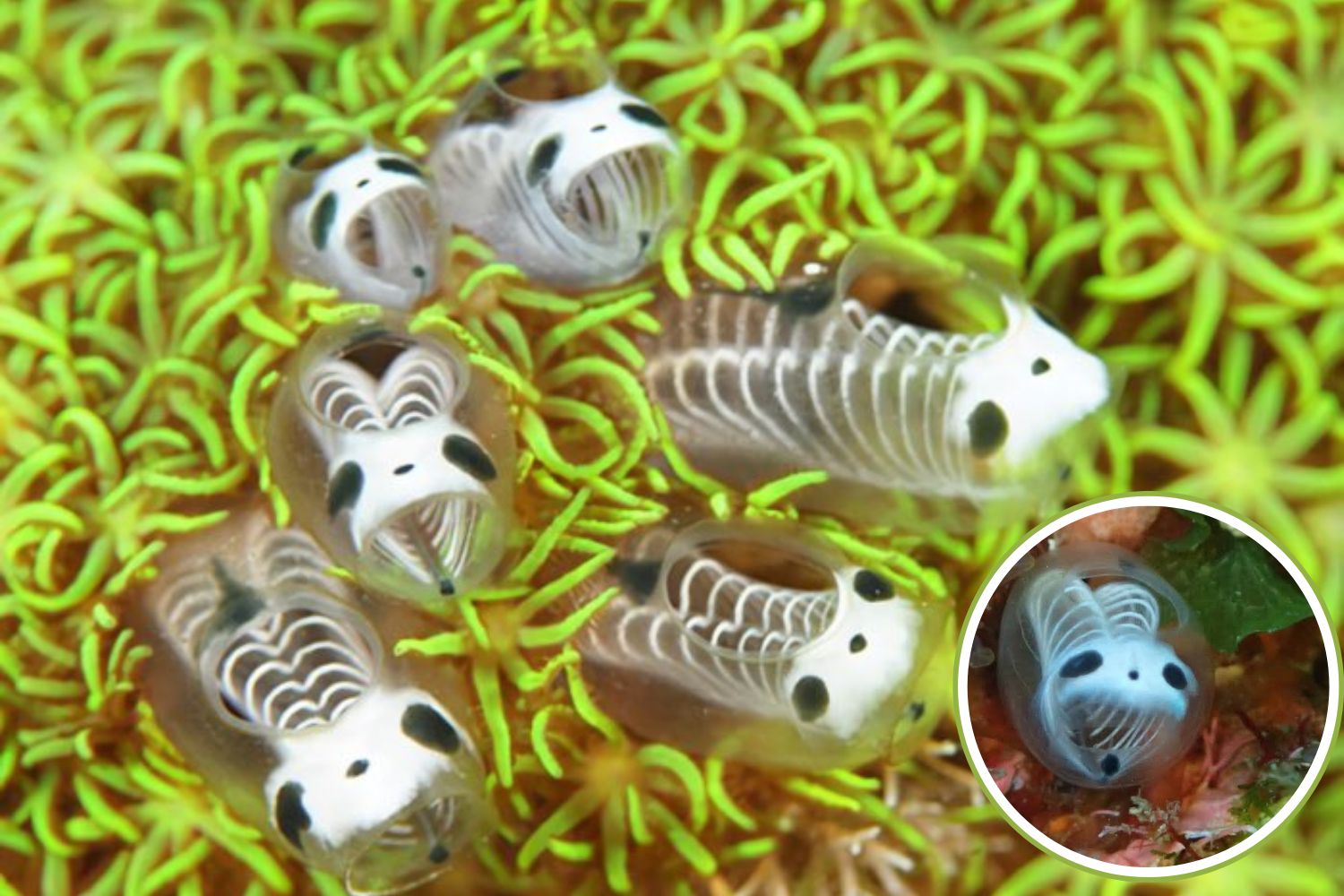
Imagine you immerse yourself in the waters that bathe the Japan And to come across a creature that seems to have come out of a Tim Burton movie: A small skeleton with the head of a panda. It looks like science fiction, but it is reality!
We are talking about the Clavelin oxipandaea new species of ascidia (marine invertebrates filters) Discovered off the Prefecture of Okinawain the waters that bathe the island of Kumejima, in Japan. These marine invertebrates They feed on submarine phytoplankton after filtered and live at 15-20 meters deep. But what makes the C. Ossipandae Special is its unique appearance: the transparent body shows a net of white blood vessels reminiscent of a skeletonwhile on the heads they stand out black spots that look like the eyes and nose of a panda.
The story of this discovery is equally singular. It all started between 2017 and 2018, when some divers published photos of this strange creature online, renamed it “Gaikotsu-Panda-Hoya”, or “Panda Skeleton Ascidia”. The images went around the web, attracting the attention of Naohiro hasegawaresearcher at the University of Hokkaido.
Hasegawa, intrigued, organized a research expedition thanks to a crowdfunding campaign. In 2021, the team managed to collect some specimens of the animal, confirming that it was a species unknown to science. The discovery was then published in the scientific journal Species Diversity in 2024.
“The white parts that look like bones are the blood vessels that cross the gills of the ascidias,” Hasegawa AA Reuters explained. “The black spots on the head, on the other hand, are just a drawing, and”.
There C. Ossipandae It is a colonial species, which means that it lives in groups of individuals, called zooidsconnected to each other. Each zooid is about 2 centimeters long and still to the rocks through a structure called stolone. Like other ascidias, the C. Ossipandae It reproduces both sexually and asexallygenerating thy -shaped larvae that swim freely before sticking to the substrate and transforming into adults.
There C. Ossipandae It is not the only ax with an unusual appearance. There are other species with particular spots and drawings, such as the C. Moluccensiswith skeletal stripes and blue dots, and the C. Pictawith spots and stripes similar to ribs. But the “Panda degli Abissi”, with its bizarre aspect and its fascinating history, has already conquered a special place in the hearts of enthusiasts of nature and scientists from all over the world.
