
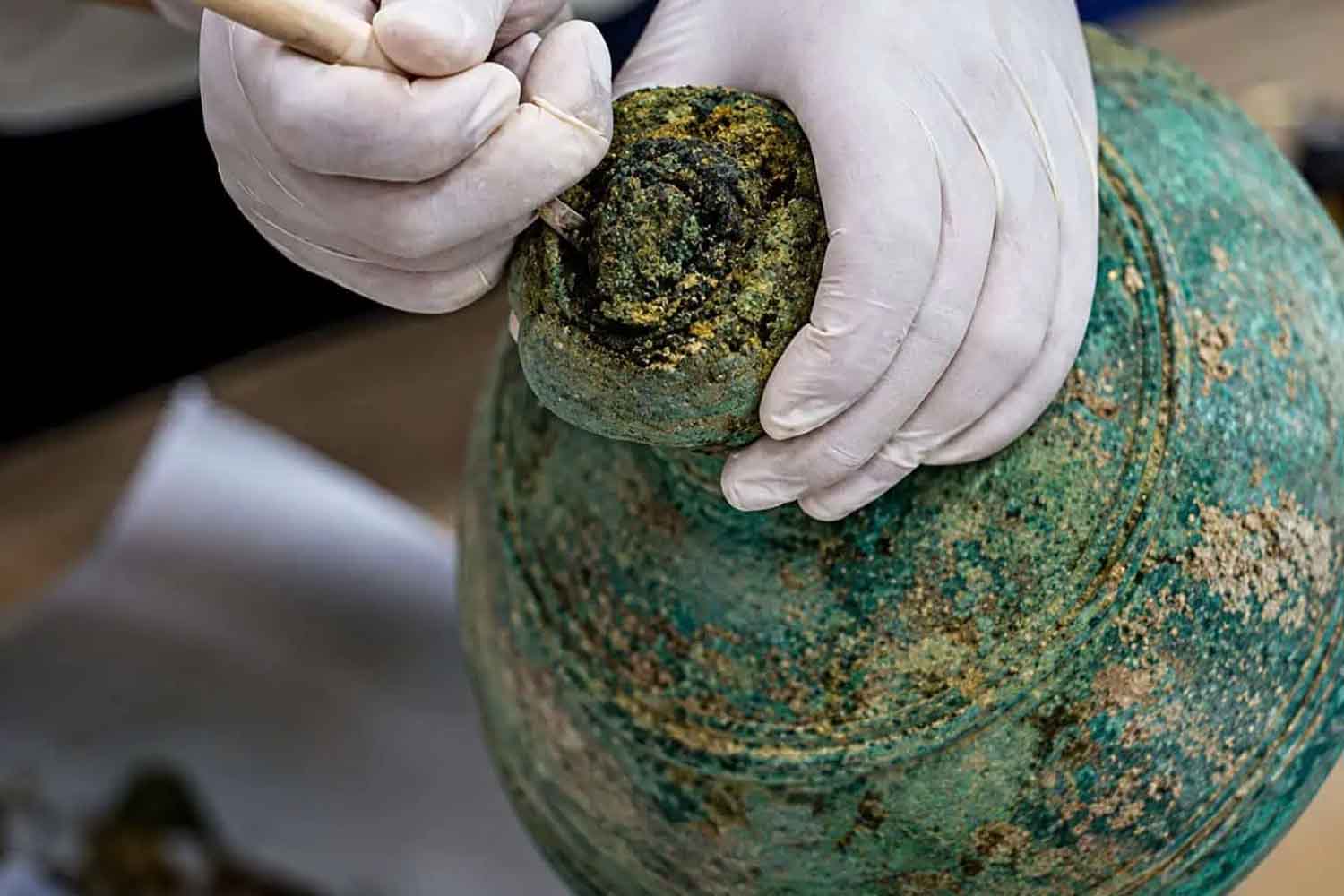
Archeology usually arrives late, when the banquet has been over for centuries and only footprints, residues and stains absorbed into the ceramic remain on the table. This time, however, inside a tomb in northwestern China, researchers found something much rarer: liquid. Still there. Encased in a bronze bottle, sealed well enough to survive more than two millennia underground.
The vessel comes from tomb M39 in the Shanjiabao cemetery, in Ningxia, an autonomous region in northwestern China, near the ancient border defenses linked to the Qin world. The excavations covered 183 tombs from the Warring States period, between 475 and 221 BC, the last centuries before Chinese imperial unification. Among those objects, a bronze bottle with a “garlic head” mouth, a shape associated with the Qin culture and often linked to alcohol consumption, yielded approximately 3.7 liters of clear, blue-green, odorless liquidwith a thin layer of sediment at the bottom. The study was published in Journal of Archaeological Science: Reports.
The cap did its job
The decisive detail lies in the closure. According to the researchers, the bottle was protected by a two-layer barrier: fabric inside the mouth and a sealing paste on the outside. A simple, concrete solution, effective enough to keep air and groundwater away. For those who study ancient drinks it is an enormous fortune: it allows one to be analyzed ancient alcoholic drink still preserved in the vase, instead of just the residues left attached to the walls.
The first chemical analyzes took the most banal hypothesis off the table. That liquid, in all likelihood, had been prepared on purpose. With FTIR spectroscopy and mass spectrometry, the team identified high levels of lactic acid and oxalic acid, while tartaric acid, often linked to grapes, was present in very low quantities. Translated with caution: the contents of the bottle resemble a fermented cereal drink much more than a fruit wine. Thousands of organic compounds were also detected inside, including amino acids, sugars and fatty acids, a picture that is not very compatible with simple water infiltrated into the vase.
Millet, yeasts and a Qin recipe
The most interesting part came from the sediment. Under the microscope they appeared further 100 thousand starch granules. The vast majority, about 92 percent of those identified, belonged to common millet, also known as broomcorn millet, a crop central to northern China’s agriculture. The rest referred to the Triticeae group, therefore cereals such as wheat or barley. Along with starches, researchers found more than 8,500 yeast cellsa strong signal of fermentation.
Some grains related to wheat and barley showed damage consistent with milling and heating. This also matters, because it shifts the scene from simple spontaneous fermentation to a more controlled practice. The painting refers to qua traditional Chinese starter made from grains inoculated with molds, sometimes with herbs, used to transform starches into fermentable sugars and support the action of microorganisms. There was also the nobased on sprouted grains, but Shanjiabao’s clues seem to come closer to the point.
The result is a kind of technical photograph: a drink dominated by millet, with a smaller share of wheat or barley, fermented with an already structured method. In China, alcohol production has much older roots, with evidence dating back to around 9,000-10,000 years ago; in the southern regions rice was used more often, while in the north millet had a strong role. The Shanjiabao bottle fits right into this northern line, adding a rare piece because here the contents have been preserved in liquid form.
Better to leave it in the laboratory
The temptation to call it “beer” is understandable, although it must be handled with care. We are talking about an alcoholic beverage based on cereals, probably similar in production logic to some traditional fermentations, but far from modern beers in terms of ingredients, microbes, water, container and process control. A modern-day brewer might attempt a reconstruction inspired by that recipe, using millet, a small portion of wheat or barley, and a qu-style starter. It would be a safe and contemporary version, with one foot in history and the other in current hygiene standards.
The original one, however, remains laboratory stuff. It spent more than 2,000 years in a corroded bronze vessel inside a tomb. Even if it contains traces of alcohol, it may contain metal compounds, degraded residues, microorganisms and contaminants. The romantic idea of the ancient sip lasts long enough to imagine what bronze did to that liquid for twenty-three centuries.
A frontier inside a bottle
The discovery goes beyond the curious image of liquid surviving in an ancient bottle. Shanjiabao was located in a frontier area, near the Qin Great Wall and a system of defenses: soldiers, local residents, people accustomed to carrying objects, funerary practices, tools and eating habits. A sealed bronze bottle, with a cereal drink inside, shows that alcohol was also part of that material and cultural baggage.
When Qin power was advancing towards the empire, those communities already knew a refined, repeatable fermentation technology, based on local cultures and on a more conscious control of microorganisms than one might imagine by looking only at an ancient vessel in a display case. Inside there were millet, yeasts, sediment, chemistry. And a very human thing: someone had thought that a drink deserved to accompany a dead person over the threshold. The cap held up. The toast, however, is better done with a more recent vintage wine.
