
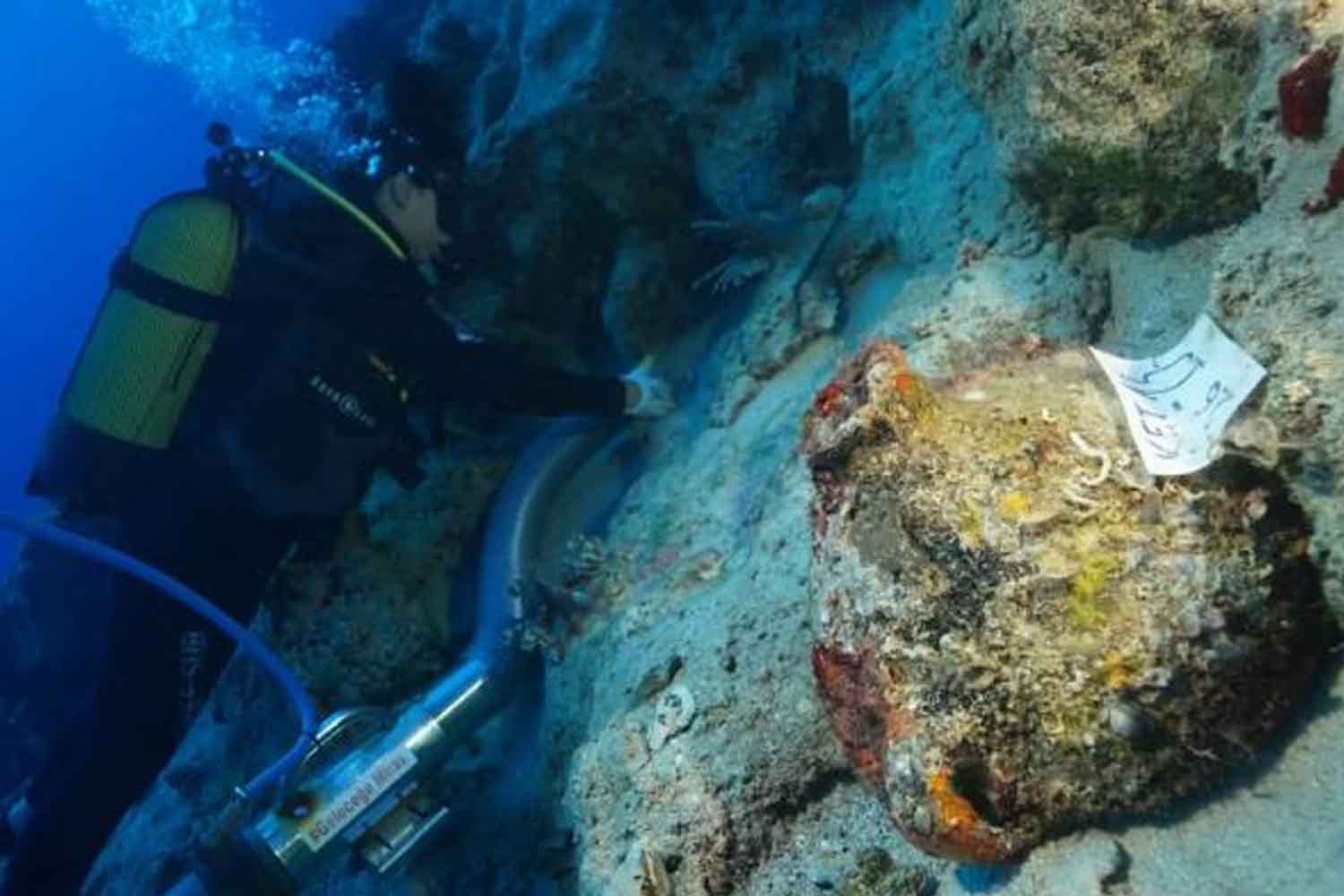
On the seabed of Kekova, off the Mediterranean coast of Türkiye, very little remains of the ship. Wood has disappeared for millennia; the load, however, resisted. Large ceramic vessels, fragments and stone anchors allowed a group of archaeologists to preliminarily place the shipwreck between 2700 and 2400 BC If this dating is confirmed, it could be the oldest wreck known so far.
The chronological range also includes the era of the great Egyptian pyramids, including that of Cheops in Giza. The comparison is impressive, but it must be kept with a certain margin: the exact chronology is still under discussion and the researchers themselves explain that it could move forwards or backwards. In short, the record is very promising. The record-breaking plate can wait for some more analysis.
The ship is gone, its cargo is not
The site was identified in 2024 in the Kekova region, in the Demre district, after indications collected by local sailors. A first study published in the Journal of Maritime Archeology by Hakan Öniz, of Akdeniz University, and Ceyda Öztosun had already documented a shipwreck from the Early Bronze Age and some of the ceramics visible on the seabed.
Subsequent campaigns made it possible to study those containers better. Nothing can be seen of the ship’s planking: after thousands of years of exposure underwater, the organic material has not survived. The wreck is therefore recognized above all through the concentration of the cargo and other finds associated with the shipwreck.
Among these appear large oval jars with a flat bottom, two handles and, in several cases, a raised clay band along the widest part. They were also found in the area three stone anchors. However, the preliminary study maintains an important caution: it is not yet possible to establish with certainty whether they all belonged to the ship.
It was the amphorae that gave the wreck an age
With no preserved wood to date, archaeologists had to read chronology especially in ceramics. The shape, manufacturing technique and characteristics of the mixture can be compared with vessels already known and dated from other sites in the eastern Mediterranean.
Karin Sowada, an archaeologist at Macquarie University involved in the most recent analyses, explains that for now the group places the ship and cargo between 2700 and 2400 BC It is a more precise estimate than the generic attribution to the Early Bronze Age contained in the work published in July. The same researcher, however, specifies that the chronology remains provisional and that the updated results have yet to be presented in a new publication subjected to scientific review. Macquarie University reconstructed the research group’s new analyses.
It’s a distinction that changes the news quite a bit. The existence of the Early Bronze Age wreck is already described in the scientific literature; its possible place at number one in the world rankings rests instead on the most recent dating, yet to be refined.
Inside the jars there are still residues
The cargo could tell much more than the ship’s age. Some containers still retain visible residues, which have survived for approximately four and a half millennia. The analyzes are ongoing and for now no one can say for sure what they contain.
Among the possibilities indicated by the researchers are olive oil, wine and vegetable resinsgoods that circulated in the eastern Mediterranean. The provenance of the jars is also treated with caution: some vessels, or at least the clay used to produce them, may have come from the central Jordan Valley.
This makes the Kekova wreck interesting even without a medal. We know much less about maritime trade in the eastern Mediterranean in the 3rd millennium BC than in subsequent eras. Yet in those same centuries Egypt imported wood, metals, oils and resins from the Levant and other regions. A small coastal ship loaded with containers can therefore add a concrete feature to trade routes that we still only know in fragments.
The previous record belongs to Dokos
Before Kekova, the reference was the Dokos wrecknear the Greek island of the same name between Hydra and the coast of Argolis. The Hellenic Institute of Marine Archaeological Research dates its ceramic cargo to around 2200 BC. Even there the hull had disappeared and the shipwreck was mainly told by the goods scattered on the seabed.
If Kekova were indeed dated between 2700 and 2400 BC, it would predate that testimony by at least a couple of centuries. It would be a notable leap for maritime archeology and would push back the material evidence of organized trafficking along these coasts. To get there we still need the definitive dating of the ceramics, the analyzes of the residues and the complete publication of the results of the new campaigns. Under the water, meanwhile, the cargo has already done the most difficult part: waiting about 4,500 years without being carried away by the sea.
