

Will the winter of 2026-2027 be full of snow or should we expect a season with little snowfall, especially in the plains? With autumn now underway, the first indications of weather models for the coming months are starting to arrive.
And, as expected, the El Niño phenomenon exists and is strengthening in the tropical Pacific Ocean and could become one of the most intense ever recorded.
According to the latest analyses, much of Europe could face a winter with below-average snow accumulations. A scenario that potentially also affects Italy.
Less snow in Europe?
A new analysis by meteorologist Andrej Flis, published on October 15 on Severe Weather Europe. The study examines the results of six seasonal forecast models and shows a common trend: much of western, central and southern Europe could experience below-average snowfall during the winter of 2026-2027.
The October update also scaled back previous expectations on snow quantities, especially in central and southern European regions. In particular, comparing the September calculations with those of October, the ECMWF model indicates a decrease in snow accumulations expected in various areas of the continent.
It is important, however, to distinguish snowfall forecasts from those of overall precipitation. A winter with less snow is not necessarily a winter with less rain. In fact, if temperatures are higher, part of the precipitation that would normally fall in the form of snow could occur in the form of rain, especially at lower altitudes.
@Severe Weather Europe
When will the snow arrive in Italy?
For Italy, seasonal indications suggest the possibility of a winter less favorable to snowfall at low altitudes, especially if above-average temperatures prevail. This does not exclude snowfall in the plains, not even in the North.
For them to occur, however, specific atmospheric conditions must coincide: sufficiently low temperatures, availability of humidity and a disturbance capable of producing precipitation. A combination that cannot be reliably predicted months in advance. The situation in the Alps also requires caution.
According to the update of Severe Weather Europeseasonal models present significant differences precisely across the Alpine arc. Some indicate above-average accumulations, while others predict significant snow deficits.
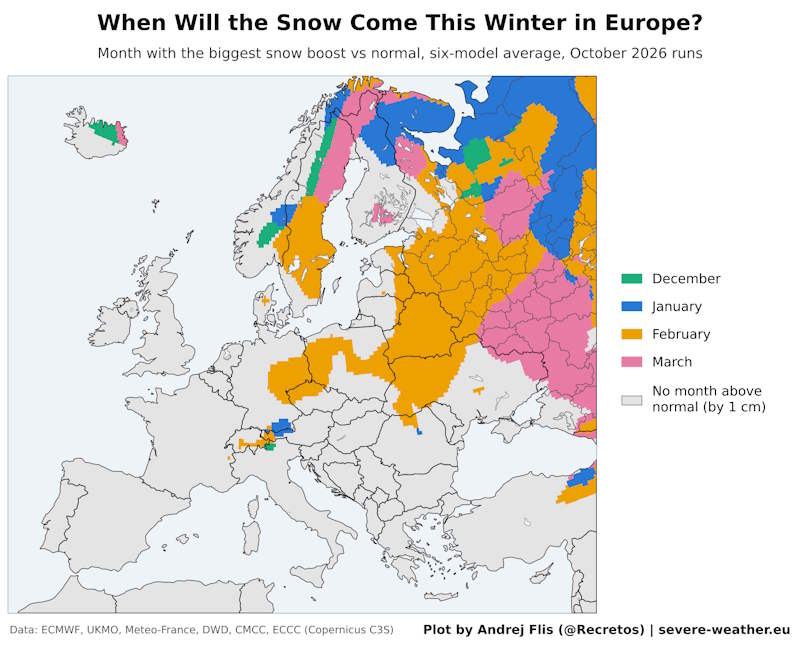
@Severe Weather Europe
The average of the calculations suggests conditions close to normal in the eastern Alps and slightly lower in the western Alps, but with a high level of uncertainty. There is therefore not enough evidence to state that natural snow will only arrive permanently above 1,800 or 2,000 metres. What is certain is that the snow level will vary depending on the individual disturbances and the temperatures present during each episode.
What we really know about winter 2026-2027
Initial trends indicate that El Niño could reach exceptional intensity and favor a winter with less snow than average in much of Europe. In Italy, milder temperatures could limit snowfall, especially in the plains, while in the Alps the forecast remains uncertain.
However, it is not possible to establish when the snow will arrive or exclude episodes of intense cold. The updates in the coming weeks will allow us to outline a more precise scenario.
