
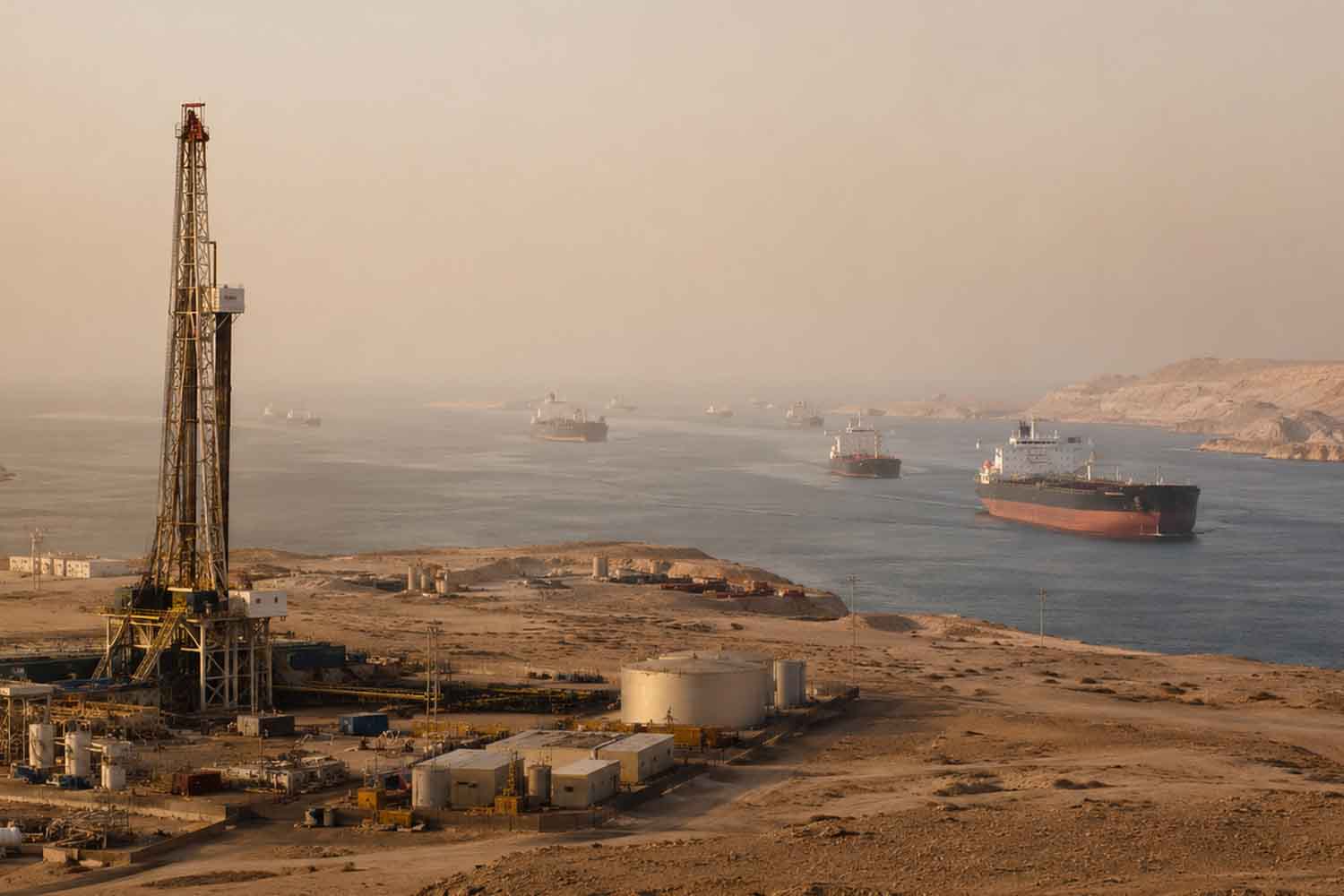
Iraq has just found billions of barrels of oil in the desert, while struggling to export what it already extracts. It is an almost perfect photograph of the current energy crisis: crude oil under the ground, oil tankers slowed down, full tanks, a sea route transformed into a cap. In the south of the country, in the province of Najaf, near the border with Saudi Arabia, a new giant field has been announced.
A few political kilometers away, the Strait of Hormuz, the passage between Iran and Oman through which an enormous share of the world’s crude oil passes, continues to show how fragile a system built on obligatory routes, regional wars and geographical bottlenecks is. The war linked to Iran and the blockade of traffic across the Strait have already caused Iraqi production and exports to collapse, leaving the paradox exposed: a country rich in oil can become vulnerable precisely at the moment in which its wealth remains trapped on the road to the market.
The discovery concerns the al-Qarnain block, also transcribed Qurnain, an area of approximately 8,773 square kilometers in southwestern Iraq. The Shams-11 exploratory well would have indicated reserves estimated at around 8.8 billion barrels of light crude oil, with initial production indicated at 3,248 barrels per day. These are very large figures, to be read with caution: an exploratory estimate remains an initial snapshot, then checks, investments, systems, connections and years of work are needed before reaching stable commercial production. But the political message has already arrived.
Oil under Najaf
The field discovered in the al-Qarnain block is in an area still considered underdeveloped compared to the large historical Iraqi fields. The Chinese company ZhenHua Oil, through its subsidiary Qurnain Petroleum Limited, is the main operator of exploratory drilling and seismic survey activities. Following the results of the Shams-11 well, the company proposed an accelerated investment plan to move more quickly from the exploration phase to commercial production. ZhenHua had obtained the block during the 2024 licensing round, at a time when Iraq was looking for new capital and new areas to develop, also to strengthen its future production.
This is heavy news for Baghdad, because Iraq remains one of the major oil-producing countries in the world. According to the US Energy Information Administration, it has about 145 billion barrels of proven crude oil reserves, equal to about 17% of the Middle East’s reserves and a share close to 9% of the world’s. Within OPEC it is the second largest producer after Saudi Arabia. Numbers which, in normal times, serve to express strength. In a crisis like this they also talk about dependence.
Before the Hormuz-related disruptions, production from the main fields in southern Iraq was around 4.3 million barrels per day. With the blockade of the Strait, production fell by around 70%, to around 1.3 million barrels a day, as tanks filled up and crude oil found less and less room to exit the country. Exports collapsed to around 800 thousand barrels a day in the hardest phases of the crisis. For a state that finances much of its public spending with oil, this is not a technical difficulty. It’s a direct hit to the budget.
Hormuz acts as a stopper
The Strait of Hormuz is one of those names that only makes headlines when something goes wrong. On ordinary days a line remains on the map. On days like these it becomes the point where oil tankers, prices, governments, refineries, insurance companies and consumers come together. About a fifth of the world’s oil and liquefied natural gas flows pass through that passage. For Iraq, the dependence is even more exposed: around 90% of exported crude oil passes through there, especially from the southern terminals near Basra.
The hit on revenue was immediate. Iraqi exports rose from more than 99 million barrels in February to 18.6 million barrels in March, while revenues fell from $6.81 billion to $1.96 billion. The Iraqi authorities have linked the collapse above all to the blockade of exports, rather than to a problem of production capacity. In other words, the oil is there, the demand is there, the plants can restart. The key is to get it out.
A billion-barrel field can strengthen Iraq’s position in the coming years, attract investments and give oxygen to its energy industry. But it does not resolve the underlying fragility: an economy still hanging on crude oil, in a region where any military crisis can transform a trade route into a funnel.
New routes, same fossil
Baghdad is trying to reduce that dependence through new infrastructure. The largest project involves an oil pipeline between Basra and Haditha in western Iraq, with an expected capacity of 2.5 million barrels per day. The line is expected to help the country open alternative routes to the ports of Ceyhan, Turkey, and Baniyas, Syria, as well as other regional connections. For now, an initial allocation of around 1.5 billion dollars has been indicated, while timing and completion will also depend on the next available funds.
Seen from Baghdad, the choice has an obvious logic. If Hormuz closes, other pipes, other ports, other passages are needed. Seen from a climatic point of view, however, the scene remains more bitter. The world should reduce its dependence on coal, oil and gas to cut climate-changing emissions, as international scientific reports have indicated for years. Yet, faced with a crisis also caused by the vulnerability of the fossil fuel system, the immediate response continues to be to look for new oil, build new routes to export it and secure the old model. The oil is there. The way out, much less.
You might also be interested in:
