
Every year thousands of photographers from all over the world try to describe nature through a single shot. In 2026, nominations for the Wildlife Photographer of the Year, the most prestigious nature photography competition in the world, exceeded 65,000. From this enormous archive of images will be born a selection of one hundred winning photographs, which will be officially proclaimed on 13 October.
In the meantime, some images awarded with Honorable Mention have already been released, capable of anticipating the level of the edition: a polar bear photographed from the point of view of a seal, an African bullfrog chasing a butterfly, a leopard chasing a squirrel up a tree, an orchestra of animal behaviors that describe nature without filters.
After the debut at the Natural History Museum in London, the exhibition with the one hundred award-winning photographs will also arrive in Italy, at the Museo della Permanente in Milan, from 20 November 2026 to 7 February 2027.
The polar bear seen from the point of view of a seal
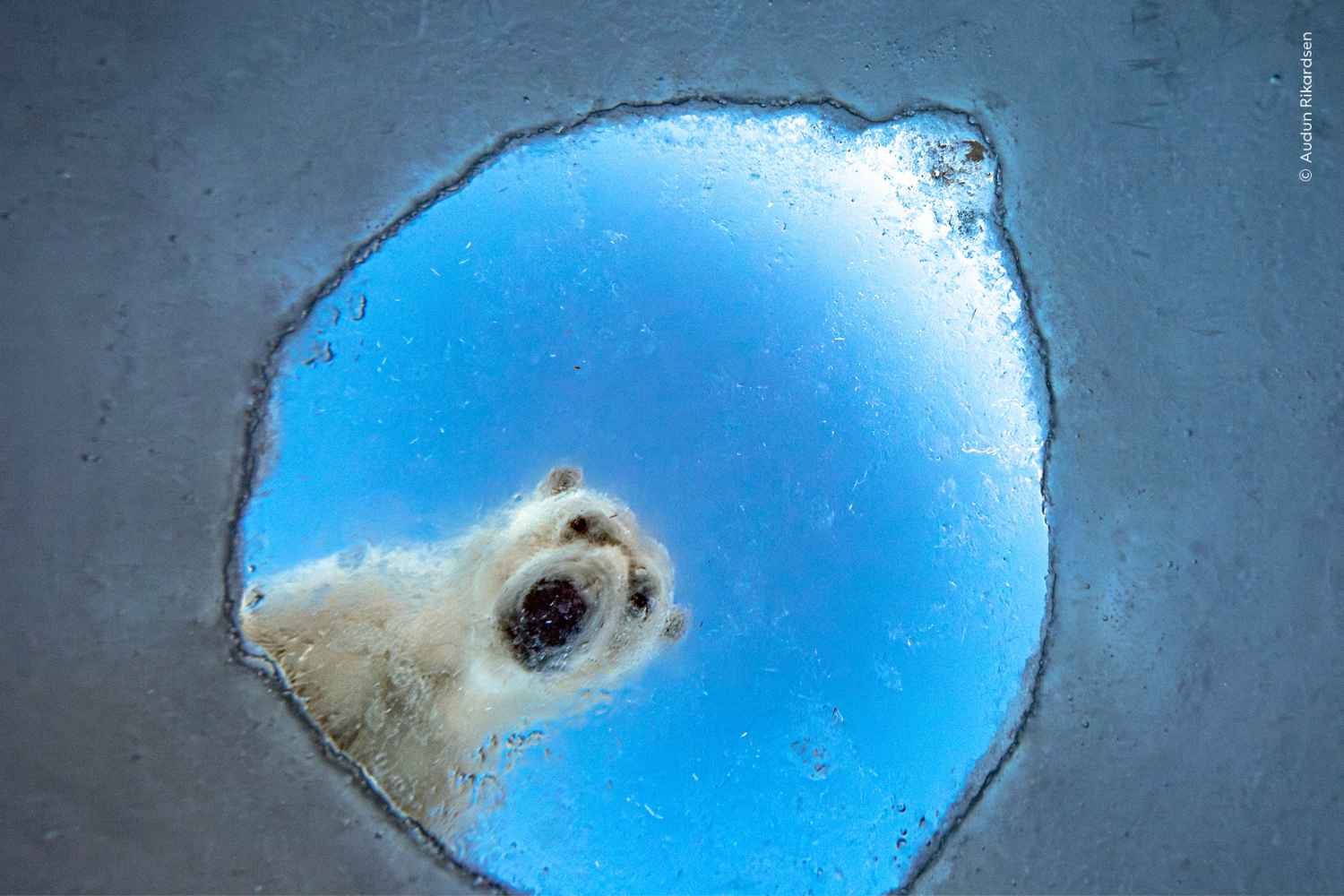
Among the most surprising shots is Window on the ice by Audun Rikardsen, made in the Arctic, at 83 degrees north latitude.
The photographer placed a camera inside a breathing hole used by seals, equipping it with a sensor capable of activating the shot when an animal passes by. The result overturns the usual point of view: we are not in front of the bear, but below him, almost in the position of his possible prey.
In the image, the large predator appears beyond the edge of the ice, looking directly into the hole. While taking the shot, the bear even grabbed the motion sensor, attempting to drag part of the equipment upwards. Shortly thereafter he lay down nearby and fell asleep, forcing Rikardsen to wait about nine hours before retrieving the camera.
It is a spectacular photograph, but above all effective because it tells of natural behavior through an unusual perspective: that of the prey.
Predation, survival and coexistence with man
View this post on Instagram
The first images released show how the competition goes far beyond simple animal portraits. Jens Cullmann froze the moment an African bullfrog lunges towards a butterfly without managing to catch it.
View this post on Instagram
Allegra Hutton photographed a young leopard chasing a squirrel in the Okavango Delta, Botswana.
View this post on Instagram
Other images instead tell of the increasingly close relationship between wild fauna and anthropized environments. In California, Loren Elliott immortalized a black bear entering the swimming pool of a private home. In Tokyo, Sora Miyazawa portrayed an East Japanese toad in the streets of the metropolis.
Nature in its most extreme forms
The path also includes situations that are difficult to observe directly. In the Namib Desert, Dewald Tromp photographed a Namaqua chameleon facing a sandstorm.
View this post on Instagram
In Kenya, Bence Máté filmed a huge flock of red-billed chelae gathered around a pond: aggregations that can number millions of individuals.
Even more unusual is the photograph by Andrea and Maceo Grammatico, in which a mosquito feeds on the blood of a fer-de-lance, an extremely poisonous viper from Central America. The scene was technically constructed through a focus stacking of 37 images, necessary to obtain sufficient depth of field on such small subjects.
View this post on Instagram
The exhibition in Milan
After the presentation at the Natural History Museum in London, the selection will arrive in Italy thanks to the exhibition organized by the Radicediunopercento Cultural Association at the Museo della Permanente in Milan.
The appointment is in via Filippo Turati 34, from 20 November 2026 to 7 February 2027.
