
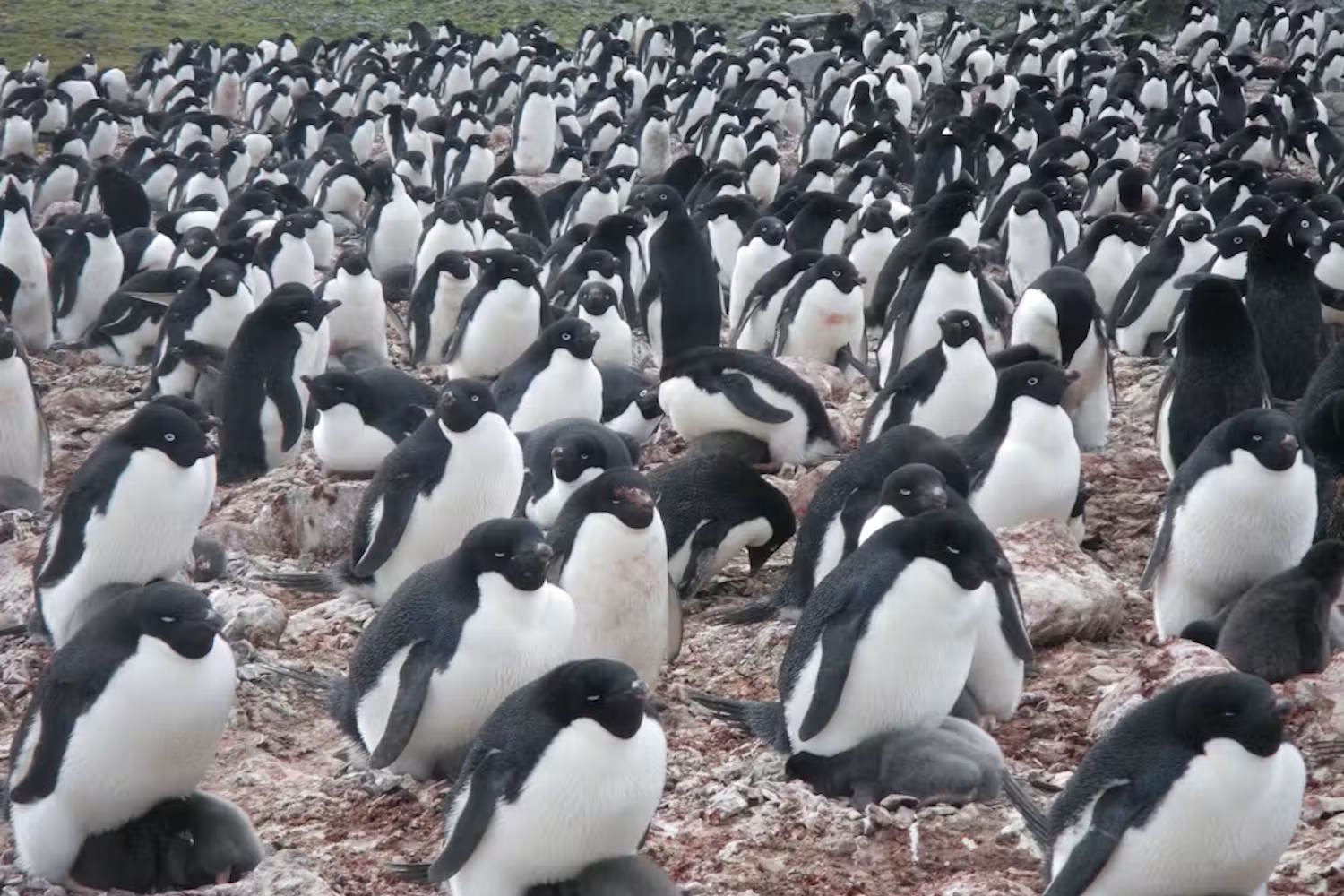
Penguin feces are changing, and it’s due to climate change: a study led by Clemson University (USA) demonstrates in fact that the color of guano changes in response to the available food, i.e. the prey available to penguins, the presence of which varies based on the climate.
How the study was conducted and what it highlighted
The research was conducted by focusing observations on Adélie penguins, among the most numerous predators in the Southern Ocean. These, although they feed on oceanic resources, nest on rocky outcrops throughout the Antarctic continent.
Their colonies are perfect for studies like this: in fact they often host hundreds of thousands of nesting specimens, which produce enormous quantities of guano, so abundant that it can be easily detected from space thanks to NASA’s Landsat satellites.
The researchers were therefore able to analyze thousands of satellite images dating back to the 1980s in order to examine these patches of guano, with the aim of discovering the penguins’ diet and how environmental changes could influence it, consequently impacting their survival.
(…) we found that, in the presence of abundant sea ice near the colony, Adélie penguins tend to feed more on small fish – explains Casey Youngflesh, who led the study – When sea ice is scarce, their diet is mainly based on krill, small shrimp-like crustaceans
A satellite view of a group of small islands, with ice floating in the surrounding waters, shows how some islands appear pink, while others do not. Likewise, some of the Danger Islandsin Antarctica, appear colored pink by the guano of Adélie penguins, whose diet is rich in krill. Without the nesting colonies, those islands would look more like Darwin Island.
©Thomas Sayre-McCord/WHOI/MIT via The Conversation
The krill in fact, it has a pink exoskeleton that penguins do not digest completely, giving their guano a pinkish hue.
It is precisely the color of the guano that allows us to determine what the penguins feed on: this method is based on a quantitative approach developed by us, which analyzes the color of the guano by relating it to the percentage of krill present in the penguins’ diet
To establish this correlation, scientists collected samples of guano in several locations, then, using a spectrometer, determined the color of each sample as it would appear seen from a satellite.
The analyzes were conducted in a small laboratory on board a ship in Antarctica and the composition of the guano was developed using environmental chemistry techniques, to trace the diet that had determined that specific color.
This information, integrated with statistical models, made it possible to determine the penguins’ diet based on the color of their guano observed by satellites.
More broadly, this offers a glimpse into what’s happening in the vast Antarctic marine food web. information usually hidden beneath the surface of the Southern Ocean. To our knowledge, this is the first attempt to directly monitor animal nutrition from space
Data from around 4,000 satellite images were used, discovering that penguins feed on different prey depending on the area of the Antarctic continent and that their diet varies both during the year and from one year to the next.
How the observed results are related to climate change
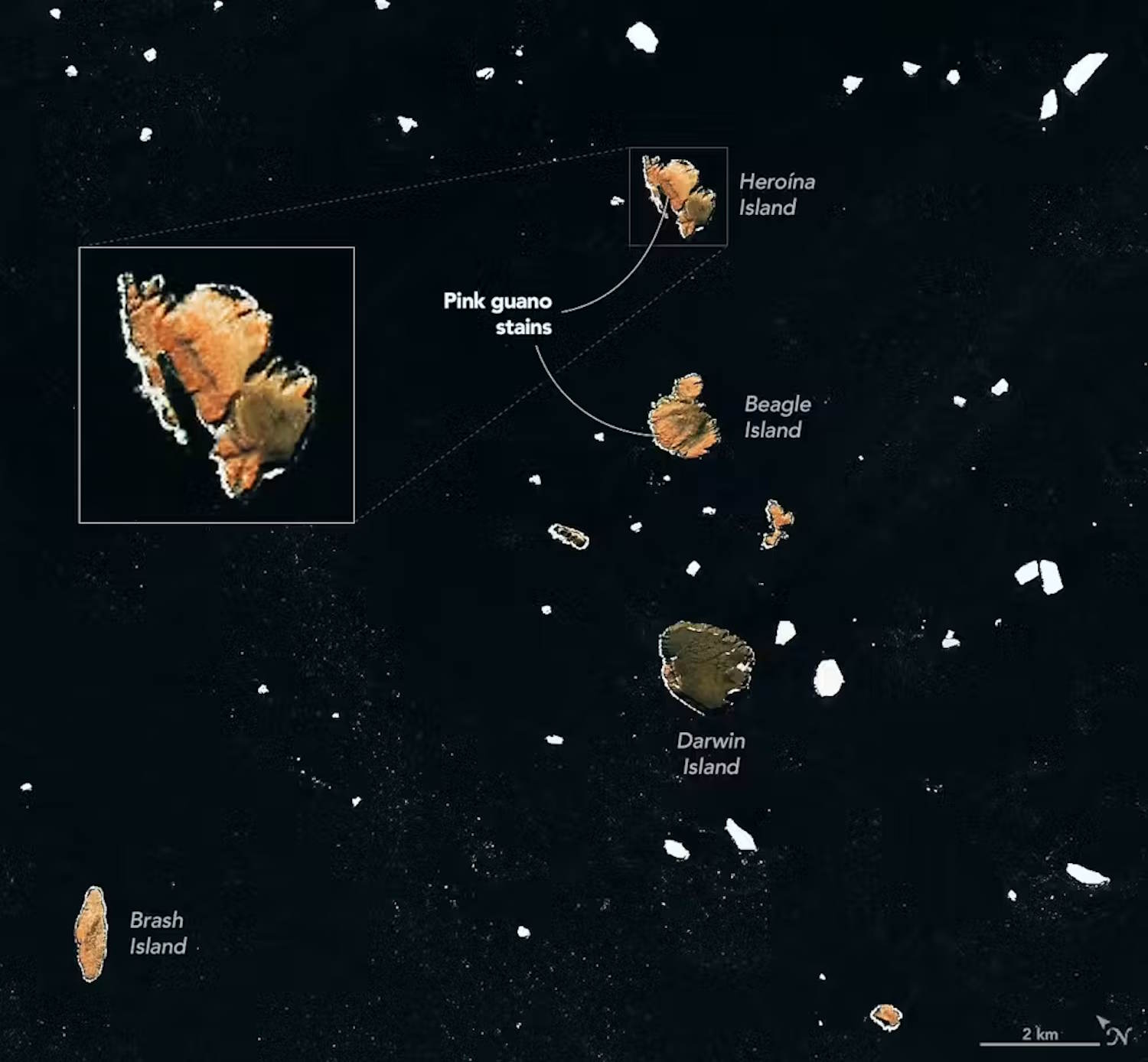
©NASA Earth Observatory/Michala Garrison via The Conversation
Our data reveals how climate change is changing penguin diets and how the Antarctic food web as a whole is changing
Since the 2010s, the extent of sea ice around the continent has undergone a drastic decline, recording new historic lows in several years.
Less sea ice means less fish available, which is bad news for penguins: Adélie penguin chicks tend to be heavier when they feed on fish rather than krill, and heavier chicks are more likely to survive to adulthood.
Our results indicate that, in areas where penguins consume less fish, numbers have declined in recent decades across the species’ range. In contrast, colonies that feed more on fish tend to remain stable or grow
Not just climate change
Unfortunately, large-scale declines in sea ice are expected to continue into the future. Adélie penguins are also facing increasing competition for fish and krill from other marine species and humans.
For example, in the Antarctic Peninsula region, the area directly south of South America, populations of baleen whales, which feed predominantly on krill, have recovered significantly since the end of commercial whaling decades ago. As the climate warms, Gentoo penguins are shifting their range from sub-Antarctic areas southwards towards Antarctica.
Trawlers are also now taking large quantities of krill for the production of fish feed and human food supplements, which could put further pressure on Adélie penguins in these regions.
The indispensable contribution of satellite images and technologies
Only thanks to the use of thousands of satellite images has our research group been able to understand how the diet of Adélie penguins varies throughout the species’ entire range, how it changes over the seasons and how it is reacting to the environmental transformations of recent decades
Information from satellites is particularly valuable for remote and difficult-to-reach areas, such as penguin colonies in Antarctica: other methods of data collection would in fact require an enormous expenditure of personnel and resources, as well as complex planning, movement and logistics operations for survival.
The continuous improvement of satellite technologies – characterized by ever higher resolution, shorter intervals between one image and another and new sensors for collecting information – offers the opportunity to revolutionize the monitoring of some animal species, providing fundamental data on how the world is changing and how humanity can respond to these changes
Even in the face of something truly visible like this, can we continue to deny what is happening?
The work was published on Current Biology.
Sources: The Conversation / Current Biology
