
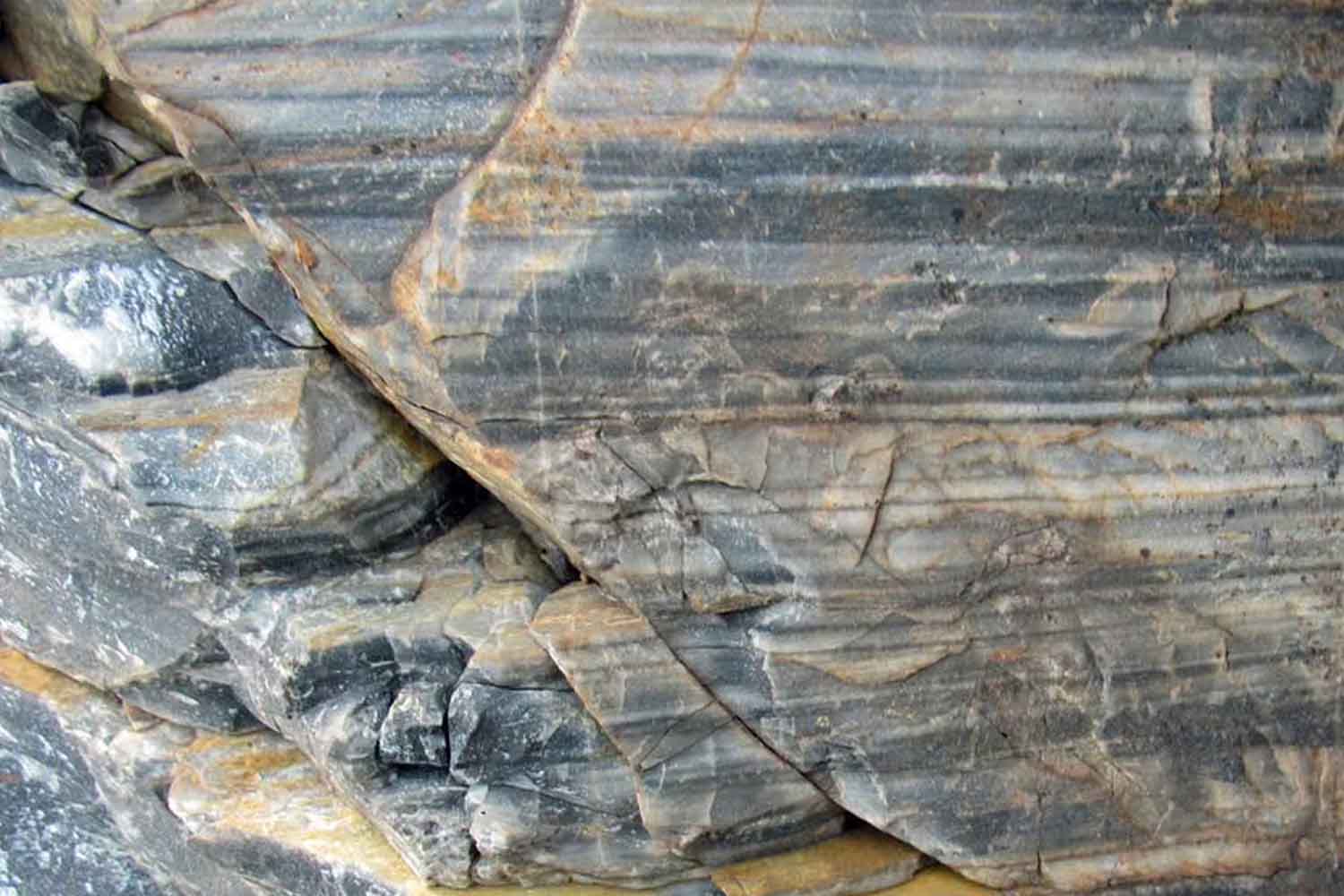
In a black-and-white banded rock from eastern India, researchers have found carbon about 3.5 billion years old. No tiny petrified bacteria to put under a lens: what remains is a kind of chemical fingerprint. And that imprint has characteristics compatible with material produced by very ancient microorganisms.
The discovery comes from the Singhbhum craton, one of the oldest portions of the Earth’s crust, and is described in a study published in Proceedings of the National Academy of Sciences (PNAS). The group led by Trisrota Chaudhuri, del Geological Survey of Indiahe dated the rock to 3.497 billion years, with a margin of about 5 million. According to the authors, it could be the oldest rock dated in this way that retains a biosignature, that is, a chemical trace attributable to life.
How do you put an age on something so old?
The carbon present in the rock does not come with an identity card. To determine when it ended up there, the researchers looked for tiny crystals of zircona very resistant mineral that can preserve the information necessary for dating for billions of years.
They found them within the same chert, a silica-rich rock formed at the bottom of an ancient sea. The crystals would have arrived along with ash produced by volcanic activity as those sediments were being deposited. Four fairly well preserved zircons have yielded compatible ages: hence the estimate of 3.497 billion years.
This is an important step because many supposed traces of early life are difficult to date precisely. Some come from even older rocks, in Greenland and Canada, but they have been heavily transformed by heat and pressure over billions of years. When the Earth cooks a rock long enough, reconstructing what it originally contained becomes quite complicated.
Carbon has the signature we expect from life
Once the age was established, the most interesting question remained: Where did that carbon come from?
Carbon exists in slightly different forms, called isotopes. When living beings use it to build their molecules, they tend to prefer the lighter version. A characteristic proportion between carbon-12 and carbon-13 therefore remains in the material.
In the Indian sample the researchers measured a value of −30.9 per thousandcompatible with biological carbon fixation. In less laboratory words: the composition resembles what would be expected if that material had passed, billions of years ago, through the metabolism of living organisms.
The authors also arrive at a more precise possibility. That signal is compatible with relatively sophisticated mechanisms of CO₂ fixation, including the Calvin cyclenow used by plants, algae and numerous microorganisms. This would suggest that already 3.5 billion years ago some life forms had developed well-organized systems for obtaining carbon. It would suggest, in fact: from the composition of a rock we cannot reconstruct the entire metabolism of its ancient owner.
The chert structure also helps. Inside it appear very thin alternating layers of silica and carbon-rich material, which the researchers interpret as a possible residue of a microbial carpet: communities of microorganisms that grow on top of each other forming small layers, something that still exists today in certain environments.
The fossil to show, however, is missing
The caution lies here. In the chert. The evidence proposed by the study comes from the combination of the age of the rock, carbon isotopes, position of the material and structure of the layers.
The researchers also checked how much the rock was heated after its formation. Ancient carbon in the chert layers would have reached approx 338°C: enough to modify it, without completely transforming it into neat graphite and erasing every original characteristic. Graphite formed much later, when much hotter fluids passed through the material, appears in rock fractures. Distinguishing the two things was fundamental: otherwise we would have risked mistaking a visitor who arrived later for the tenant from 3.5 billion years ago.
The place where that rock formed must have been quite eventful. The sea was devoid of the oxygen we know today and volcanic and hydrothermal activity brought iron, silica, sulfur and other elements into the water. Similar environments, around hydrothermal vents on the ocean floor, still host microbial communities capable of living without the need for sunlight.
The discovery, therefore, does not deliver the portrait of the “first living being” on Earth and does not establish when life appeared. However, it moves another piece far back in time: about 3.5 billion years ago biological processes capable of leaving a recognizable signature in carbon may have already been active.
Now the team wants to look for other similar rocks in the Singhbhum craton. That dark band trapped in the quartz has persisted for nearly three-quarters of Earth’s entire history. Understanding whether there are others could tell us how common life was in those ancient seas. The cell is long gone. His chemistry, perhaps, had much more patience.
