
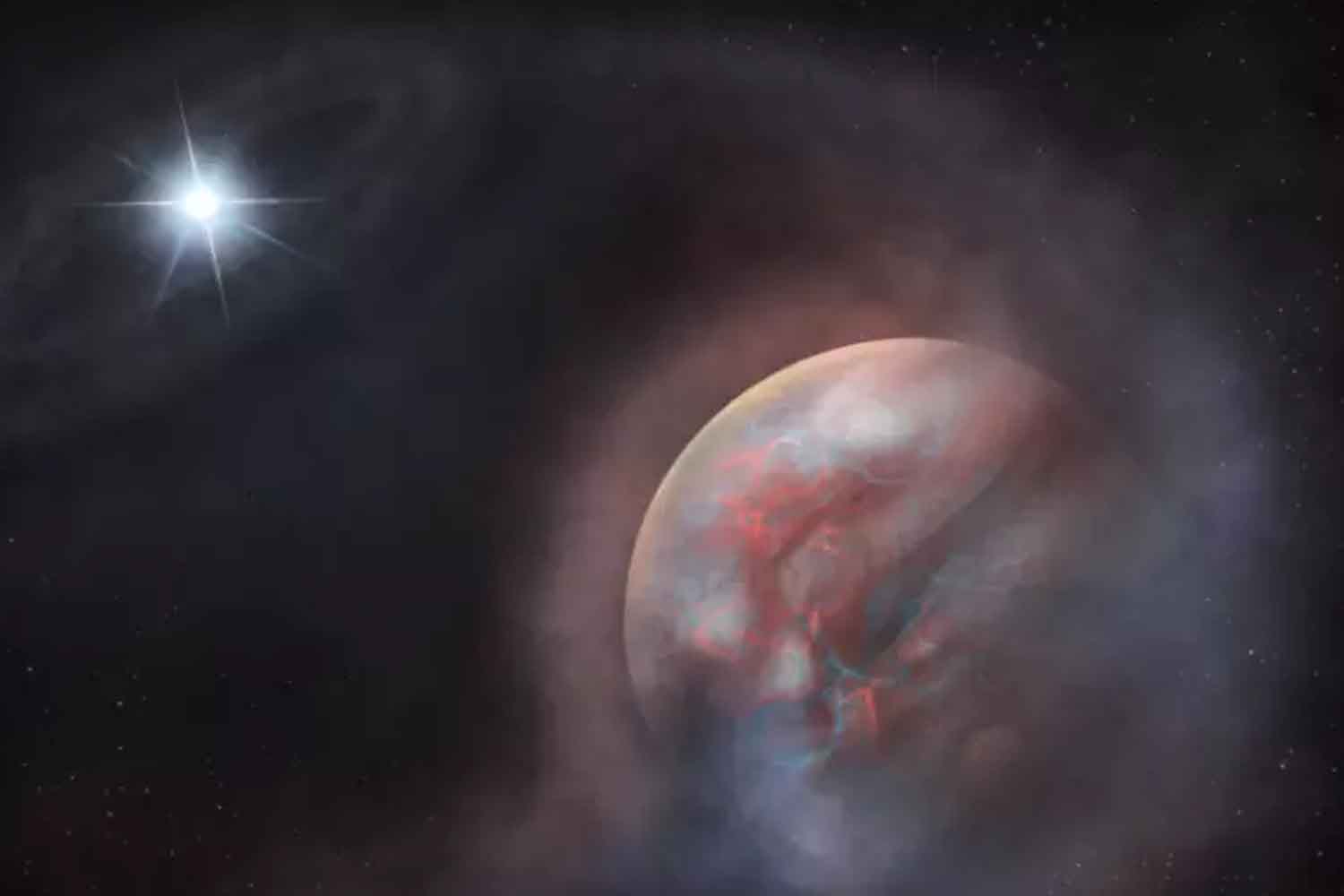
In 1999 Hubble had registered in the nowhite ana HS 0209+0832 about a hundred spectral lines that astronomers could not identify. Twenty-seven years later a part of that old mystery has found a name: niobium. And together with the niobium, something decidedly bigger appeared, a possible planet born after the death of the star that is now taking away its atmosphere.
It is the candidate described in the study published on Nature Astronomy by an international group led by Jamie T. Williams, of the University of Warwick. The authors talk about a possible second generation planet around the white dwarf HS 0209+0832: a gas giant that could have formed with material expelled from the star during the last stages of its life. It would be the first case identified around a white dwarf, even if the important word, for now, remains “candidate”.
The niobium that reopened a 27 year old case
HS 0209+0832 is a young, hot white dwarf, with a surface temperature of approximately 35,800 kelvins and a cooling age estimated at around five million years. White dwarfs are what remains of stars of relatively low mass after the expulsion of the outer layers: small, very dense and still very hot objects.
By reanalyzing old ultraviolet observations from Hubble, along with data from the FUSE telescope and the Very Large Telescope, researchers found a very strange chemical combination in its atmosphere. Zinc, copper and above all niobium are highly enriched, while iron and silicon, very normal ingredients of the rocky bodies of the Solar System, are very scarce or absent. Niobium exceeds solar abundance by more than three orders of magnitude.
This signature leads to the last stages of the progenitor star’s life. Elements such as niobium are produced through the so-called process-sthe slow capture of neutrons that occurs above all in evolved stars of the asymptotic giant branch. When these stars lose their outer layers, they spread into space material that is chemically different from that present in the disk in which their first planets were born.
It is precisely that composition that makes HS 0209+0832 interesting. The matter falling onto the white dwarf resembles very little the normal planetary debris observed so far around dead stars and much more like material processed and expelled from the star itself. NASA described the discovery as the resolution of an old Hubble “unsolved case,” reopened thanks to much more complete atomic databases than those available in 1999.
A complete tour every 4.4 days
Chemistry alone only tells half the story. A regular variation in brightness every time also appears in the data from the TESS space telescope 4,399 dayswith a width of 0.120%. The models are compatible with a gas giant very close to the white dwarf, about 0.04 astronomical units: more or less six million kilometers.
At that distance the white dwarf’s radiation is ferocious. The planet’s outer atmosphere should then disperse into space; part of the gas would then end up on the surface of the star, leaving precisely those traces of carbon, zinc, copper and niobium observed in the spectrum.
The planet, however, . The TESS signal also admits more than one explanation: it could derive from the temperature difference between the side always facing the star and the night side, or from a long tail of evaporated gas that periodically crosses our line of sight. The data are compatible with a gas giant, but other observations will be needed to better define its characteristics and nature.
Was he really born from the ashes of his star?
The study’s most interesting response also brings with it the greatest caution. The data indicates that the material ingested by the white dwarf is compatible with that of a second generation planet. Reconstructing how that planet formed is more complicated.
One possibility is that some of the gas expelled by the old giant has formed a new disk around the white dwarf, perhaps thanks to interaction with a second star or a low-mass companion. The new gas giant could have formed from that disk.
The authors also consider a more hybrid route: the core of a previous planet, a super-Earth or a sub-Neptune that survived the star’s transformation, could have crossed that new disk and collected an atmosphere composed of the second generation material. The “Phoenix planet”, therefore, could have been completely reborn from the ashes or have preserved a piece of its previous life. For now, chemistry allows us to see the ashes very well; the birth, understandably, didn’t have a camera pointed at it.
And when will it be the Sun’s turn?
The connection with the Solar System comes from the same researchers at the University of Warwick. In about five billion years the Sun will run out of hydrogen in its core, become a red giant, lose most of its outer layers and end its evolution as a white dwarf.
The discovery of HS 0209+0832 adds a hypothesis that until now had very few examples to cling to: after the death of a star, the expelled material could participate in the construction of new planets. Boris Gänsicke, co-author of the study, goes so far as to ask whether one day even what remains of the Sun could contribute to the birth of second-generation worlds.
It is a possibility, not a prediction about the fate of the Solar System. A single distant candidate is not enough to know whether something similar will happen here in billions of years.
Astronomers will now look for other white dwarfs with the same combination of carbon and elements produced by the s-process. If more appear, the phoenix planet will stop seeming like an isolated cosmic whim. HS 0209+0832, meanwhile, continues to slowly consume the very world that may have been born from the remnants of its old stellar life.
