
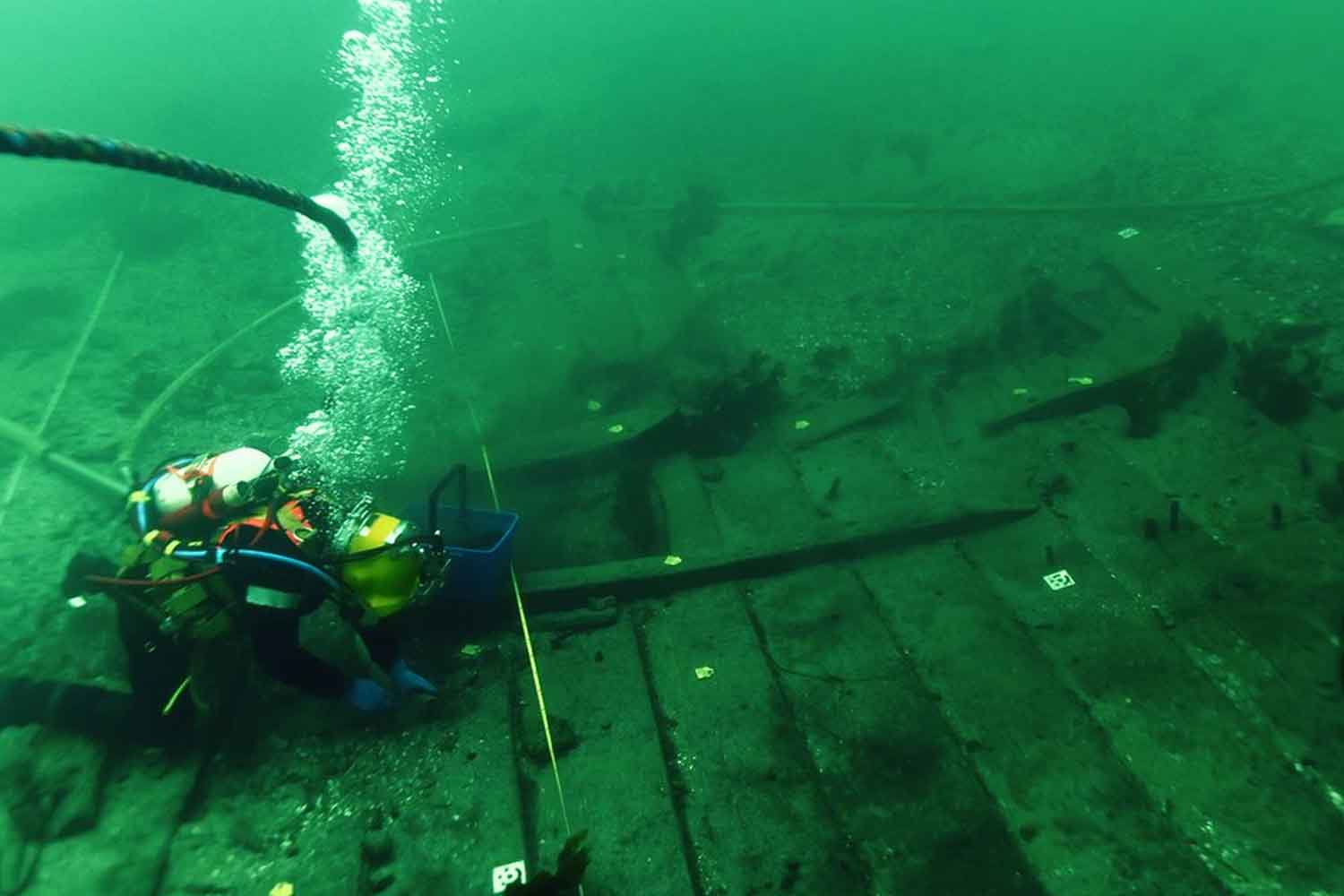
For six hundred years it remained there, motionless and silent, protected by the mud and cold water of the Øresund Strait. Now, one sunken medieval ship reemerges from the past and does so in a sensational way, because it is not just any wreck: it is there largest medieval nock ever discovered. A discovery that comes from the sea between Denmark And Swedena few kilometers from Copenhagenand which forces us to review what we thought we knew about the trade and technologies of the Middle Ages.
Archaeologists brought this giant of the sea to light Viking Ship Museumwho identified the hull almost intact, with the entire starboard side remaining buried in the mud. A rare condition, which functioned as a time capsule. The wood, the ropes, the internal structures and even the spaces dedicated to life on board have been preserved in a surprising way, giving us a concrete and non-idealised image of fifteenth-century commercial navigation.
The ship was called Svaelget 2named after the canal in which it lay, and its dimensions are still impressive today. It is approximately thirty meters long, over seven meters wide and more than five meters high, with an estimated load capacity of around three hundred tons. Numbers that tell of a Europe that is already deeply interconnected, capable of supporting intense trade routes and building ships designed to transport enormous quantities of goods.
How fifteenth-century sailors lived and worked
Thanks to analyzes of the growth rings of the wood, scholars have established that the oak used to build the ship was felled around 1410, probably in the area of present-day Poland. Among the remains, personal objects of the sailors were found, such as combs and rosary beads, small details that suddenly make those distant silhouettes human. Everything suggests that the ship sank while underway, without cargo, perhaps heading north after leaving the Netherlands.
One of the most fascinating aspects of this sunken medieval ship it’s what it tells us about daily life on board. Traces of a covered bridge emerged, a sort of elevated shelter that protected the crew from wind and rain. It is the first time that such a structure has been documented archaeologically, confirming what we have so far only known through drawings and written sources.
Even more surprising is the presence of a brick-built galley, designed to resist fire. A luxury, for the time. Here sailors could cook over an open flame, a huge achievement compared to older ships, where eating hot was often impossible. It is a detail that speaks of safety, but also of quality of life, and reminds us that progress does not only come from large companies, but also from daily gestures.
Because this discovery changes our view of the Middle Ages
It is a fundamental discovery for maritime archaeology, explained the archaeologist Otto Uldumwho leads the project. Not so much because it overturns what we know about medieval trade, but because it finally makes it tangible. Ships like Svælget 2 demonstrate that there was an economy strong and organized enough to justify the construction of such behemoths.
This sunken medieval ship it’s not just a spectacular wreck. It is physical proof of a world in movement, made up of exchanges, work and routes that have contributed to building Europe as we know it today. And perhaps this is precisely the most fascinating aspect: knowing that, under the cold waters of the North, the past does not really sleep. He’s just waiting for the right time to tell his story again.
