
Do you know those videos in which a person stands still in front of the mirror, expels all the air and pulls their belly inwards until it almost disappears? Now, that’s the abdominal vacuum. It causes a lot of drama on social media, because it has that slightly “before and after” effect that algorithms like so much. In practice, however, it was not born on TikTok and it is not even yet another trick to sell a flat stomach on your lunch break.
The vacuum comes from yoga, Pilates, bodybuilding, postural work and physiotherapy. Its strong point is simple: it doesn’t ask you to get on and off the mat like a tired spring, but to learn to draw the abdominal wall inwards, activating the transversus abdominis, the deep muscle that wraps the waist like a natural fascia.
Here it is best to immediately set a marker. The abdominal vacuum does not melt belly fat, it does not replace physical activity, it does not transform your posture on its own and it does not erase a sedentary lifestyle with five poorly taken breaths in front of the mirror. However, it can be useful for improving core control, feeling the abdomen more collected and working on an area that classic crunches often barely touch.
The hidden muscle that acts as a corset
When we think of the abdominals, we almost always imagine the rectus abdominis, the one with the “squares”. It is the muscle that works in crunches, sit-ups and exercises in which the torso flexes forward. The abdominal vacuum behaves differently: it works deeper, without obvious movement, through an isometric contraction.
The gesture resembles what in the technical field is called abdominal hollowing, i.e. the controlled recall of the abdomen towards the spine. Some studies on muscle activation have observed that this type of exercise mainly involves the local and deep muscles of the core, including the transversus abdominis. You’re not just “pulling in your belly,” you’re teaching an important part of your abdomen to do its job more precisely.
The transversus abdominis participates in the stability of the trunk, the control of posture and the management of internal pressures. For this reason it is often cited in core re-education programs and in exercises designed for the well-being of the lumbar area. The World Health Organization also reminds us that muscle strengthening is part of general health, alongside aerobic activity. The vacuum alone is not enough. But it can become one of those small, intelligent pieces that help the body function better.
How do you do it without turning it into a freediving competition
To start, it’s best to choose the simplest version: lie down on the ground, knees bent, feet supported, back relaxed. Breathe in calmly through your nose, then slowly exhale through your mouth, emptying as much air as possible. At that point the navel is drawn towards the column, as if the belly were to retract and rise slightly. The contraction is held for a few seconds, then released and you return to breathing normally.
At the beginning, 4 or 5 repetitions of 5 seconds are enough. This already makes it clear: if you are stiffening your neck, raising your shoulders, squeezing your lower back or holding your breath until you see St. Peter’s against the light, you are going too far. The abdominal vacuum must be controlled, not heroic. Over time you can reach 8-10 repetitions, maintaining the contraction for even 10-15 seconds, always without forcing.
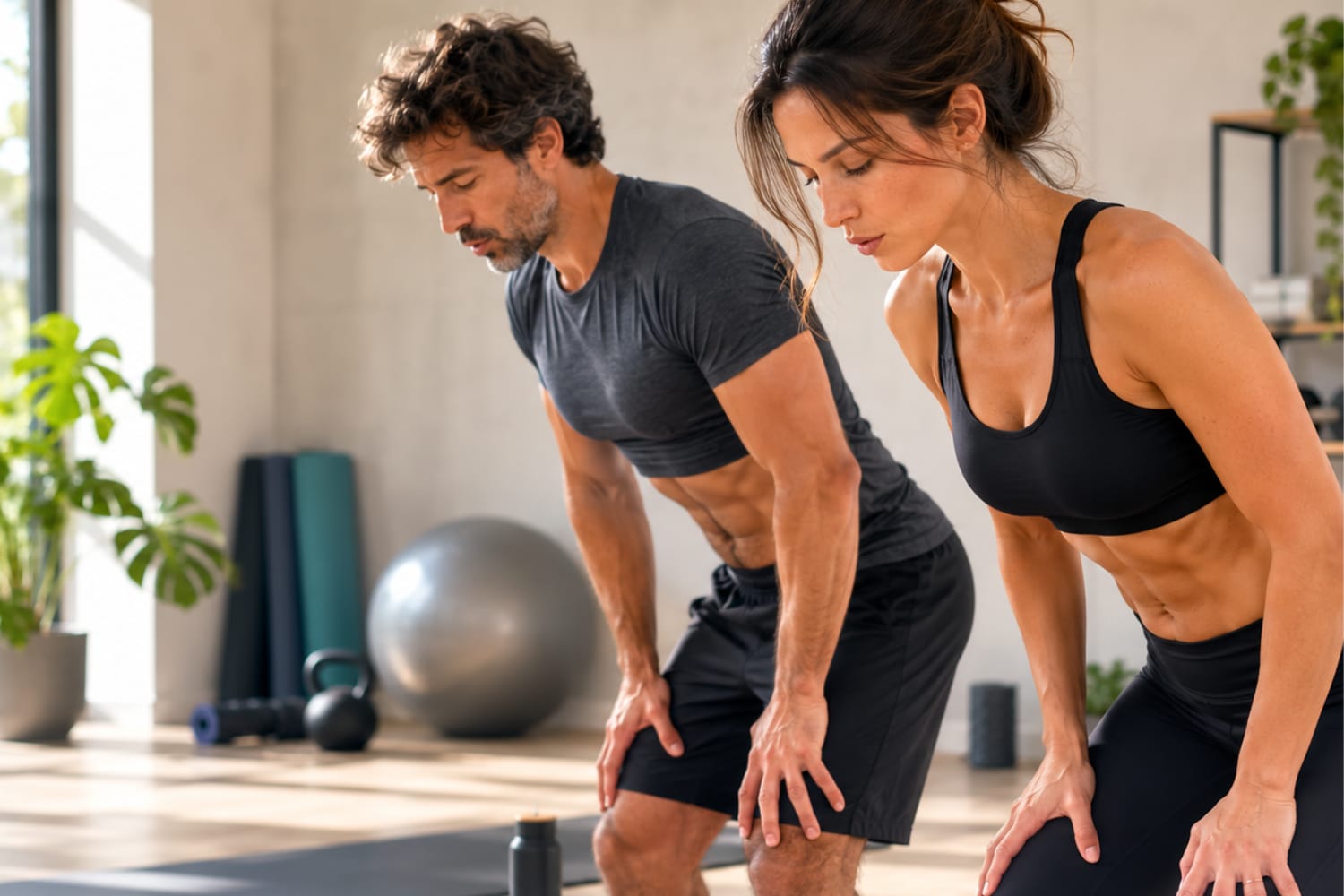
Those who have more control can try it standing, with their hands on their thighs and their torso slightly inclined, or on all fours. The logic remains identical: empty, recall, hold, release. The movement must remain internal, almost discreet. The belly should not be pushed downwards. The pelvic floor should not feel uncomfortable pressure. The shoulders must not become two rigid coat hangers.
The best time, for many people, is in the morning on an empty stomach, because the abdomen feels better. It’s not a sacred rule set in stone, but it can make the exercise easier. Even before a light workout it can make sense, as a deep core activation. Before a hearty carbonara, well, maybe not.
Because it can be more useful than crunches
The comparison with crunches must be made without religious wars in the gym. Crunches are not bad, if done well and included in a sensible program. They serve to strengthen the rectus abdominis and can contribute to core strength. The problem arises when they become the only answer to any “flat stomach” desire.
If the goal is to have a more collected abdomen, the abdominal vacuum can be more targeted because it works on deep containment. Training only the superficial part, especially with many repetitions done quickly, does not automatically mean improving control of the abdominal wall. In some people it can even increase the sensation of a hard but protruding abdomen, especially if good work on breathing, posture and stability is lacking.
The vacuum teaches the body to better manage the central area. This can give a different visual effect: same amount of fat, same body, but more controlled abdomen and less abandoned posture. It’s a subtle difference, but it can be seen in everyday life: when you sit for many hours, when you get up, when you walk, when you carry a heavy bag or when you try not to collapse in your chair after eight hours on the computer.
There is also the issue of the back. Poorly done crunches often end up loading the cervical and lumbar area, especially when you pull your head with your hands or work with momentum. The vacuum, if performed calmly, is gentler because it does not require repeated flexions of the spine.
When caution is needed
The abdominal vacuum is often described as an exercise suitable for everyone. A little measure is needed here. If it is done well, with a gentle inward call and without pushing downwards, it can dialogue well with the work on breathing and deep control. If it is forced, however, it can create annoying pressure, especially in those who already have fragility of the pelvic floor.
During pregnancy, in the recent post-partum period, in case of significant abdominal diastasis, prolapse, hypertension or respiratory disorders, it is better to avoid do-it-yourself and talk to a doctor, midwife or physiotherapist. Even the NHS, in its guidance on recovery after pregnancy, insists on gradual exercises, breathing control and attention to the body’s signals. The point is not to be afraid of exercise, but to stop treating the body like a tutorial to be copied without context.
Signs to listen for immediately: dizziness, feeling of downward pressure, pelvic discomfort, back pain, nausea, hunger for air. In that case we stop. No flat stomach deserves the “I almost lay down on the mat out of pride” award.
The intelligent detail, not the magic wand
A simple routine may be enough: 5 minutes of abdominal vacuum, 3 or 4 times a week, without making it a new home religion. It can be useful before training, to “turn on” the deep core, or in a small morning practice together with mobility, breathing and some light exercises.
For a more complete routine it can be combined with planks, anti-rotation exercises, brisk walking, strength training and posture work. The CDC guidelines, in line with international ones, remind that adults should include muscle strengthening activities at least two days a week. The vacuum can enter this framework, without stealing the place of everything else.
The flat stomach, the real and sustainable one, never depends on a single exercise. Nutrition, daily movement, sleep, stress, genetics, hormonal cycle, posture, retention, intestinal habits come into play. The abdominal vacuum can help improve tone and control, but it remains a detail within a bigger picture.
Its advantage is that it forces you to do something that many workouts ignore: listen to your body while it breathes. It seems like little, until you realize how often we live with hunched shoulders, a protruding belly, shortness of breath and a dull abdomen. The vacuum does not promise miracles. It promises, if done right, a little more presence in the center of the body. And that’s already a lot.
