
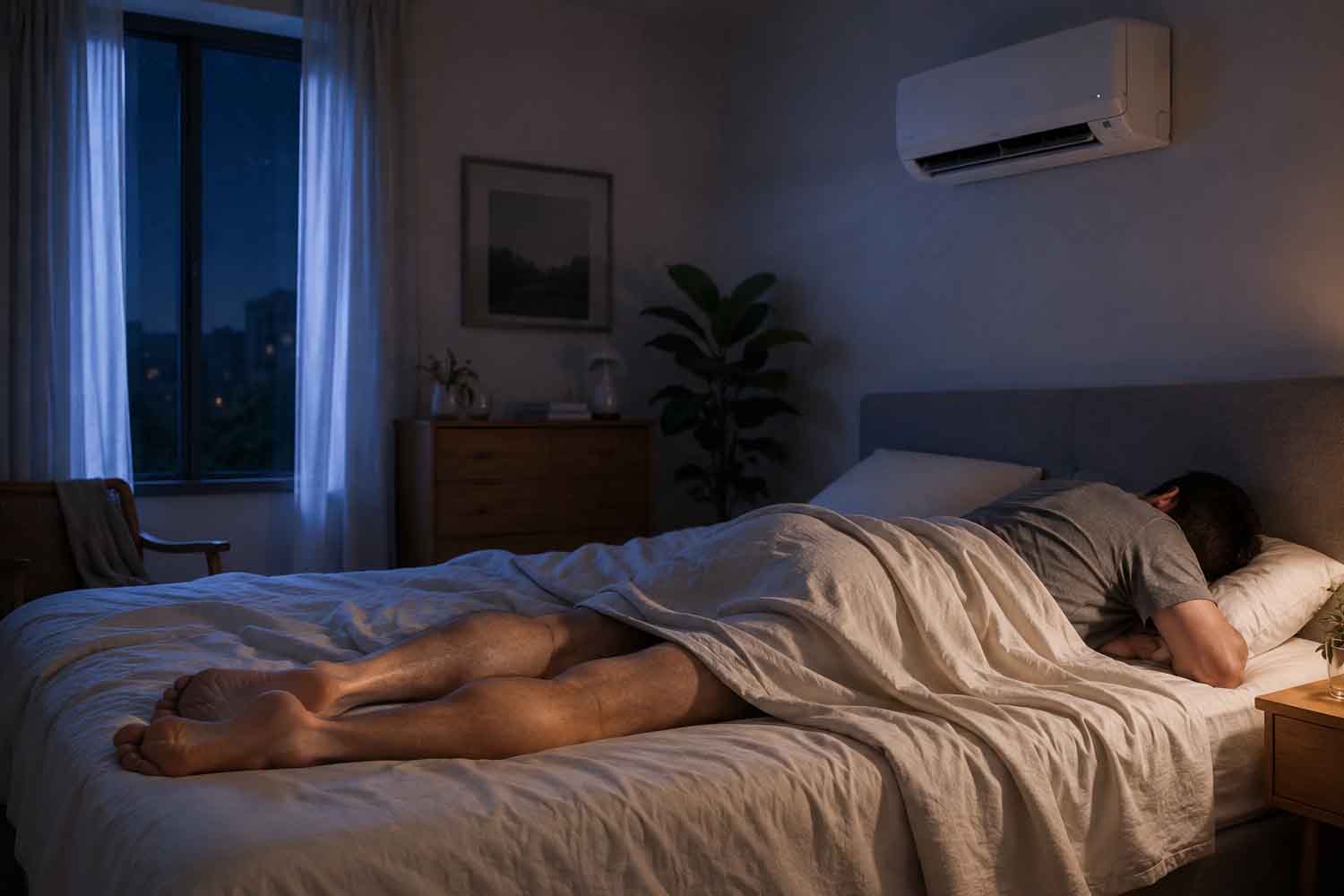
The jet of the air conditioning reaches straight onto the calves, in the morning the legs seem stiffer and the culprit seems to have already been found. The problem is that scientific research has not yet proven that sleeping in air conditioning causes cramps, loss of muscle mass or damage to leg muscles. The cold really changes the circulation and temperature of the tissues, of course. The studies that demonstrate this, however, use much more intense conditions than those normally found in a bedroom.
In a controlled study of twelve men published inEuropean Journal of Sport Sciencefor example, participants performed squats and then immersed their lower bodies for ten minutes in either 8°C or 22°C water. The cooling reduced blood flow in the femoral artery and in the skin of the thighs and calves. A real physiological response, obtained however by directly immersing the body in cold water. An air conditioner set to a moderate temperature is another exposure.
Cold changes circulation
Peripheral vasoconstriction is one of the mechanisms by which the body limits heat loss. Really cooling a muscle can also change its metabolism and oxygen demand. A 2025 experiment conducted on eleven men compared exercises performed with the leg muscle heated, cooled, or held at neutral temperature. In the cold protocol, muscle temperature was lowered by approximately 6°C: enough to modify some metabolic parameters during exercise.
This study also tells what happens when muscle tissue is deliberately cooled. It doesn’t tell us that a blast of air at night produces the same effect, nor that that variation causes cramps or persistent stiffness upon waking.
And it is precisely the step that is currently missing. In the available clinical literature, there are no studies that have taken healthy people, made them sleep with an air conditioner facing their legs and then found an increase in night cramps. The individual sensation of cold, tension or discomfort may exist; turning it into a proven cause of muscle disorders requires data that we don’t have today.
Regarding cramps, magnesium and dehydration are less obvious than they seem
Nighttime leg cramps are common and their causes can be different. This is why it is easy to build an apparently perfect chain: air conditioning, dry air, dehydration, loss of mineral salts, tight calf at three in the morning. Too bad each ring isn’t that sturdy.
The Cochrane review of magnesium supplements for muscle cramps analyzed eleven randomized clinical trials. In five studies conducted primarily in older adults with idiopathic cramps, magnesium did not produce a clinically significant reduction in cramp frequency compared to placebo. For other conditions, including pregnancy, the results are more uncertain.
This does not mean that true magnesium deficiency or other electrolyte imbalances are unimportant. It means that a night cramp does not automatically demonstrate a deficiency, let alone that this was caused by the air conditioner.
Even hydration requires moderation. Drinking enough during hot days remains important, especially when you sweat a lot or play sports. However, it does not follow from this that air conditioning normally used during sleep dehydrates a person to the point of causing muscle cramps.
The strongest connection comes through sleep
An unpleasant nighttime temperature can disturb rest, and this is the part of the story supported much better by the data.
In a study published in Journal of Sleep Researchfifteen physically active young adults slept in the laboratory at 22°C and 32°C while their sleep was recorded with polysomnography. At 32°C total sleep time was reduced on average by about 25 minutes; Sleep efficiency and the duration of the REM phase also decreased, while the periods of wakefulness after falling asleep increased.
So a room that’s too hot can actually interfere with sleep. And sleep also matters for muscle recovery. A randomized crossover experiment in thirteen young adults compared a normal night with a night of complete sleep deprivation. The following day, muscle protein synthesis was reduced by 18% after the sleepless night. Cortisol was also increased.
Another study published on The Journal of Physiology subjected young men to five nights with just four hours available for sleep. Also in this case a reduction in myofibrillar protein synthesis was observed compared to the group that slept normally.
These are conditions of severe sleep deprivation, so it would be wrong to turn them into proof that a restless night causes you to lose muscle. However, they show a credible biological link between insufficient sleep and muscle recovery. If anything, the air conditioner can enter history through this door: if the chosen temperature makes us sleep better, it can indirectly promote recovery; if it wakes us because we are cold, the benefit disappears.
At what temperature should you keep the air conditioner at night?
For Italian homes we can avoid the international competition to see who sleeps in the room most similar to a cold room. The Ministry of Health, in its indications for heat waves, recommends using the air conditioner in moderation and keeping the room temperature around 24-26 °C. It also recommends avoiding sudden transitions from hot to cold and taking care of maintenance and cleaning of the systems.
Avoiding a strong, continuous flow of air directly on your body remains a reasonable choice for comfort, especially if you wake up feeling cold. From here to say that incorrectly orienting the air conditioning fins can compromise the leg muscles, however, the literature does not arrive.
If you often experience cramps, pain or weakness in your legs when you wake up, attributing it all to the air conditioning is an unhelpful shortcut. The air conditioner can be moved a few degrees or oriented elsewhere in a few seconds. A persistent symptom, however, deserves to be understood. The calf may have a lot to say before accusing the split hanging on the wall.
