
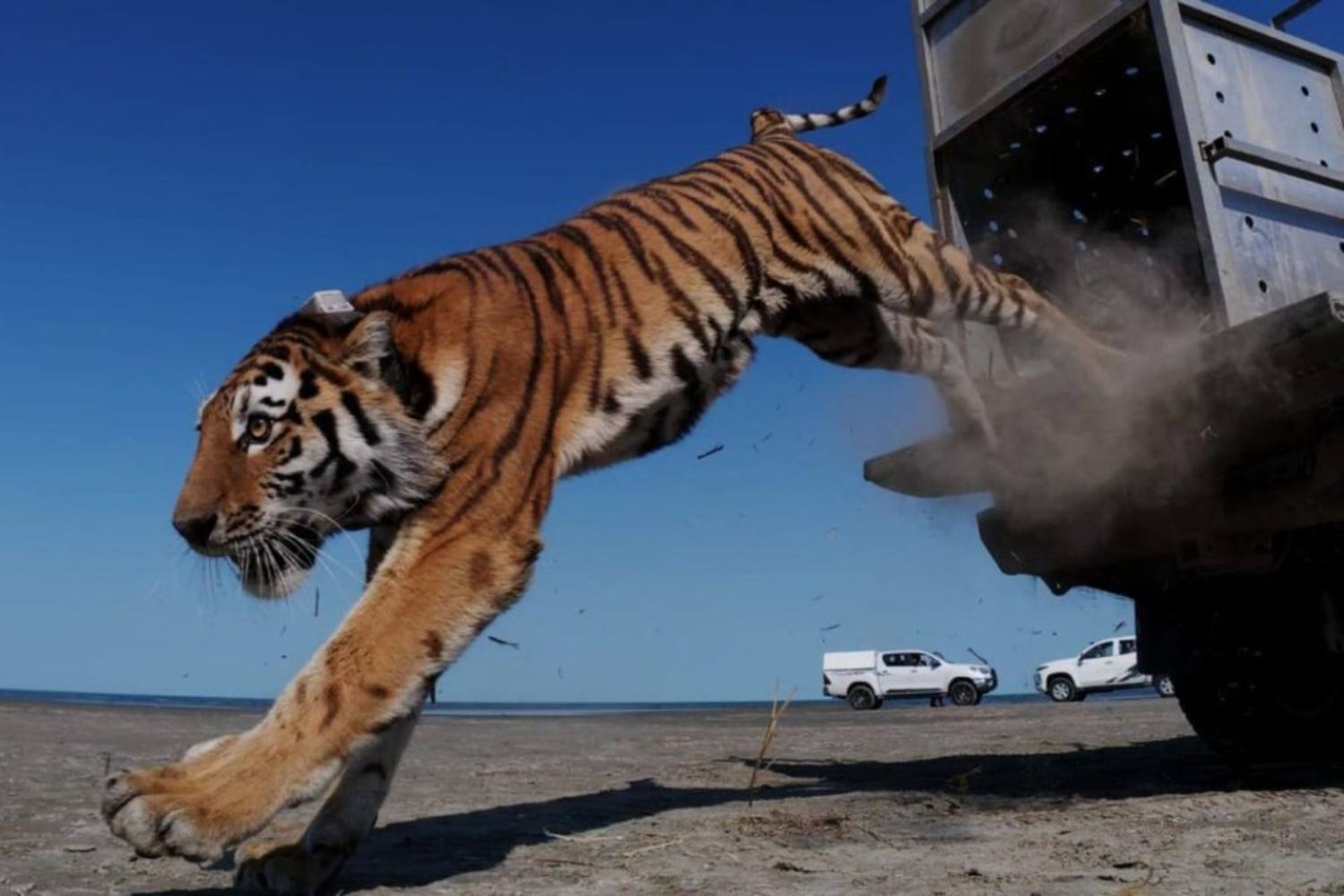
After over 70 years of dramatic absence, the roar of the big cats finally returns to echo in the boundless steppes of Central Asia. The symbol of this extraordinary environmental rebirth is called Umit – a Kazakh term meaning Hope –, a stunning female Amur tiger who became the first specimen to regain freedom in the Ile-Balkhash Nature Reserve.
The specimen is part of a group of four Siberian tigers transferred from the Russian region of Khabarovsk as part of a historic agreement promoted by Russian President Vladimir Putin and welcomed with enthusiasm by local authorities. The objective of the operation is to reconstruct a sedentary wild population where the now extinct Turan tiger once dominated.
Tiger is back in Kazakhstan after seventy years.
It’s a historic release of the first tiger into the wild in over 70 years in Kazakhstan, a landmark achievement in species recovery and ecosystem restoration. pic.twitter.com/412glAXgOR
— Ramesh Pandey (@rameshpandeyifs) August 5, 2026
A 50-year repopulation and monitoring plan
The liberation of Umit represents only the first step of a long-term strategy led by the chairman of the Forestry and Wildlife Committee, Daniyar Turgambayev. The project, destined to develop over the next forty or fifty years, involves the use of sophisticated satellite GPS collars to track every single movement of the animals.
To ensure the full safety of local communities, Ecology Minister Yerlan Nyssanbayev confirmed the activation of rapid intervention teams ready to act if the cats come within five kilometers of residential areas. Together with Umit, the program involves an adult male, two cubs and the couple formed by Kuma and Bohdana, transferred from the Dutch center Stichting Leeuw to support protected breeding.
Rebuilding the food chain: the challenge of prey
Bringing the largest felid on the planet back to its historic habitat required over a decade of complex preparatory interventions. In fact, an adult tiger needs to hunt between fifty and seventy large mammals every year to ensure its survival. For this reason, biologists have repopulated the area south of Lake Balkhash and along the Ile river by introducing 119 specimens of kulan, the typical Asian wild donkeys, as well as encouraging the natural proliferation of wild boars, roe deer and Bukhara deer. Only the presence of a rich and structured ecosystem will allow newborns to grow strong and independent without having to resort to direct human assistance.
A world record for nature conservation
If the experiment led by the Kazakh government and international experts achieves the desired results, Kazakhstan will achieve an absolute record on a global level, becoming the first nation capable of restoring a population of wild tigers in an area where the species had become completely extinct in the mid-twentieth century.
The close genetic relationship between the Siberian tiger and the extinct Caspian tiger provides the perfect scientific basis for this ecological miracle. The path towards self-sufficiency for the species will be long and fraught with pitfalls, but Umit’s journey to freedom demonstrates that human determination can truly repair the damage of the past.
Kazakhstan has released an Amur tiger, Umit, into the wild for the first time in over 70 years
This step forward marks real progress in restoring the species to its historic habitat through a long-term reintroduction program in the Ile–Balkhash State Nature Reserve.
… pic.twitter.com/HQssVYnpbK
— Kazakh Embassy
(@KazakhEmbassyUK) August 5, 2026
