
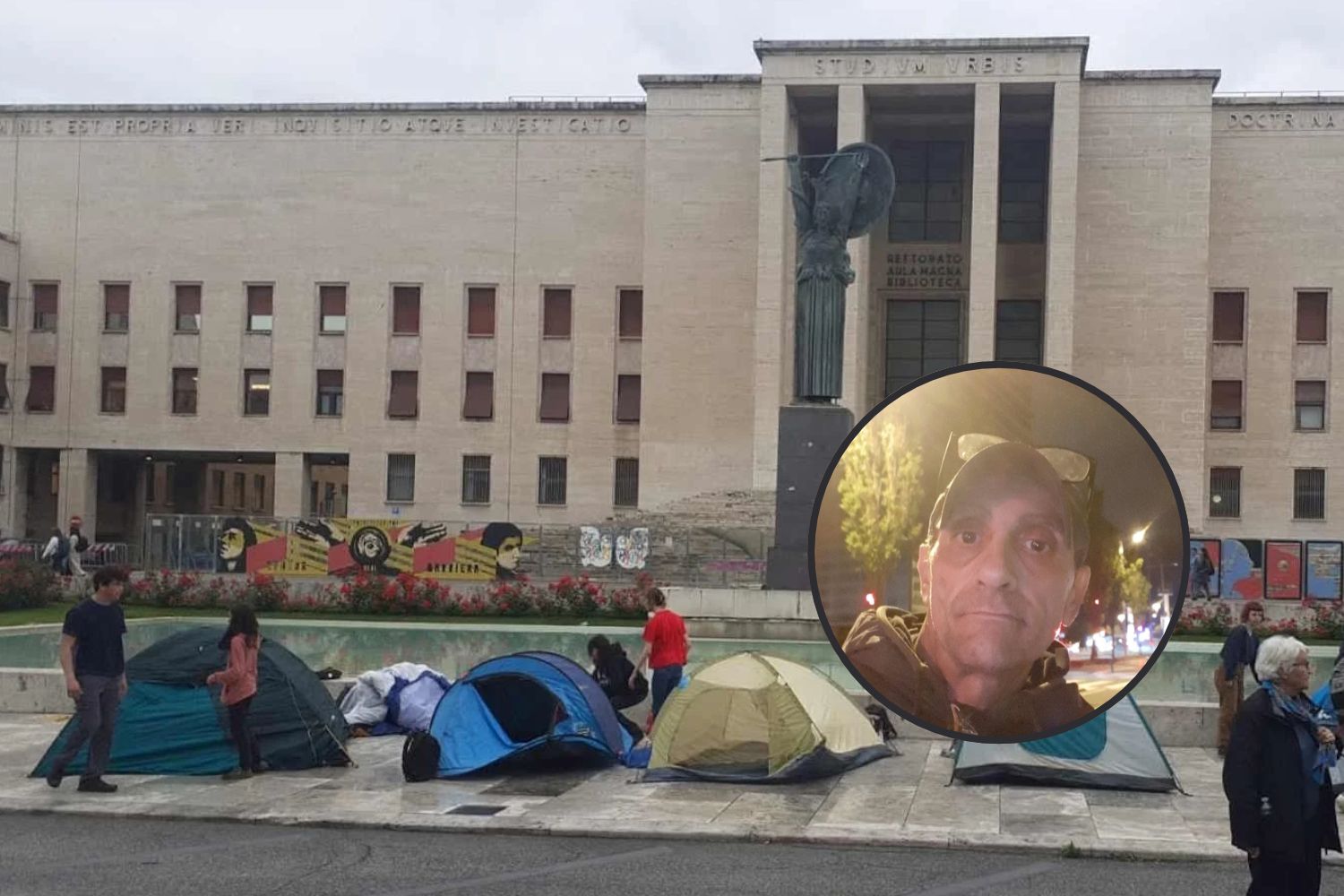
During the day he attended physics lessons, at night he slept on the street, looking for cardboard to lie down on. He was 58 years old, had a heart condition and had a civil disability of 50%. He had decided to start again at university, because “it is never too late to pursue a passion”. But to do this he needed a place to sleep, wash, eat and study.
Alessandro Ingusci died on the afternoon of Monday 23 November inside the Sapienza university city, in Rome, where he lived in a tent. That very day he had announced the resumption of his hunger strike in which he asked for university accommodation. The causes of death are still under investigation.
Only a few weeks ago we told you about the students who returned to sleep in tents against high rents, three years after the first mobilizations that swept through Italy. From Milan to Montecitorio, the demand was always the same: without a home you can’t study.
The dream of going back to study
Raised in Lecce, Alessandro studied at the European Institute of Design in Milan and worked for years in the communications sector. In 2014, a heart attack marked a setback in his career. He then moved to the Netherlands, where he opened a food and wine bookshop in Amsterdam, forced to lower its shutters in 2022 after the economic difficulties linked to the pandemic and a series of legal vicissitudes.
Having returned to Italy last summer, he chose to enroll at Sapienza University to cultivate his passion for physics. Once his savings were exhausted, however, he found himself homeless. For over two months he had slept in Piazza San Silvestro, in the heart of the capital, before receiving a tent from activists of the housing rights movement.
I need a place to live, study, wash and eat.
He wrote like this on social media, where he documented his days, his economic difficulties, the precariousness of his health conditions, but also his enthusiasm for his studies and the emotion of having met the Nobel Prize winner Giorgio Parisi.
In October he had a second heart attack. His situation was known to the institutions: Sapienza, through a note, announced that it had had repeated contacts with the student, involving the health services and local authorities and proposing reception solutions. The president of Lazio DiSCo, the regional body for the right to education, specified that Ingusci had not submitted an application in the notices for the assignment of accommodation or a scholarship. According to what Alessandro himself said, the bureaucratic difficulties linked to the lack of a residence had also complicated the path to obtaining accommodation.
The right to study
It will be necessary to ascertain the circumstances of Alessandro’s death and reconstruct the interventions implemented by the institutions. But his story once again imposes on us a reflection that goes far beyond the single case.
Last October the University Union reported how, compared to the over 63 thousand beds activated through the PNRR programme, only 33 thousand had actually been created at the time of the ministerial announcement in September. And how, according to the student union, in some private residences people even asked for a thousand euros a month for a room.
The right to study, enshrined in Article 34 of our Constitution, necessarily passes through the right to live. And it has no expiry date: it applies at 19 as well as at 58, for those who graduate from high school as well as for those who, after losing their job and their savings, try to rebuild their life.
And what about homeless people and those with disabilities? Well, the question is legitimate: how accessible is our assistance system really to those who are already in a condition of extreme fragility? How can a person busy every evening getting cardboard to sleep on also deal with the complexity of tenders, documents and administrative procedures?
The time has probably come to question ourselves about the effectiveness of a welfare system which should be able to intercept situations of hardship before they become emergencies.
