
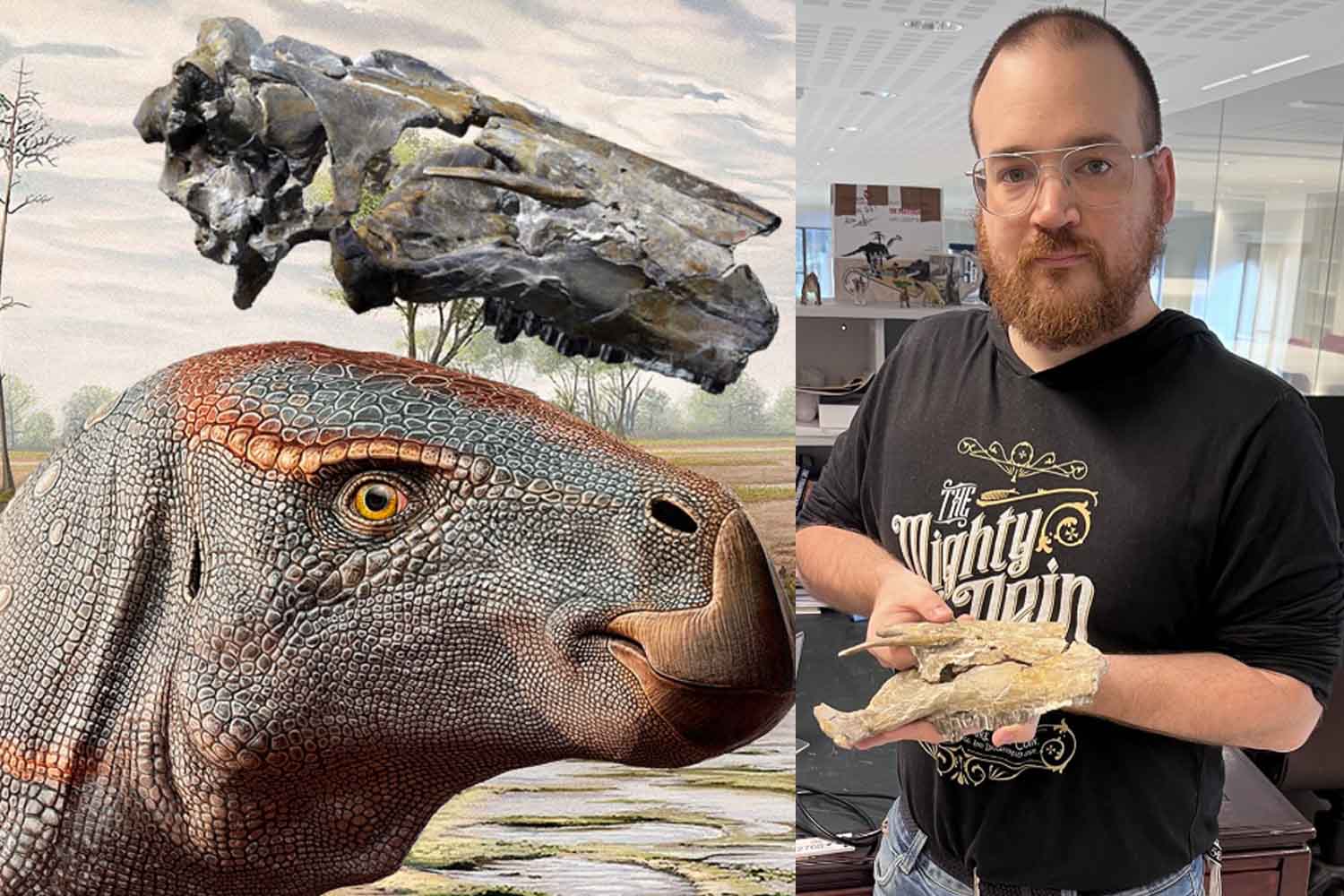
A dinosaur never seen before, lived about 125 million years ago in the current Portugal, it was just recognized as new species. The researchers of an international team led by the Italian paleontologist announced it Filippo Bertozzowho works in Belgium today, at the Royal Belgian Institute of Natural Sciences. Not only did he participate in the scientific description of the fossil, but he also has chosen the name of the new genrea rare privilege in the world of paleontology.
The new dinosaur is called Cariocecus bocageibelongs to the group of iguanontiand it is part of the family of the so -called “Duck -diet dinosaurs”widespread herbivores in various areas of the planet during the Cretaceous. The discovery, published in the scientific journal Journal of Systematic Palaeontologytells an important piece of the evolution of dinosaurs in Europe, and does it starting from a fossilized skull that emerged by chance among the rocks of a Portuguese beach.
The name Cariocecus is a tribute to a forgotten divinity
The name Cariocecus It is not accidental: it recalls one Divinity of the war Venerated by the pre-Roman populations who lived in the region where the fossil was found, in the south-west of Portugal. With the Roman conquest, this figure was assimilated to MarsGod of war in Latin mythology. The second name, Bocageion the other hand, is a tribute to José Vicente Barbosa du BocagePortuguese naturalist who lived between the nineteenth and twentieth centuries, known for his studies on reptiles and birds.
The discovery dates back to 2016when the Portuguese paleontologist Pedro Marrecas he noticed some teeth that appeared from a rock in the Geological formation Papo Secoan area rich in fossils near Sesimbra, not far from Lisbon. The area is dated to Lower barremianoan ancient phase of the lower Cretaceous. Here have already been found fossils of other dinosaurs, such as the great Sauropodes, the carnivores of the mainland and other iguanodons of the upper Giurassico. But this is the first specimen attributed with certainty to this family in the Portuguese Cretaceous.
Until today, the iguanonti Found in Portugal all dates back to oldest eras. This new specimen moves their geographical and temporal presence to the Iberian peninsula, as he explained Bertozzo:
We have a great variety of iguanodonti in the Portuguese superior Giurassico. Discovering a species in the lower Cretaceous helps us better understand how they have evolved and spread over time.
According to scientists, these dinosaurs were born in the current South America and, over the age of millions, they moved north and then east, also arriving in Europe. Portugal could therefore have been a point of evolutionary passagea Ponte place where intermediate species have been preserved among the most ancient and the most modern.
The fossil skull is a treasure of information
The fossil skull, even if incompletehas been preserved in an exceptional way. Thanks to advanced technologies such as the computerized micro-comographyit was possible to reconstruct the interior and observe structures never seen before: The imprint of cerebral hemispheres, the auditory systemand even theinner earwith his maculaa fundamental part for balance and orientation in space.
It is the reconstruction of the inner ear more detailed ever obtained by a dinosaur.
Not only that: the shape and arrangement of the bones of the skull, including jaw, cheekbone, nose and foreheadshow Obvious adaptations to the herbivorous dietmade of hard and resistant plants. In particular, the Fusion between jaw and cheekbone It may have made the bite of the most powerful animal, useful for chopping ferns and leathery leaves.
A dinosaur with a “frown” gaze, like a modern bird of prey
Another curious detail is linked toSopraortiBitale bonewhich is located above the eye. In Cariocecus bocagei has a particular form that has allowed to reconstruct the aforementioned membranea sort of rigid “eyelid” that gave the dinosaur one serious gaze, almost frozen. A trait that very reminiscent of today’s birds of prey, such as hawks and eagles.
It is no coincidence: Birds are dinosaurs in all respectssurvivors of the mass anger that took place 66 million years ago, caused by a huge asteroid. All the dinosaurs did not disappear, but some small feathered theopods turned into the birds we know today. Any discovery like that of Cariocecus bocagei helps us fill the voids of this long evolutionary history.
View this post on Instagram
