
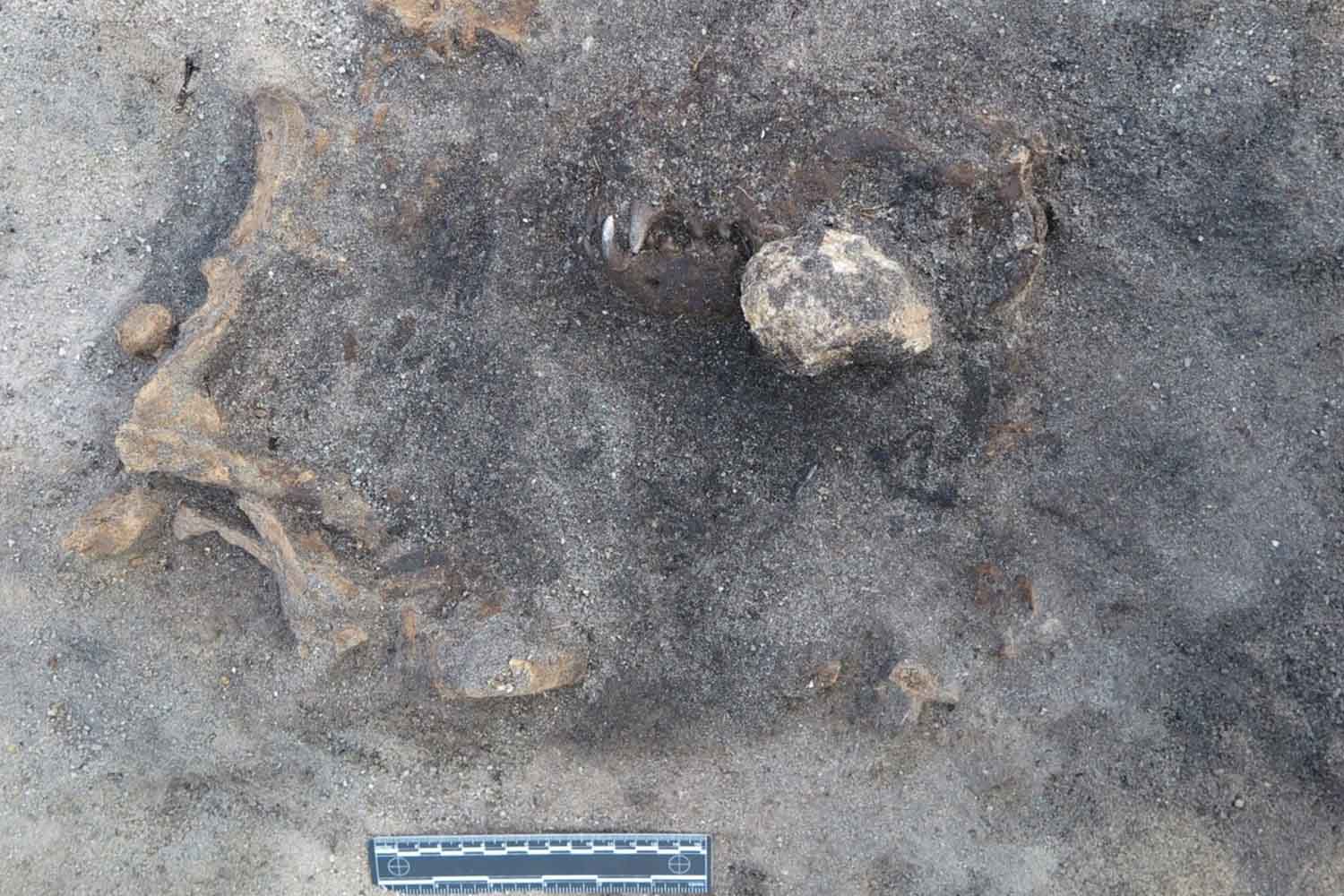
Under a thick layer of peat, in what was once a calm expanse of water, archaeologists have unearthed a story that speaks of bonds, rituals and respect. The complete skeleton of a dog that lived around 1000 years ago was found in Sweden 5,000 years agoburied carefully and accompanied by a bone daggeran object that can hardly be considered random.
It is not just an archaeological discovery: it is an open window onto a past in which the relationship between humans and animals was already deep, complex and full of symbolic meanings.
The discovery occurred in Logsjömossensouthwest of Stockholmduring an excavation conducted by the team of Arkeologernawhich operates within the Swedish National History Museums. Five thousand years ago, this place was not a swamp but a shallow lakerich in fish and frequented by Neolithic communities not only for survival, but also for ritual activities.
The dog was found several meters from the ancient shore, placed on the bottom of the lake and then covered by time. The position, depth and preservation of the skeleton indicate an intentional gesture. Archaeologists believe the animal was wrapped in a skin or wrapper and weighed down with stones, so that it would sink. The skull is crushed, but the context does not suggest a violent or hasty act: everything speaks of a ritual deposition.
A burial that suggests an emotional bond
Osteological analyzes tell a lot about this animal. It was a robust maleapproximately tall 52 centimetresdied between three and six yearswith bones that show signs of an active and challenging life. Not just any animal, but a dog that probably supported man in hunting, surveillance or daily life.
Next to the paws, almost as if it had been entrusted to him for the afterlife, was found a dagger 25 centimeters longobtained from the bone of elk or deer. A detail that makes this discovery exceptional. As Linus Hagberg, archaeologist and head of the excavation, explained, finding an intact dog from this period is already rare; find it buried with a weapon is almost unique.
In the Scandinavian Neolithic, dogs were not just working animals. They were companions, allies, daily presences. Burying one with such care and with such a symbolically strong object suggests a relationship that goes beyond utilitya recognition of the animal’s value within the community.
The burial of the dog is part of a very rich context. In the area they emerged wooden poles driven into the seabedprobably remains of walkways or small platforms, as well as precisely arranged stones, perhaps used as weights for nets. One was also found fish trap about two meters longcreated by intertwining thin branches, around which the mud has preserved the footprints and surfaces trampled by those who, thousands of years ago, moved on the shores of the lake.
In Stone Age Scandinavia, lakes and wetlands were places full of symbolic valueborder spaces between worlds, chosen to deposit objects, animals and sometimes people. This dog, therefore, is not an isolated case, but part of a broader ritual tradition.
What more can this Neolithic dog tell us?
Recovery wasn’t easy. Archaeologists worked in an unstable peat bog, simultaneously with work on the Ostlänken high-speed railway line. But now the most fascinating phase begins. The radiocarbon dating will allow us to precisely define the age of the burial, while the isotopic analyses they could reveal what the dog ate, offering clues to the eating habits of human communities. The DNAfinally, it will help to understand how this animal fits into the evolutionary history of European dogs.
More and more often archeology invites us to look at animals as witnesses of human history. This dog, buried with respect and accompanied by a weapon, tells of a past in which the bond between man and animal was already full of affection, symbols and meanings. A bond that, five thousand years later, seems surprisingly familiar to us.
