
Walls, towers, a port, a theater, a temple and entire neighborhoods. Below the Baths of Trajan there is a painted Roman city seen from abovewhich remained buried together with an enormous wall mosaic when, in 109 AD, the emperor’s large spa complex arrived on that piece of Colle Oppio. Rome, after all, has the habit of building on top of Rome.
Now that stratification can finally be crossed. After the works financed by the PNRR within the scope of Caput Mundithe Capitoline Superintendency has completed the restoration of the so-called Painted City and the Great Mosaicexpanded the excavations and arranged the underground tunnel for public access. The first visits will start on September 12, 2026, in very small groups.
The discovery, however, has a longer history than the last construction site. The underground tunnel measures approximately 70 meters and excavations began in the 1990s. Between 1997 and 1999 the fresco of the Painted City emerged; subsequent campaigns brought to light the large mosaic apparatus. With the latest work the archaeologists have simply gone further down. And they found more.
The Great Mosaic continued underground
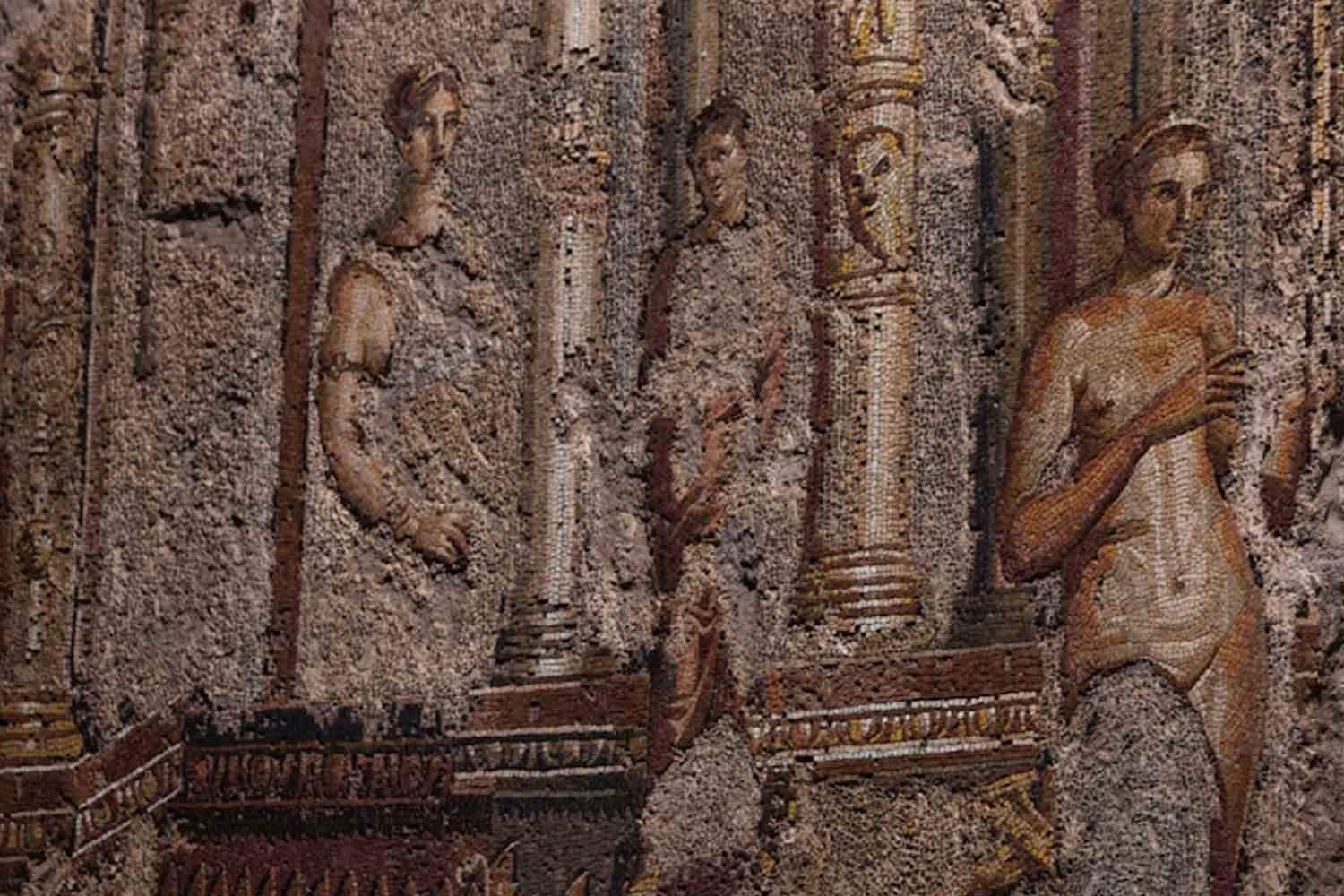
The mosaic occupied a monumental room preceding the Baths of Trajan, overlooking a large nymphaeum. A sort of gigantic theatrical scenography runs along the walls: buildings in perspective, columns, capitals, garlands, plant motifs and symbols linked to Dionysus. Statues, a centaur and human figures appear inside; a man sitting in the center has such individual features that it almost seems like a portrait. The overall interpretation of the scene, however, is still open.
The preserved eastern wall measures approx 15 metersthe southern one about ten. The known decoration already reached about five meters in height, then the PNRR project made it possible to deepen the excavation and below it appeared another mosaic band: a series of buildings probably overlooking the sea, linked to the motif of the so-called “maritime villas”.
Even further down, traces of large marble slabs and a niche approximately 2.20 meters high emerged, perhaps intended for a statue. The floor of the room, however, . Archaeologists estimate that those walls originally reached about twelve meters in height. The mosaic has been restored; the room, in a certain sense, has yet to finish emerging from the earth.
Next to it is a Roman city seen from above
A few meters further on the scene changes completely. There Painted City it is a fresco of approximately ten square meters which shows an urban center as observed from an elevated point: turreted walls, entrance door, port, streets, theatre, temple, quadriportico and residential neighbourhoods. All concentrated on a wall almost two thousand years old.
The building to which it belonged dates back to the second half of the 1st century AD, so it was already there before Trajan built his baths. The historical sheet of the Superintendence simply speaks of a port city: the precise identification remains open. Assigning Ostia to it because there is a port and walls would be very satisfying. Even a little premature.
The same fate befell most of the oldest structures on Colle Oppio. The Baths of Trajan, designed by Apollodorus of Damascus and inaugurated on June 22, 109 ADextended for approximately 60 thousand square meters above an enormous artificial terrace. Previous buildings ended up inside the foundations, including rooms of the Domus Aurea. Part of first-century Rome became, very pragmatically, the support of second-century Rome.
Above the gallery there is also the large south-western exedra, traditionally connected to a cultural function. The niches could contain cabinets for books and documents, while the steps hosted those who participated in readings and public meetings. On some plates there are even small engraved games left. Two thousand years ago there were books, lectures and someone scribbling during the meeting. Some cultural heritages resist better than others.
From September 12th, 15 people will enter at a time
The restoration and redevelopment work lasted from 24 April 2025 to 15 June 2026 and cost 2,701,760 euros. In addition to the interventions on the decorated surfaces, a new walkway, paths for the public, lighting, a reception point and the arrangement of the fistulaethe large lead pipes of the ancient water network. The details are reported in the official technical data sheet of the project.
The opening will be gradual because mosaics and frescoes live in a delicate underground environment and the presence of visitors must be monitored. In September the gallery will be accessible on Saturday and Sundaywith six shifts at 10am, 11am, 12pm, 1pm, 2pm and 3pm and a maximum of 15 people at a time. Guided tours will be free and by reservation required on 060608. Times, rates and booking methods are available on the official page for visits to the Cryptoporticus of the Baths of Trajan.
