
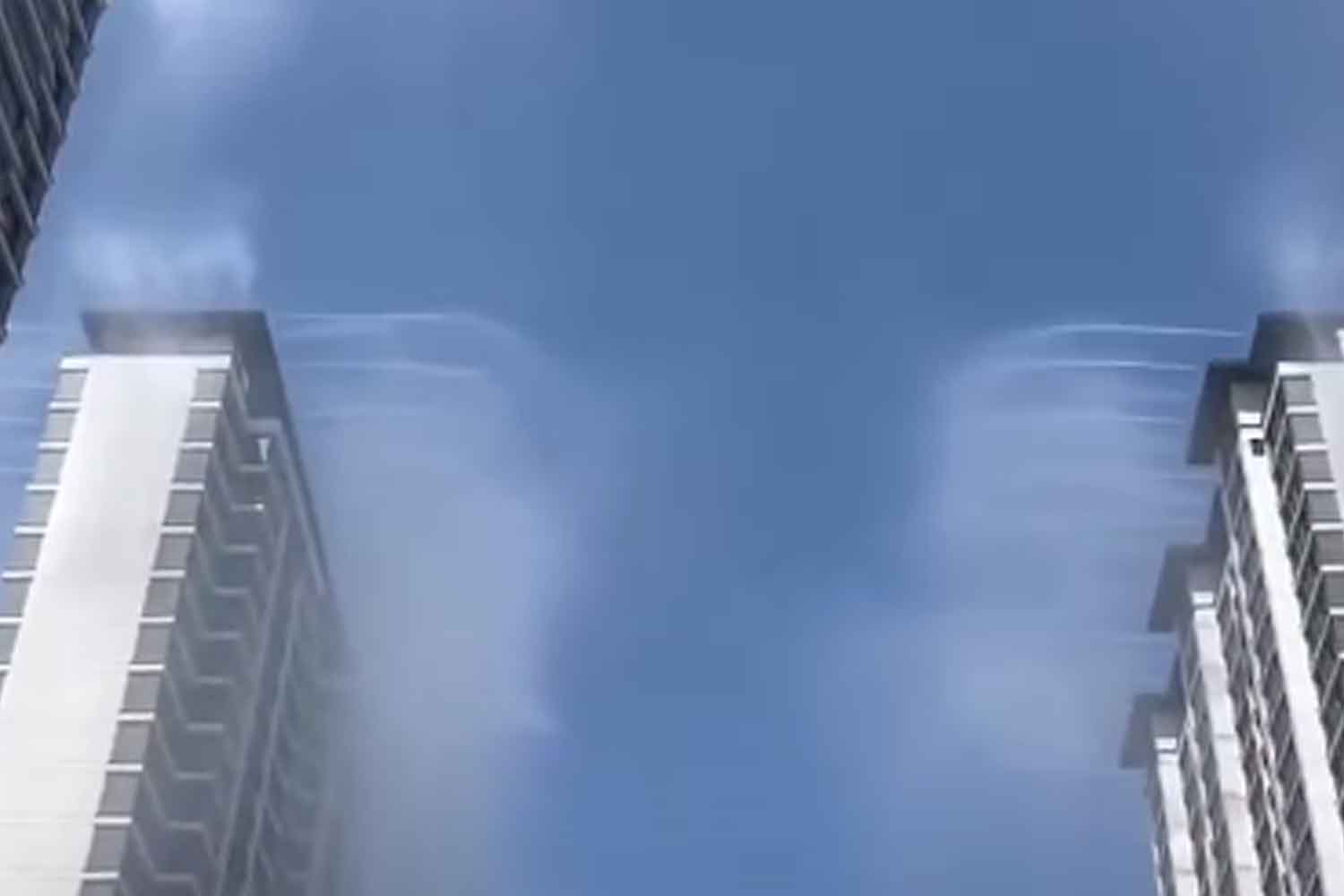
In the videos circulating on social media you can see a scene capable of immediately triggering the imagination: tall buildings, red-hot streets, roofs and poles spraying a white fog into the air. In some versions of the story that fog immediately becomes an “urban air conditioner”, a kind of simple, almost ingenious solution to lower the temperature of cities during heat waves.
The verdict, however, is rougher: misting systems exist, the cooling effect may be there, but calling them urban air conditioners risks telling only half the story. In China, systems of this type have also been reported on residential buildings in Yuncheng, in the province of Shanxi, where high-pressure nozzles release water in micro-drops during periods of intense heat. The physical principle is that of evaporative cooling: the water, by evaporating, absorbs heat from the environment.
Some reconstructions speak of a local reduction of several degrees in a few minutes, especially when the air is hot and dry enough to quickly evaporate the drops. In short, the mechanism is real. The delicate part comes immediately afterwards: how much does it really cool, where, for how long and with what humidity?
The verdict: true, but with several conditions
The real part is simple: a water mist can lower the local temperature. Misting systems are already used in public spaces, stops, dehors, parks, construction sites, pedestrian areas and highly exposed outdoor environments. Research on evaporative cooling shows that, under controlled conditions, these systems can improve thermal sensation quickly, especially in hot, dry environments.
A study published in City and Built Environment noted that a misting system can reduce air temperature, but also significantly increase relative humidity. And this is precisely where the matter stops being a cute viral clip and becomes an issue of urban comfort.
The misleading part lies in the “urban air conditioner” label. An air conditioner extracts heat from a closed environment and controls temperature and humidity with a certain precision. Urban misting works outdoors, in continuously changing air: wind, sun, relative humidity, building density, surface materials, traffic, quantity of water sprayed. It can provide relief in a specific point, for a limited time. Transforming it into the general response to the heat of the cities would be like calling a coat of white applied in the corridor a “renovation”.
Those sprays also serve against dust
In viral videos, different technologies often end up in the same cauldron: roofs that spray water, sprayers along the streets, systems near construction sites, systems mounted on poles or mobile vehicles. An important part of these devices was created with a very practical objective: to reduce dust and particulates, especially where traffic, roadworks, construction sites or dry surfaces raise material into the air.
The mechanism is quite intuitive. The micro-drops meet the suspended particles, wet them, weigh them down and favor their fall downwards. A review published on ScienceDirect describes water-based methods as one of the solutions used to reduce airborne dust, while pointing out important limitations: water consumption, safety, costs and sustainability of the system.
This point changes the way in which it is best to read those films. In some cases the water jet is described as an anti-heat technology, while it can also have an anti-dust function. The two things can coexist, of course. A misted street may seem cooler and retain some of the dust. However, the result must be measured, because spraying water in urban spaces produces different effects depending on the size of the drops, the type of particulate matter, the ventilation and the quality of the water used.
There’s even a less intuitive reverse. Massive water use on streets and urban surfaces can have secondary effects on air quality if it is poorly managed. Translated: water is not automatically a clean solution just because it seems harmless. It matters how it is used, how much is used, where it ends up and what it takes with it.
The big limit is called humidity
The key word, in this whole story, remains humidity. Evaporative cooling works best when the water evaporates quickly. Warm, dry air helps. The air already full of steam makes everything more complicated.
The National Weather Service also explains it well when talking about the heat index: the human body cools through the evaporation of sweat, and when the relative humidity is high this evaporation slows down. Result: the body disperses heat with more effort and the perceived temperature rises.
For this reason, the real fact check on Chinese videos should move from the most convenient question to the most useful question. It’s not enough to ask: is the temperature dropping? We have to ask ourselves: are people really better off or are we just adding steam to an already burdensome environment?
A light spray in a dry square can provide relief. The same jet in an already humid environment can leave you with that sticky feeling of an outdoor sauna, with all due respect to the futuristic narrative. The temperature of the air or surfaces can also drop by a few degrees, but human comfort depends on humidity, ventilation, shade, exposure to the sun and time spent there.
Here too the research invites us to keep our feet on the ground. Misting systems can work well in thoughtfully designed outdoor spaces, especially when combined with shade. A study of evaporative misters in urban spaces found improved thermal comfort and reduced heat stress, with more robust results when misting is combined with shaded areas. Detail is everything: water alone does one thing, water plus shade does another.
View this post on Instagram
The city that breathes works better than the one that sprays
Urban fogging can play a role, especially in very hot, dry, crowded places with a need for rapid relief. It can be useful near stops, pedestrian areas, public spaces without immediate alternatives, exposed courtyards, areas where particulate matter is a real problem. It remains a punctual, technical solution, dependent on water and maintenance. It needs pumps, clean nozzles, sensors, water networks, controls, energy, ignition criteria. The mist that seems light in the videos has a much heavier infrastructure behind it.
Cities, on the other hand, need a structural response to heat. The EPA lists trees, vegetation, green roofs, cool roofs and cooler paving among the strategies to reduce urban heat islands. Trees and plant surfaces cool through shade and evapotranspiration, while lighter or better-designed pavements can absorb less heat than traditional asphalt.
Here the difference becomes almost physical. A nebulizer tries to correct an already hostile environment for a few minutes. An adult tree changes the liveability of a street for years. A less hot flooring reduces the heat absorbed. A light roof avoids turning the top floor into a slab. A ventilated, shaded, permeable neighborhood, with less exposed concrete, already starts with an advantage that no jet of water can improvise at three in the afternoon.
The video from China remains interesting, also because it shows how cities are looking for quick solutions in the face of heat waves that are increasingly difficult to manage. All that needs to be removed is the veneer of a technological miracle. Urban misting can refresh, it can help break down some dust, it can give local relief. Then comes the issues with humidity, water, maintenance, fine particulate matter, real comfort.
Cities that can handle the heat will also have a few nozzles here and there. First, however, they will have real shade, less hard soil, trees placed where they are needed and materials that stop acting like stoves. The scenic fog passes. The asphalt stays there, hot like a bad idea.
You might also be interested in:
