
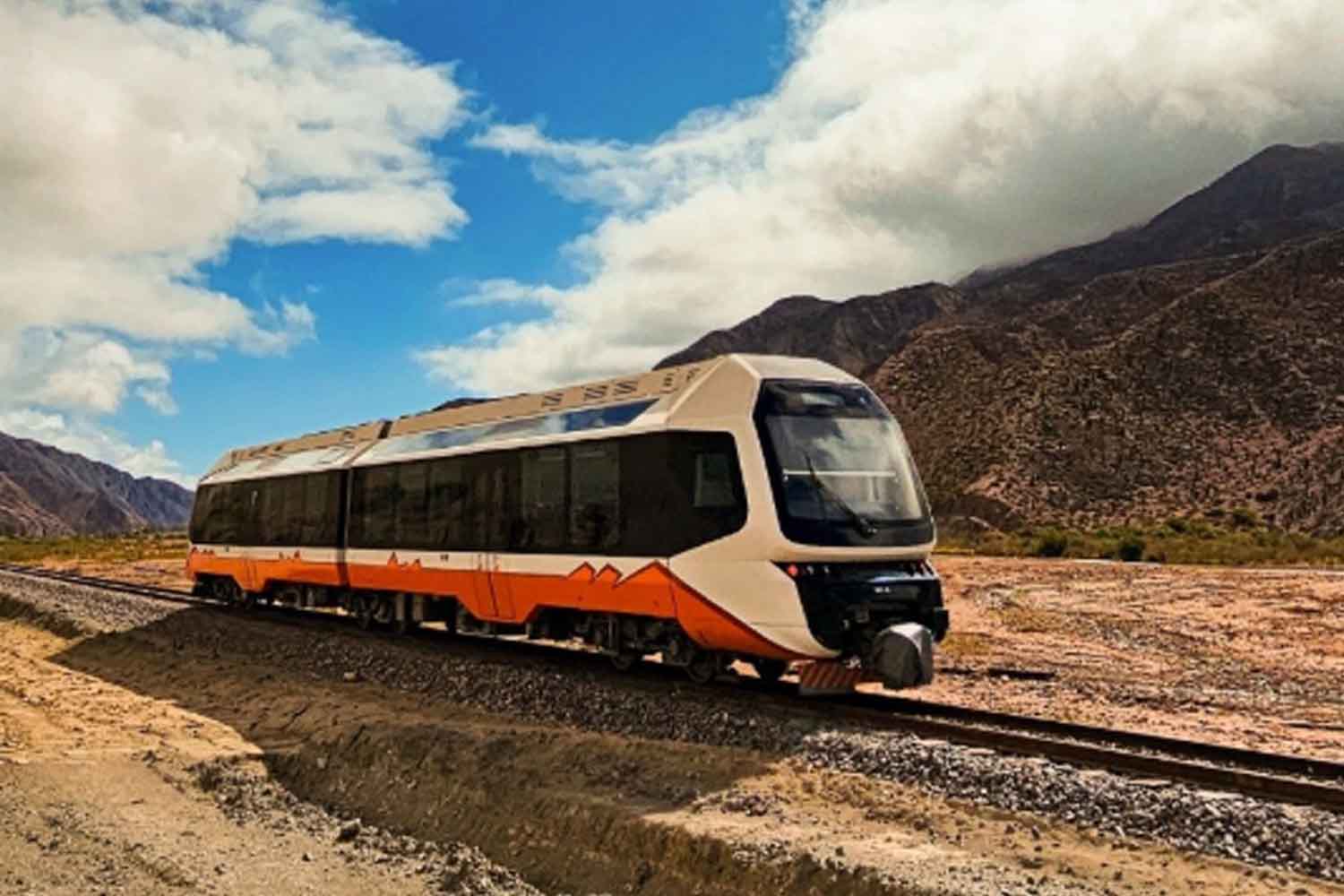
On June 18, 2024, after about thirty years, a train moved again in the Quebrada of Humahuaca, in north-west Argentina. Except that instead of the old convoy a pair of electric cars with large panoramic windows, lithium batteries and solar-powered charging arrived. It is the Tren Solar de la Quebrada, presented by the authorities of the province of Jujuy as the first tourist train in Latin America powered by batteries and solar energy through distributed generation.
Today it travels 42 kilometers between Volcán and Tilcara, crossing one of the most spectacular landscapes of the Argentine Andes. The Quebrada of Humahuaca has been included in the UNESCO World Heritage List since 2003: a valley that for about 10 thousand years was a corridor of exchanges, settlements and human movements between the Andean highlands and the South American plains. The train passes through us.
The “solar” ends up in the batteries
The name may suggest a train covered in photovoltaic panels. The system is a little different. According to the official manager, each convoy has six lithium batteries plus an auxiliary battery, with a declared range of between 100 and 120 kilometres. The units are charged at stations: Volcán and Purmamarca have fast charging points and Tilcara is listed among those set to be added to the system.
The manager declares that the energy used comes from solar; the Jujuy Government explicitly talks about solar power through distributed generation. During travel, therefore, the train is electric and does not produce exhaust emissions along the route. This does not, of course, mean that batteries, infrastructure and electricity are free of impacts throughout their entire life cycle. It means something more precise and already quite interesting: on that route you don’t need to drag a diesel engine with you.
View this post on Instagram
From Volcán to Tilcara, with six stops and a long time to get off
The route passes Volcán, Tumbaya, Purmamarca, Posta de Hornillos, Maimará and Tilcara. Hornillos was added in 2025 with a new access point near the historic post, while the entire route measures 42 kilometers.
The service today is above all a tourist experience, an important detail because the “solar train” could make one think of a new regional transport line for commuters. The Argentine National Commission for the Regulation of Transport, the CNRT, classifies it as an “exclusively recreational and tourism-oriented” railway service. In 2024, since its launch in mid-June, it has still carried 20,741 paying passengers. So no renderings, models or promises for 2047: it’s really on track.
Two formulas have been built to visit the area. The Experiencia 360° lasts approximately ten hours and includes passage from the six stops with guides on board and time to get off at the different centers. The groups leave Volcán at 9 or 10 am and during the day they can visit markets, historical places and Quebrada towns. Activities in individual locations remain the responsibility of the traveler.
The Experiencia 180° is much shorter: it leaves and returns to Purmamarca and allows you to choose between the route to Maimará and the one to Volcán. Departures currently indicated are at 9.55am and 11.55am, with a duration that can range from approximately one and a half to two and a half hours, including a short stop. It’s the version for those who want to try the train without spending the whole day on it.
How much does it cost to travel on the solar train in 2026
Here it is best to look at the updated rates, because those circulated in recent months have already changed. For the period indicated by the manager as low season, from 1 August to 31 December 2026, the Experiencia 180° costs 43 thousand Argentine pesos for Argentine citizens and 53 thousand pesos for foreigners. In high season the two rates rise to 56 thousand and 69 thousand pesos respectively.
For the Experiencia 360°, in the low season the ticket alone costs 80 thousand pesos for the national rate and 103 thousand pesos for foreigners. The package with round-trip transfer from Salta reaches 156 thousand pesos for a foreign passenger; from San Salvador de Jujuy to 138 thousand. Rates can be changed, so before building your trip around a number it’s best to double check the official page. There is also an unromantic but useful detail. In April 2026 the Government of Jujuy had to publish a notice on unauthorized sales sites: for online purchases the only portal indicated by the province is the one connected to trensolar.com.ar.
The Tren Solar is not revolutionizing Argentine transport alone: it is 42 kilometres, built mainly for tourism, in a country with many other railway problems to solve. But those two cars exist, they travel, they recharge and they have brought the tracks back into a valley where the train had been missing for decades. For once, solar mobility didn’t sit still in a PowerPoint presentation.
View this post on Instagram
