
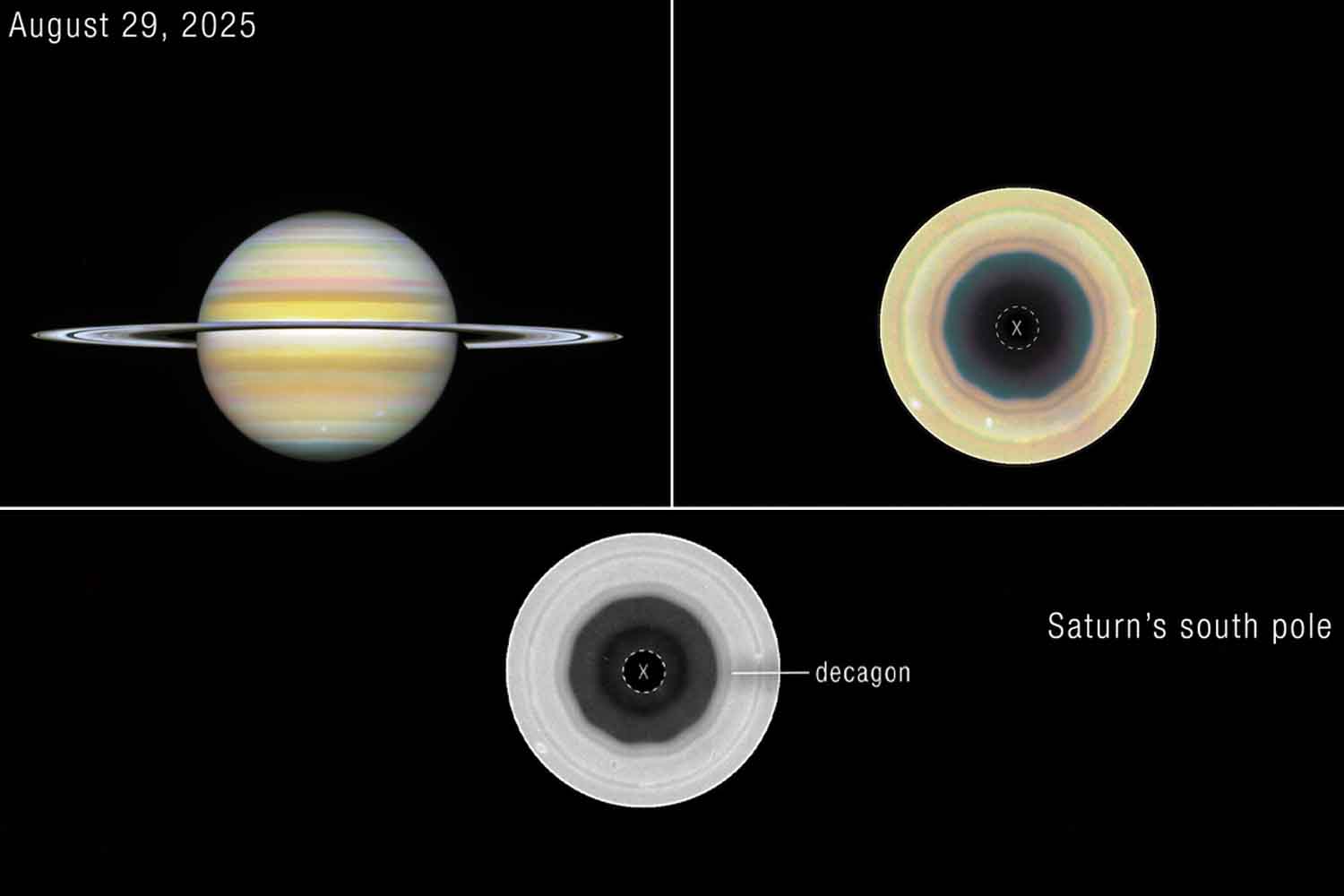
Saturn already had a giant hexagon planted above the north pole for more than forty years. Evidently six sides weren’t enough. On the other side of the planet, around the south pole, astronomers have now spotted a ten-sided atmospheric structure: a huge decagon, immersed in a jet stream and becoming increasingly recognizable in the images collected between 2023 and 2025 by the Hubble Space Telescope.
The figure is not an outline added to the photographs to help us see it. It is the clouds and mists of Saturn’s atmosphere that follow that wavy pattern, forming sides and vertices around the polar region. The study, led by Agustín Sánchez-Lavega of the University of the Basque Country, was published in Science Advances. And the comparison with the old hexagon promises to become quite interesting.
In 2023 it was barely visible, two years later it already had ten sides
The discovery required a small journey back through the images. In 2024, Sánchez-Lavega and amateur astronomers Trevor Barry and Jean-Paul Oger noticed a wavy band in Saturn’s southern region from Earth. In 2025 the geometry became much more evident. At that point the group looked back at Hubble’s previous observations and found the first traces of the decagon already in the 2023 data. In fact, NASA speaks of a structure that seems to have strengthened over time.
And it is an important detail, because the Cassini probe had observed Saturn between 2004 and 2017 without finding anything similar to the south pole. In subsequent years, then, the planet’s seasonal tilt had made that region increasingly difficult to see from Earth. The decagon could therefore have formed precisely during that window or may have become evident enough to reveal itself only in recent years. For now, astronomers can narrow the field, not assign it a birth date.
Even the shape still seems a little undecided. Some vertices are very marked, others weaker. According to the EHU group, the University of the Basque Country, it could be the sign of a phenomenon that is still evolving and, at least for now, less stable than the northern hexagon. Saturn is doing geometry, in short, but he hasn’t passed the ruler yet.
The winds run at 400 km/h, the decagon takes it much more calmly
The scale makes everything even stranger. The decagon lies within a jet stream that reaches approx 400 kilometers per hour. The figure as a whole, however, advances compared to the rotation of the planet by just a little 10 kilometers per hour. And its vertices oscillate back and forth with a period of approx 32 days. The northern hexagon, much more stable and almost stationary, does not show the same movement.
It is precisely this difference between the furious speed of the winds and the much slower speed of the drawing that indicates that we are observing a large atmospheric wavetrapped in the jet stream, and not simply ten groups of clouds dragged together.
Hubble also observed Saturn at different wavelengths, which allow it to probe different levels of the atmosphere. The decagon appears at multiple levels. Infrared observations from ESO’s Very Large Telescope in Chile also showed variations in wind speed with altitude. That geometry, therefore, has a more complex vertical structure than a simple edge visible on the upper clouds.
Why does Saturn keep making polygons?
Here begins the part still unanswered. Simulations carried out by the researchers show that a ten-sided wave can form on the jet stream in different ways. It may have arisen from a periodic disturbance in the flow or may have been fueled by a dark anticyclonic vortex a little further north. The model, for now, demonstrates that a similar structure can exist and survive. He doesn’t say what mechanism ignited the real one.
The inevitable comparison is with the famous northern hexagon, observed for the first time by the Voyager probes in 1980 and 1981 and still present after over forty years: more than an entire Saturn year, which lasts almost thirty Earth years. For decades it seemed like an oddity without counterpart. Now he has at least one cousin on the other side of the planet. Younger, more mobile and with four more sides.
And it remains an almost entirely Saturnian oddity. On Jupiter, polar cyclones can arrange themselves in five- or eight-element geometric configurations, but this is a different phenomenon. On Saturn, however, it is the large waves associated with the jet streams that take the shape of regular polygons. Astronomers want to understand why it happens there and whether hexagon and decagon really share the same mechanism.
In the coming years the south pole will become increasingly favorable for observations. Hubble will continue to follow it and NASA also indicates James Webb among the useful tools to understand how deep the structure is and how long it can last. Perhaps the decagon will remain there for decades like its northern neighbor. Or it will warp while we’re watching it.
For now it’s still there. Saturn had a hexagon that was impossible to ignore; now it also has a ten-sided one that we still can’t explain. I would say that as a geometry problem it is enough.
