
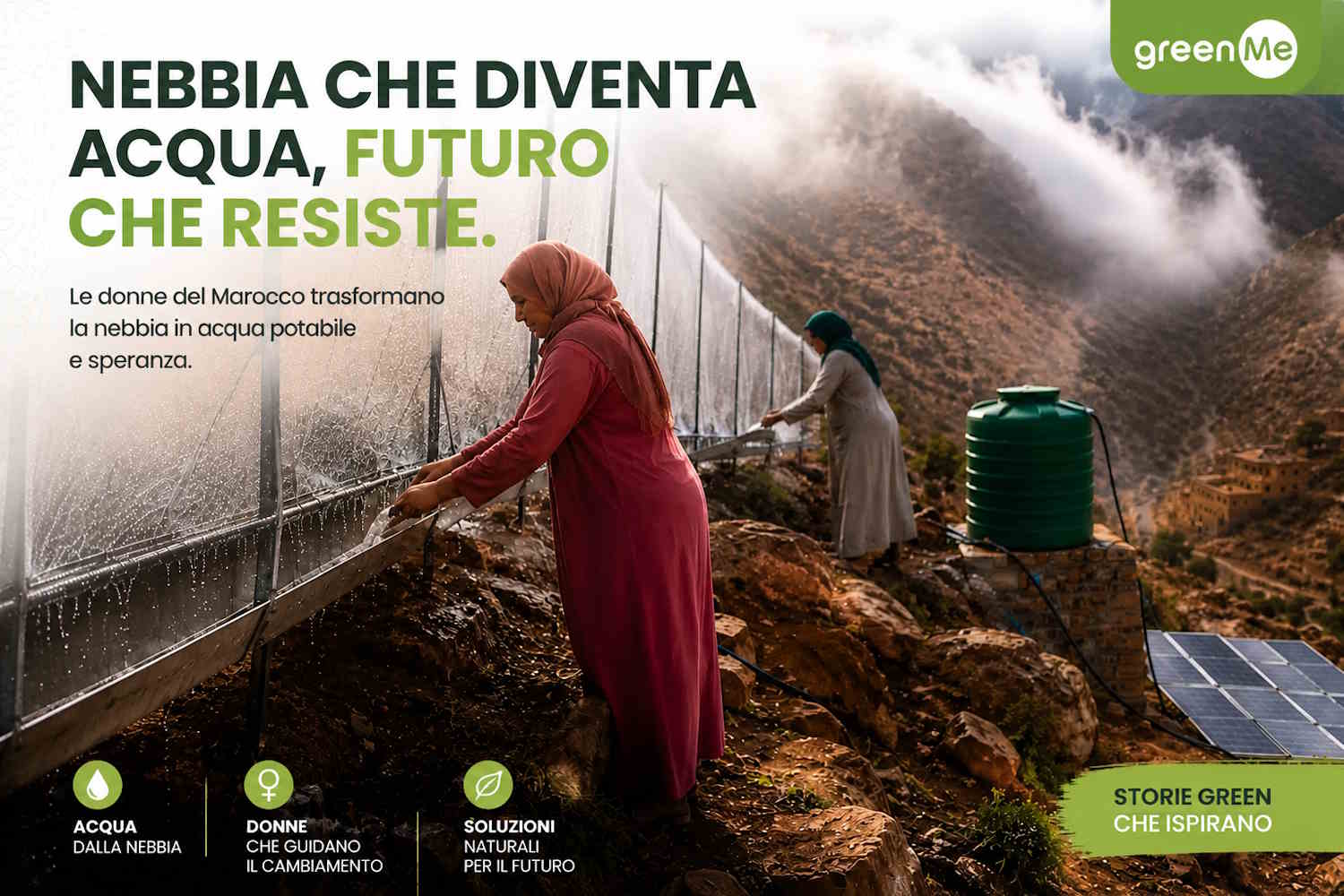
In southwestern Morocco, water comes from a place we usually associate with the opposite of thirst: a low cloud, a white mass that rises from the Atlantic, crosses the mountains and then disappears. Except that here, in the Aït Baâmrane region, on the edge of the Sahara and the Anti-Atlas, the fog has stopped being just a presence in the morning. It has become a reserve. An infrastructure. Almost like a pipe suspended in the air.
For years, traditional wells have been depleted, drought is tightening and villages have to deal with a shortage of water which in Europe often remains a word from a technical report. Here it has a precise weight: hours of walking, jerry cans to carry, broken days. For many women it meant spending up to four hours a day reaching distant sources and returning with heavy loads, often close to 25 kilos. For many girls it meant losing school, time, study, future. The lack of water organized domestic life better than any calendar.
Then on the slopes of Mount Boutmezguida, at over 1,200 meters above sea level, large nets appeared stretched against the wind. The Dar Si Hmad Foundation, active in southwestern Morocco, describes the system as the largest operational fog collection facility in the world: CloudFisher networks that intercept Atlantic fog and bring clean water to 16 villages in the Aït Baâmrane region through kilometers of pipes.
The networks on the mountain
©Aqualonis
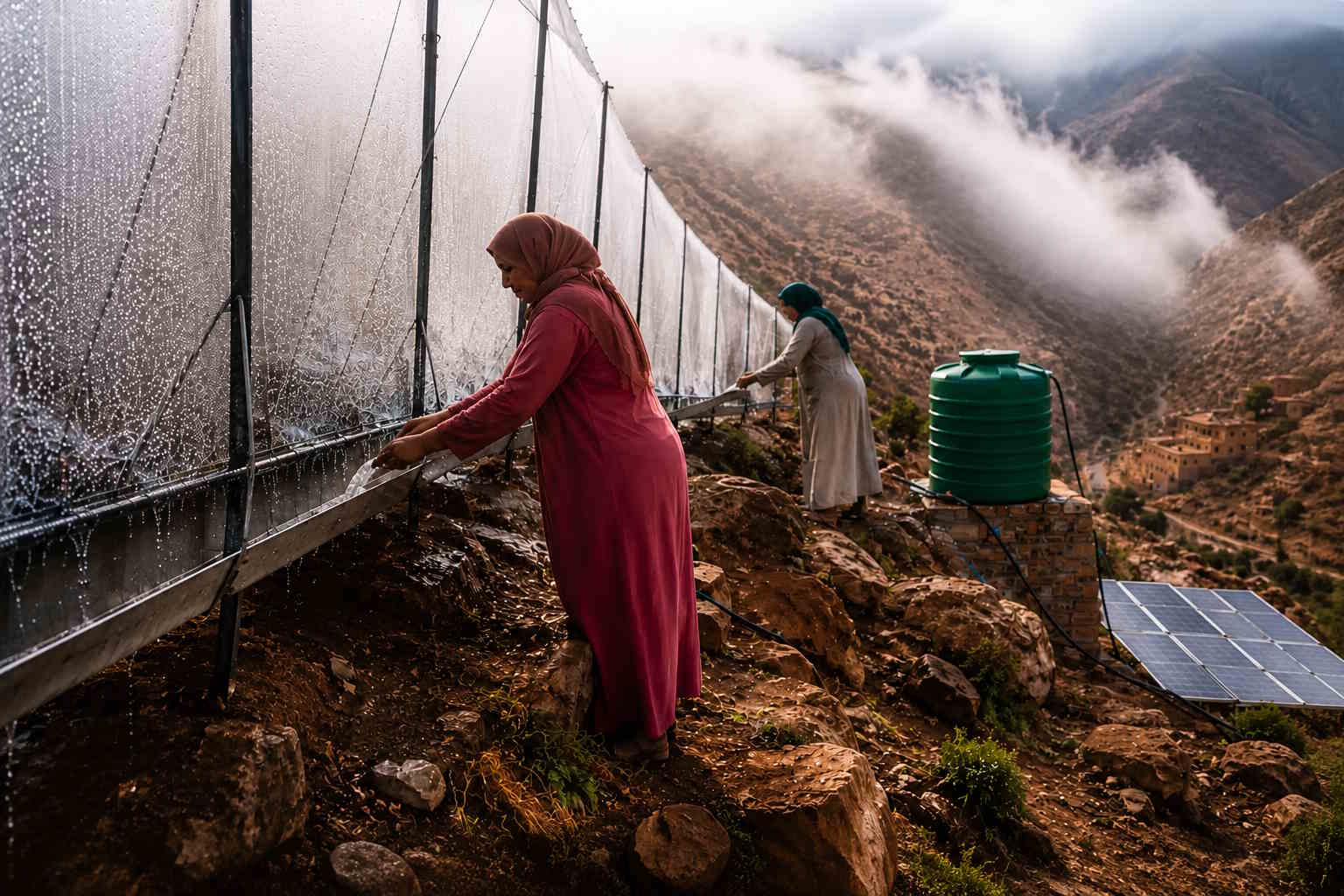
The principle seems almost too simple to actually work. The fog passes through a mesh, the microdroplets get trapped, stick together, become heavy enough to slide towards channels and tanks. From there the water flows by gravity towards the villages. No big dams, no complicated pumps, no climate science fiction imagery. You need wind, altitude, humidity and a mountain placed in the right place.
Mount Boutmezguida has precisely this combination: humid air arriving from the ocean, relief capable of intercepting it, nearby rural communities and a huge need for safe water. According to Dar Si Hmad, the project reaches over 1,000 beneficiaries in 16 villages in Sidi Ifni province; Aqualonis, a company linked to CloudFisher technology, indicates 31 collectors for the area and a total network surface area of approximately 1,674 square metres.
The scene has something ancient and modern at the same time. Ancient, because the idea of collecting humidity from the air has long accompanied communities living in arid areas. Modern, because the materials used today resist the wind better, capture more water and require less maintenance compared to the first tests done in different parts of the world, from Chile to Yemen, up to Eritrea. In the Atacama desert, Chile, among the driest places on the planet, experiments and observations on networks exposed to fog had already shown how concrete an apparently invisible resource could be. That intuition today, in Morocco, has taken the form of open taps inside houses that for generations had known above all buckets, wells and waiting.
The effort taken away from women
@AI Generated
The most obvious change concerns the weather. The water that reaches the house reduces women’s daily walking, relieves enormous physical fatigue and allows girls to attend school more continuously. The United Nations Framework Convention on Climate Change had already recognized the project among the “Women for Results” initiatives, underlining the role of the Moroccan NGO and the impact on rural communities, in particular on women and children.
The word “impact”, however, should be handled less coldly here. Because tap water changes the most normal gesture of the day: washing, cooking, drinking, watering a small vegetable garden, keeping animals. The way a family organizes hours also changes. A little girl who stays at school instead of going to the well receives a concrete opportunity, small only in appearance. A woman who stops carrying water for half a day gains time, health, mental space.
Yet every transformation, even when it improves life, shifts balances. In some communities, drinking “fog water” required trust. For many inhabitants, that water had something strange about it: it came from the sky, passed through the networks, went down into the tanks, entered the houses without having crossed the earth. There were those who perceived it as poor in minerals, almost devoid of that familiarity that makes a traditional source acceptable. Technology had solved the water problem before solving the cultural one.
Dar Si Hmad also had to work on this: literacy, technical training, community management, education on the use of water. The project, in fact, concerns pipes as much as people. Some women, freed from the task of carrying water, had to redefine a role that for years had been both tiring and central. Fatigue can become identity when a community always distributes it on the same bodies. Removing it means opening up space, of course. It also means crossing a new threshold, with all the embarrassment that thresholds bring with them.
Where it really works
Fog collection is a brilliant solution, but very demanding. It works where there are precise conditions: mountains or fairly exposed reliefs, oceanic or coastal humidity, regular winds, communities reachable with a distribution network, local maintenance. In a dry plain, far from humid currents, a net remains a net. In the wrong spot it captures little or nothing.
This is why the Moroccan case must be read carefully. It tells a possibility, not a universal recipe. In some arid areas of the world it can integrate traditional sources, reduce pressure on aquifers, support isolated villages and make access to drinking water more stable. In other areas it is of little use. Its strength lies precisely in its precision: it exploits a local condition, almost a geographical detail, and transforms it into a public service.
In 2016 the project was also indicated as an international example of climate adaptation and water harvesting in areas marked by water stress. Today it is back in circulation because it resembles a concrete response within an often enormous discourse, full of words such as desertification, water crisis, resilience. All correct words. But then, in a village, they count a little girl going to school, a woman returning without a jerry can on her head, a tap opening.
The water from the fog does not erase the drought and does not alone stop the advance of the desert. But it shows something that we should learn to look at better: sometimes climate adaptation does not have the monumental form of great works. It has a net strung on the side of a mountain, a pipe leading down, a hand turning a knob. Air becomes water. The rest, for once, stops weighing on someone’s head.
You might also be interested in:
