
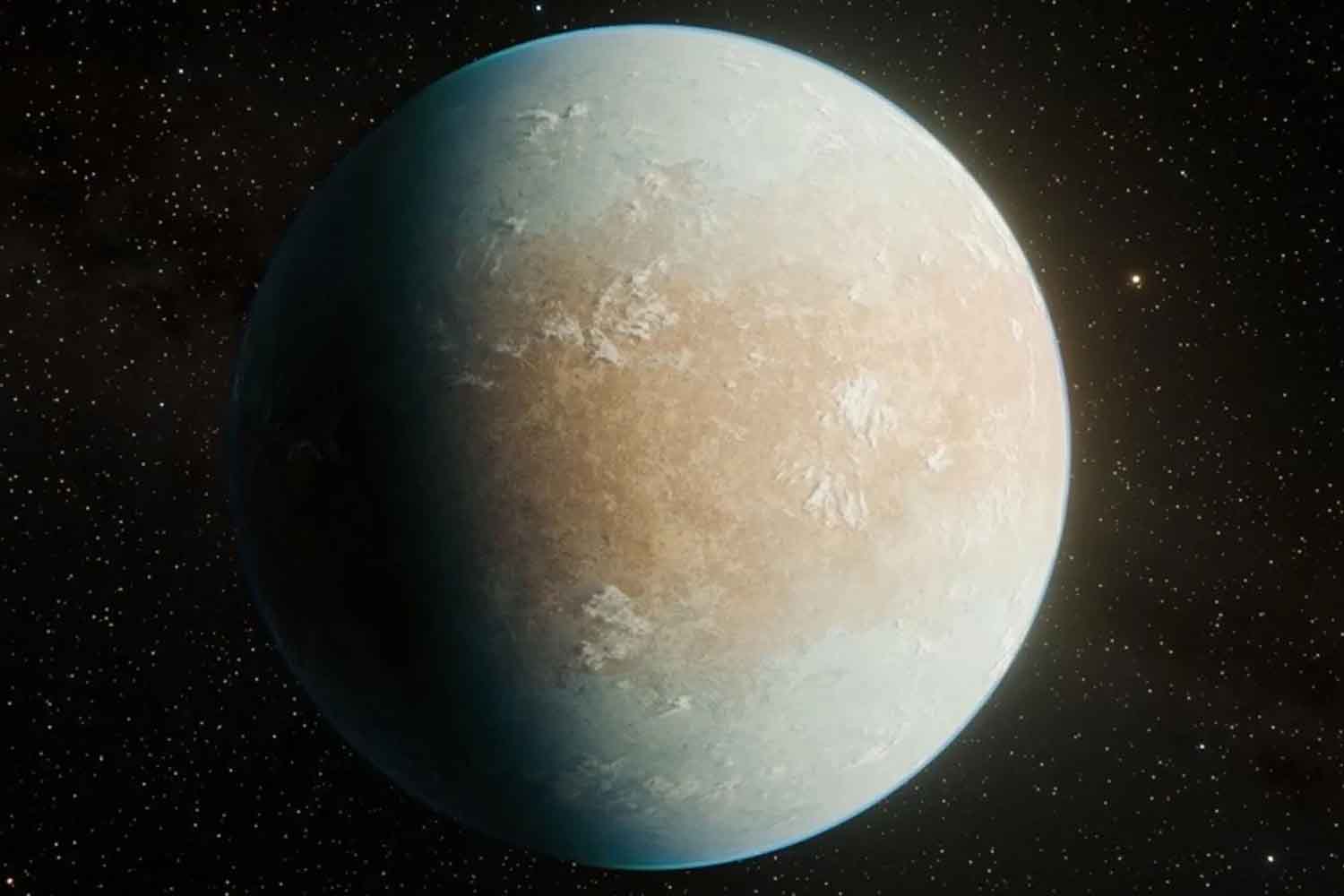
Ha the size of the Earthan orbit strikingly similar to ours and located at a cosmic distance that, for astronomers, is almost around the corner. Yet, this planet could be a frozen version of our world. A twin yes, but immersed in the cold. The new, fascinating discovery comes from the archives of a mission that has already officially retired.
This candidate planet is brought back into the spotlight by the data from Kepler Space Telescopethe space telescope of NASA which revolutionized the search for exoplanets. And which, apparently, still has a lot to tell us.
The planet is called HD 137010 b and would orbit around one K-type dwarf starsmaller, cooler and dimmer than our Sun. The system is located at approximately 146 light years from Eartha huge distance for us, but relatively small on a galactic scale.
Astronomers spotted it by reanalyzing data from the K2 mission, Kepler’s operational extension. In 2017, the instruments recorded a very slight drop in brightness of the star, lasted approx ten hours. A tiny signal, equal to approximately 225 parts per millioncompatible with the passage of a planet in front of the star.
From this almost imperceptible variation, the researchers estimated that HD 137010 b has a radius of approx 1.06 times that of Earth. In practice, a rocky planet almost the twin of ours. The time it takes to complete one orbit is also surprising: approximately 355 dayspractically a year.
Why it is called a “Frozen Land”
If its size and orbit are reminiscent of Earth, the energy received from the planet tells a completely different story. Its star is fainter than the Sun and, consequently, HD 137010 b would receive only 29% of the light that lights up our planet.
Based on these data, and assuming the absence of a strong greenhouse effect, scientists have calculated a equilibrium temperature around −68 °C. Extreme cold, enough to push NASA to talk about a real one “Frozen Land”.
Be careful though: this temperature . It is a theoretical value, useful for comparing different worlds, but it does not take into account fundamental factors such as the presence of an atmosphere, its density or its ability to retain heat. In other words, it is not a final ruling.
And it is precisely here that the discovery becomes interesting also from the point of view of habitability. A planet on the outer edges of the so-called habitable zone could, at least in theory, keep liquid water if equipped with a sufficiently thick atmosphere.
A promising clue, but definitive confirmation is still needed
At the moment, or what kind. It is likely to be a cold and inhospitable world, but its combination of characteristics — Earth-sized, long orbit and relatively bright star — makes it extremely valuable for scientific research.
However, there remains a fundamental issue to be resolved: Is the observed signal really caused by a planet? So-called “single transits” can be misleading. Background binary systems, instrumental effects, or data anomalies can mimic the passage of a planet.
The research team ran numerous checks to rule out the most common false positives, and for now, the planetary hypothesis remains strong. But the real test will only come with the observation of a second transit.
The problem is that, with an orbital period close to a year, occasions are rare and difficult to predict accurately. Planning new observations becomes a challenge, also because space and ground-based telescopes have limited time.
For now, HD 137010 b one candidate remains, a fascinating lead that emerged from data collected years ago. But this story is a powerful reminder: a scientific mission does not stop producing results when it is shut down. Sometimes, the most interesting discoveries are already there, archived, waiting for someone to come back and look more carefully.
And maybe, next time, it will be the sky that will grant us a second passage.
