
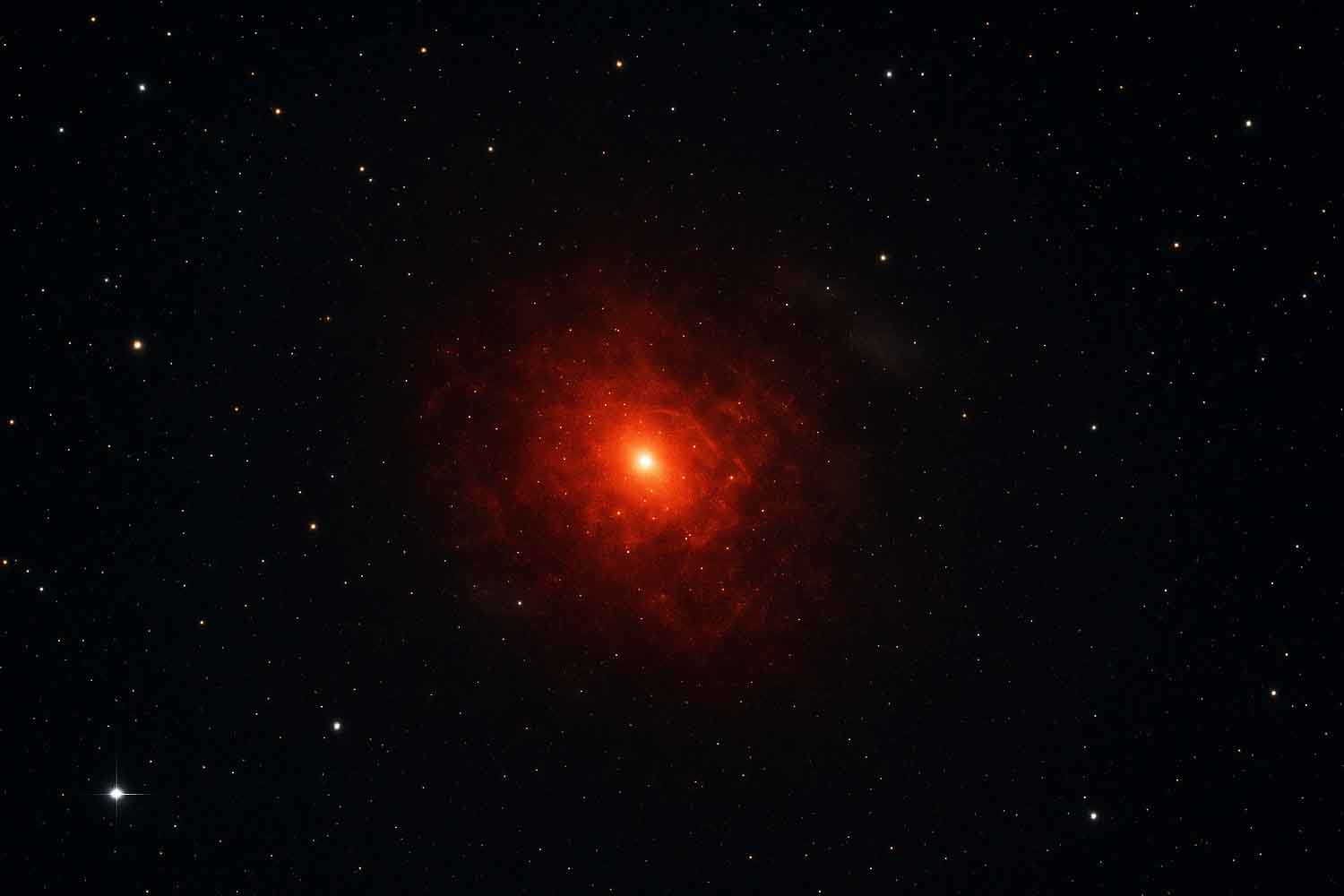
In the heart of the primordial universe, one tiny red galaxy He is revealing a secret that nobody expected. Astronomes have discovered The oldest and most distant black hole ever observed: it is located in the galaxy CAPERS-LRD-Z9whose light traveled for over 13.3 billion years before reaching us. When it formed, the universe had just 3% of its current age.
Despite its small size, the galaxy hosts A supermassive black hole with an estimated mass of up to 300 million times that of the sun. An impressive quantity, especially if we consider that the entire guest galaxy contains little more than this stars mass. The presence of such a massive object in such an ancient era of the universe question all current theories on the formation and evolution of black holes.
The discovery came thanks to the data of the James Webb Space Telescopewhich made it possible to observe galaxies so distant and weak that they have been invisible until a few years ago.
Harmless to cosmic monster
CAPERS-LRD-Z9 was initially one of the many “Little Red Dots“, Small red dots that appear in the data of the Webb telescope. These objects, detected en masse in recent years, had aroused curiosity for their compact shape and the unusual color, but nobody expected to find something so extreme.
To a more in -depth analysis, the astronomers have identified an unmistakable energy signature: that produced by a active galactic coreor a black hole that is devouring matter at very high speeds. During this process, the gas that surrounds it heats up and releases an intense light, so powerful as to be visible even by cosmological distances.
In the case of Capers-Lrd-Z9, the black hole seems to represent almost half of the mass of the entire galaxy. A figure that surprises, especially if compared with our Milky Way, where the central black hole has “only” 4 million solar masses.
The hypotheses on its origin
The presence of such a large black hole in such an early era, which foresee slow growth, starting from the remains of the first stars.
To try to explain this anomaly, scientists are considering two main scenarios. The first is that The black hole was already born very massivefollowing the direct collapse of a huge gas cloud, forming an initial “seed” of about 100,000 solar masses. The second is that it started from a smaller mass – perhaps a hundred times that of the sun – but then has accumulated subjects at the rhythms never observed beforeperhaps even exceeding the limits envisaged by classical physics.
Some researchers are also taking into consideration an even more extreme theory: that of primordial black holesborn directly from the chaos of the universe immediately after the Big Bang. But this remains a hypothesis still to be verified.
The red color as an indication
Another key element of the discovery concerns The intense red color of the galaxy. The spectroscopic analysis showed that Capers-Lrd-Z9 is surrounded by a very dense gas cloudwhich not only makes it difficult to observe, but also alters its light. This shift to red, said redshiftis one of the signs that astronomers are looking for to identify very ancient galaxies.
Just this effect had initially classified Capers-Lrd-Z9 as a simple “red dot”, similar to many others. But thanks to the detail offered by the Webb telescope, it was possible to verify that there is A black hole activepowerful and fully functional.
CAPERS-LRD-Z9 could represent a link between the very first galaxies and the modern oneslike ours. It is thought that these small objects have had A short but intense lifelighting up quickly in the first million years after the Big Bang, and then turned off or merged with other systems.
Until today, the presence of A supermassive black hole within such an ancient and compact object. This finally allows you to connect the “red dots” to the birth of the first cosmic structures, throwing new light on how the larger galaxies have formed.
This discovery is not only an extraordinary technological goal, but also an invitation to review the theories on the evolution of the universe. The first “cosmic monsters” are finally revealing, and are larger and more mysterious than it imagined.
