
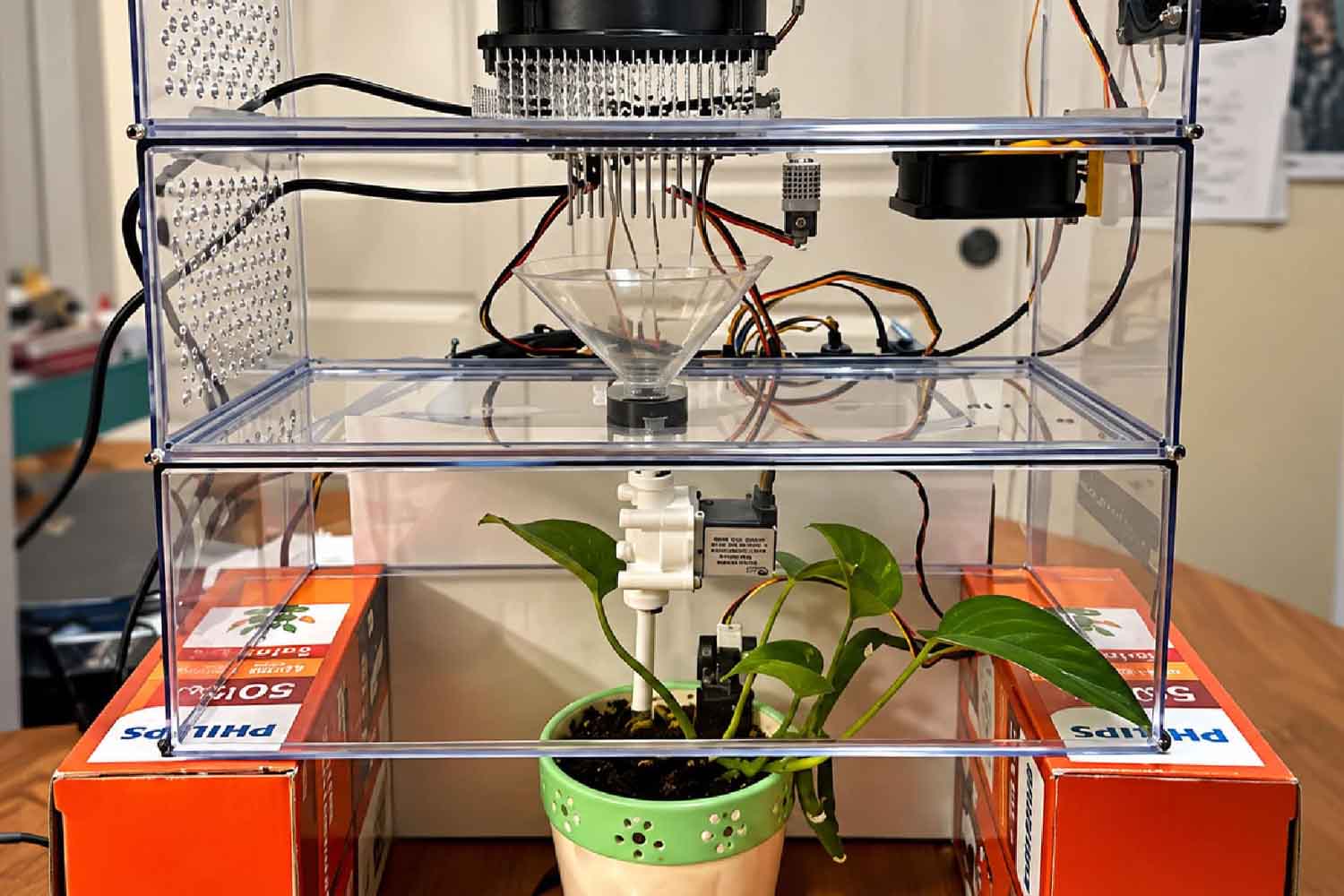
Ten milliliters of water in two hours. This is what the prototype has produced so far Roy Kim, 13 years olda student at Whitford Middle School in Beaverton, Oregon. Very little to irrigate a field, enough to demonstrate the principle: take the humidity present in the air, condense it and make the water reach a plant only when the soil begins to dry.
The project, called Sustainable Water Generating Chamber for Farmsbrought Kim among the ten finalists of the 3M Young Scientist Challenge 2026. The final begins today, October 12, at the 3M Innovation Center in Saint Paul, Minnesota. At stake are 25 thousand dollars and the title of “America’s Top Young Scientist”.
The water comes from the humidity of the air
The idea of harvesting water from the atmosphere has been around for a while. The peculiarity of Kim’s prototype lies in having put together, within a small system intended for irrigation, condensation and automatic control of soil humidity.
The central component is a Peltier module, a thermoelectric device that creates a temperature difference when current flows through it: one surface heats up, the other cools down. The air is pushed by a fan towards the cold part and, when its temperature drops enough, the water vapor condenses to form droplets.
The water ends up in a funnel and from there it can reach the plant through a valve. A probe inserted into the ground instead measures the humidity and decides when to open the passage. Other sensors monitor air temperature and humidity and allow the system to modify the flow.
In short, the appliance first obtains the water and then also tries to avoid wasting it. At thirteen you can obviously have a relationship with the watering can that is a little more sophisticated than ours.
Ten milliliters is still ten milliliters
Here, however, you need to keep your feet firmly planted on the ground, possibly with the probe next to you. In the tests reported on the prototype were collected about 10 milliliters of water in two hours. For a school experiment, the result demonstrates that the system works; for an agricultural application we are on another scale.
The atmospheric water collection sector itself is still dealing with one problem above all: the energy needed to cool the air and condense its moisture. A scientific review published in 2026 in Energy Nexus, dedicated precisely to systems that use thermoelectric cooling, describes these technologies as compact and easily controllable, but still reports high energy consumption, limited yields and difficulties in transitioning to large-scale production.
The performance also changes greatly with temperature and humidity: one cubic meter of tropical air and one of very dry air offer very different quantities of water to the machine. This is why transforming a small experimental generator into a system capable of supporting real crops requires much more than a larger Peltier.
Selection in the 3M Young Scientist Challenge therefore rewards a STEM project and its developmentand does not equate to an agronomic or commercial validation of the technology.
Why work specifically on agricultural water
The choice of the problem, however, is anything but scholastic. In the United States, irrigation absorbs an enormous part of water resources: according to the Economic Research Service of the US Department of Agriculture, between 2010 and 2020 it accounted for approximately 47% of total freshwater withdrawals of the country.
Kim explained on the competition’s official website that he wanted to become an engineer specializing in the environmental sector and that he participated in the competition to bring attention to both the problem and the possible solution. Over the summer he worked on the project with Rodrigo Marmol, 3M’s Global Portfolio Manager and his mentor for the competition.
In fact, the program envisages that the ten finalists will further develop their ideas during the summer with a researcher or technician from the company. According to 3M, on October 12 and 13 they will then have to undergo live tests and present the project in front of a jury.
For Kim’s generator it means one thing above all: moving from the first few milliliters to a progressively more efficient device. In Saint Paul the prototype will have to do the job of prototypes, that is, to support measures, questions and limits. The water in the air is already there. The tricky business is gathering enough of it without expending more energy than makes sense.
