
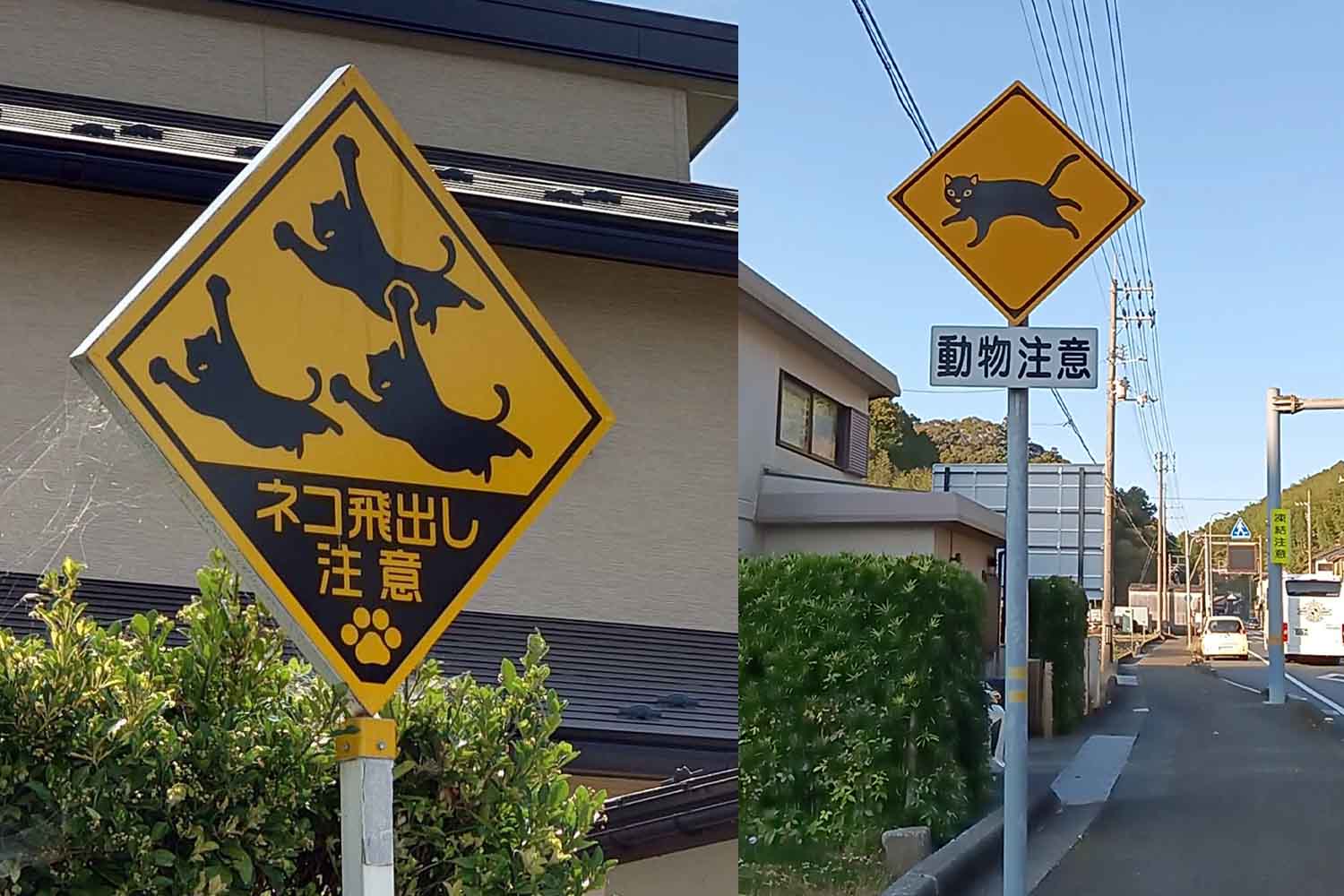
On any street in Japan, among low houses, tidy hedges, electric cables above the asphalt and that calm of a residential neighborhood that always seems on the verge of being interrupted by something, a yellow sign can appear with three black silhouettes of jumping cats. The writing is simple: ネコ飛出し注意, that is, “be careful of cats that pop out”. A short, practical, almost domestic phrase. The kind of warning that seems to make you smile for a second, then forces you to look at the road with a different attention.
The news has a real basis, with an important clarification: these road signs for cats exist, even if they often belong to local contexts or specific installations, rather than to a uniform national signage placed everywhere. Japan has a category of warning signs dedicated to animals that can suddenly appear on the road. The most common model recalls deer, however the indications of the Japanese Ministry also allow other animals to be represented when the risk concerns different species, using a silhouette consistent with the animal present in the area.
The cat enters the signage
The beautiful thing is in the precision. The sign photographed online warns of a risk that is only apparently tiny: a cat can emerge from a bush, from a gate, from the edge of a house, cross diagonally, stop halfway, and leave again at the worst moment. Anyone who lives with a cat knows well that logic of its own, made up of sudden trajectories and decisions made in a thousandth of a second, often without any respect for the Highway Code.
In Japan, animal signs vary greatly depending on the territory. In Hokkaido, for example, the regional office of the Ministry of Land and Transport cites particular signs dedicated to cows and foxes, animals more related to that landscape and that type of road. In other areas, the offices that manage the roads remind motorists to pay attention to sections with “animal” signs, especially when tanuki, cats or deer often cross paths in their areas. In a document from the district of Ishinomaki, in the north-east of the country, it is indicated that tanuki and cats are among the most common animals in local accidents, with the invitation to respect the limits and drive with caution in the marked points.
The specific signs with the domestic cat seem rarer, almost from an urban collection. A Japanese site specializing in road signs has documented some publicly installed examples, including a “cat” sign on Highway 33 in Kochi Prefecture, attributed to the Ministry of Land and Transportation and installed in 2005. This makes the story more interesting, because it removes it from the simple category of “cute Japanese sign”: in some cases the cat actually enters the formal language of the road.
In Iriomote the cat is a serious matter
Then there is an even more delicate case: the island of Iriomote, in the Okinawa archipelago, where the Iriomote-yamaneko lives, a rare wild cat present only there. In that context, cat warnings have a completely different weight. The Japanese Ministry of the Environment has repeatedly invited those driving on the island to slow down and pay attention to sudden crossings of the yamaneko, especially in the sections where sightings are more frequent and where caution signs have been installed.
The Iriomote Wildlife Conservation Center explains that underpasses have been created on the island for the animals, sound strips on the asphalt, signs at the points where specimens are most often spotted and also mobile signs placed based on recent sightings. In December 2025, the same center reported an increase in sightings of young yamaneko along the roads and invited motorists to reduce speed in the sections indicated by the monthly caution maps.
Here the sign loses any funny nuance. It becomes a small and concrete tool for coexistence between human traffic and wildlife. A car that is too fast, on an island where a fragile species crosses the same asphalt as residents and tourists, can be enough to turn an ignored warning into a real loss.
You might also be interested in:
