
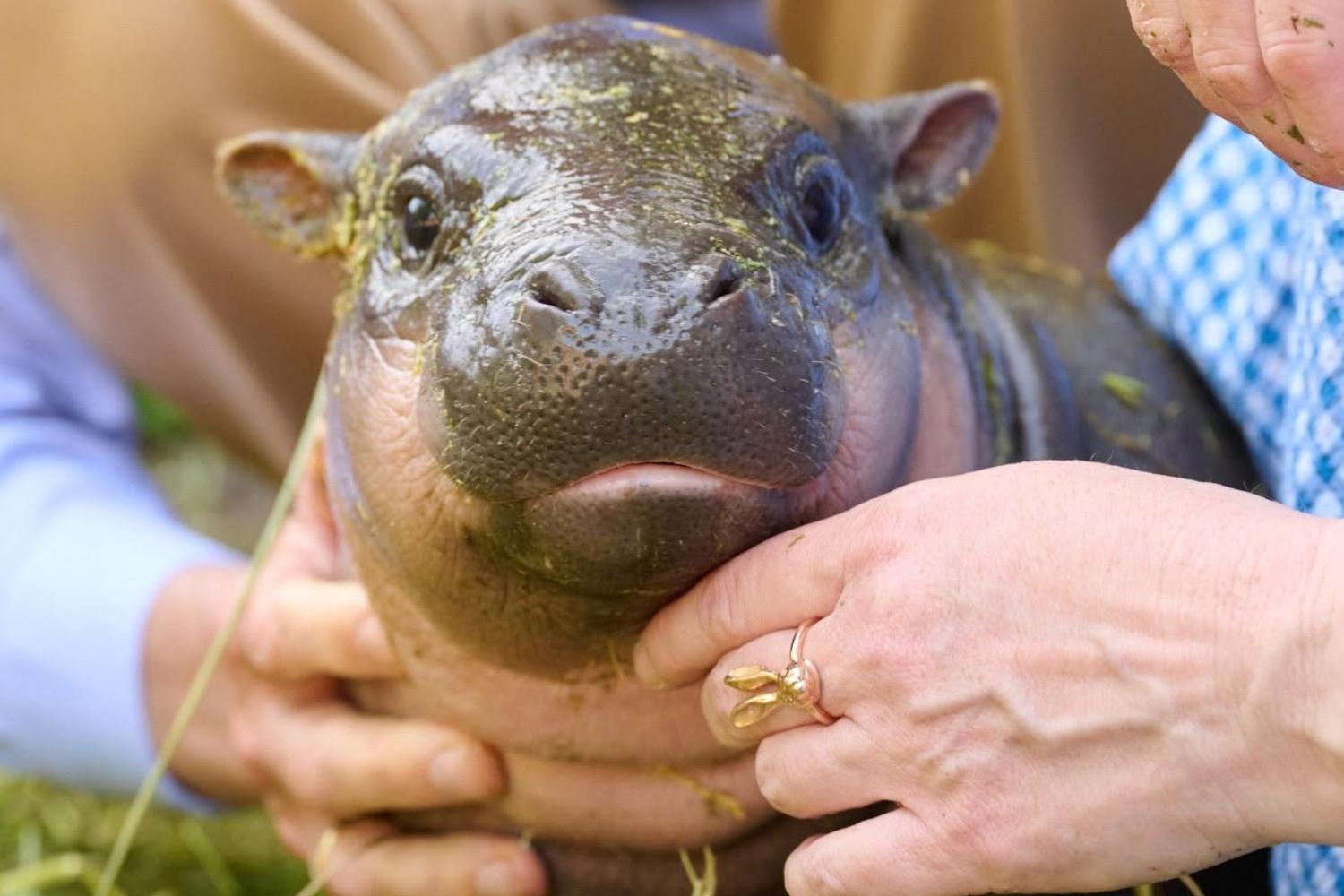
Big curious eyes, still uncertain steps and a round shape that resembles a freshly baked sandwich. The new star of the Berlin Zoo is called Brötchen, a female pygmy hippopotamus cub born on May 9, 2026 from the relationship with her mother Debbi. With her weight of 20 kilograms, the little girl has already made her triumphant debut in the external enclosure, moving ahead of her sister Toni, who has now moved to a facility in France.
The scientific management, led by Andreas Knieriem, rides the media wave by reminding us that the use of naming specimens with names inspired by food is a marketing ploy that has always worked. Already until 2005 the German capital adored the hippopotamus Bulette – the typical local meatball – while today the web idolizes global icons such as the Pesto penguin or the small hippos Haggis in Scotland and Moo Deng in Thailand, the latter linked to a pork-based dish.
During his first aquatic tests, Brötchen shows the typical gait of the species: these animals do not swim in the classic sense, but move along the bottom, pushing themselves with their legs to slide through the water. The image of the puppy was definitively launched by the well-known television presenter Enie van de Meiklokjes, a famous German pastry expert who took on the honorary sponsorship of Brötchen.
View this post on Instagram
A highly threatened species
Behind photographers’ flashes and ticket sales, however, the species faces a dramatic biological crisis: according to the International Union for Conservation of Nature (IUCN), fewer than 2,500 adult pygmy hippos survive in the wild. These shy inhabitants of the forests and swamps of Côte d’Ivoire, Guinea, Liberia and Sierra Leone are already all but extinct in Nigeria due to wild deforestation, intensive agriculture and mining.
View this post on Instagram
Behind the facade of social media: the invisible condemnation of captivity
If the official narrative pushes visitors to soften before Brötchen’s first clumsy attempts at floating, the structural reality of these institutions reveals a profoundly different scenario. These rare African mammals, known for their predominantly solitary nature, are deprived of their freedom and forced to spend an entire life inside artificial enclosures, thousands of kilometers from their native environment.
The natural dynamics of exploration, hunting and socialization are compressed between concrete, glass and the constant noise of tourists hunting for a selfie. Celebrating a birth inside a cage, disguising it as a victory, risks normalizing the idea that the survival of a species can ignore the dignity of individuals. For this reason, behind yet another viral phenomenon on the web, there is little to rejoice about if the horizon of this creature is forever limited by artificial borders.
View this post on Instagram
You might also be interested in:
