
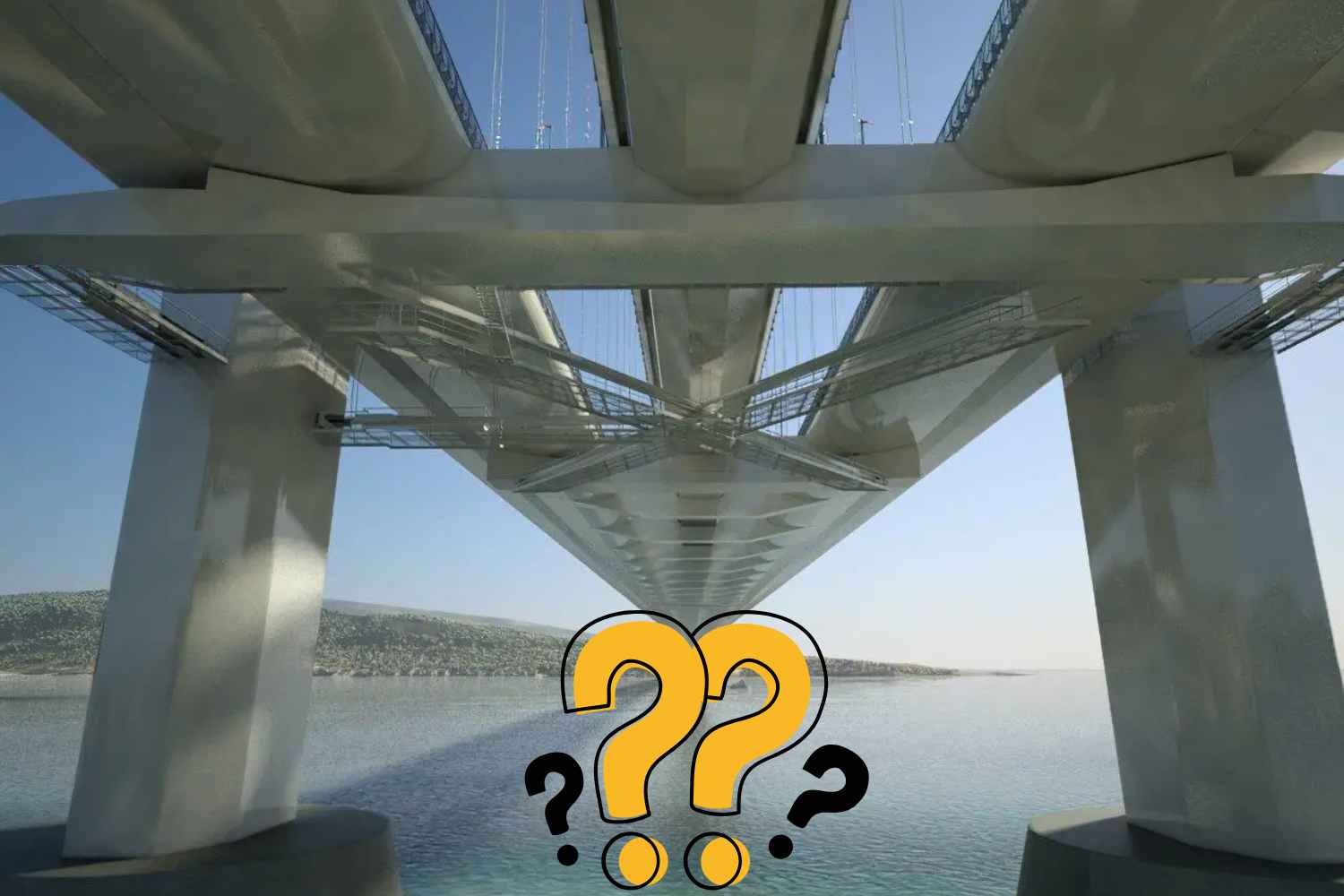
The definitive green light at the bridge over the Strait of Messina has arrived. After decades of announcements and postponements, the project was approved by the Interministerial Committee for economic programming and sustainable development (Cipess) on August 6, 2025. The start of the works is expected between September and October, with the aim of making the bridge that can be traveled by 2033. In numbers, a world record will be a single suspended span of 3,300 meters, towers of 399 meters, six road lanes railway. The cost? 13.5 billion euros, funded largely with public funds.
What is hidden behind technical ambition? Much more than an engineering work, the bridge over the strait is a concentrate of challenges and contradictions, as scientific committees, environmental associations and local realities have highlighted. An infrastructure designed to unite, but which continues to divide.
The numbers of the infrastructure
The bridge will connect the two banks of the Strait in a few minutes: 15 minutes for the trains and 10 minutes for the cars. The project includes about 40 km of road and railway fittings, with 80% in the gallery, connecting the work to the Mediterranean motorway and the main Calabrian and Sicilian railway stations. According to the Ministry of Infrastructure, the bridge will be operational all year round, H24, with an esteemed impact on GDP of over 23 billion.
However, it’s not just a matter of performance. The bridge is designed to cross one of the most complex areas of the country from a geological and environmental point of view, and the critical issues reported are not marginal.
Seismicity, wind and materials: the nodes still open
The Scientific Committee appointed by the Ministry of Infrastructure has reported four technical macro-critics, asking for further checks in the executive phase:
Only once you clarified these aspects can you really talk about a work ready to face the challenges of its context.
Environmental impacts according to associations
Greenpeace, WWF, Legambiente and Lipu, together with other local acronyms and committees, have presented very critical observations to the via the Ministry of the Environment Commission. According to these realities, the environmental impacts will be significant and partly irreversible: from the loss of biodiversity to the compromise of coastal habitats and Marini, passing through the risks of fragmentation of the ecosystems and the documentary deficiencies detected in the dossiers.
In addition, the environmental incidence assessment was issued with derogations justified by alleged “imperative reasons for significant public interest” – a point that has generated appeals at national and European level.
A bridge that costs (a lot) more than it seems
The project is currently estimated at 13.5 billion, but real costs could rise. Already in 2023 there was talk of an estimate of 14.6 billion, according to some financial sources. Ten years ago, the cost was 8.5 billion. Meanwhile, the entrusting of the project to the Eurolink Consortium took place without a new race, reactivating a 2005 contract. In the event of a stop at work, a penalty of 1.5 billion is expected to be paid to the consortium.
The Legambiente also denounced the use of funds of the Cohesion and Development Fund, originally destined to reduce territorial inequalities in Southern Italy, now diverted to the work.
The alternatives: ecological ferries and intelligent mobility
According to some experts and committees such as “instead of the bridge”, investing in an efficient network of ecological ferries, modern hydrofoils and renewed port infrastructures would cost a third compared to the bridge and would better respond to the real local mobility needs. The alternatives have so far been little considered in the public debate, but remain on the table, especially for those who question the sustainability of the long -term project.
Too high ships? Gioia Tauro at risk
Another knot concerns the height of the bridge (70-72 meters) which, according to some experts such as Luigi Merlo of Federologistica and Domenico Gattuso of the “Quaranta Committee”, would not be enough to guarantee the transition of 17% of the gates and current cruise ships. This could have heavy impacts on the port of Gioia Tauro, with a possible loss of competitiveness that the bridge itself risks aggravating.
A work that divides
If the government defines it “strategic for the whole nation”, for many committees, scholars and associations remains a high -risk work, at very high cost and with still uncertain benefits. The battle, in Sicily and Calabria, is far from closed.
Also because, net of political declarations, the most difficult part has yet to begin: the one in which the bridge will have to demonstrate that he can be built, without giving in to the wind, time and doubts.
Don’t you want to lose our news?
