
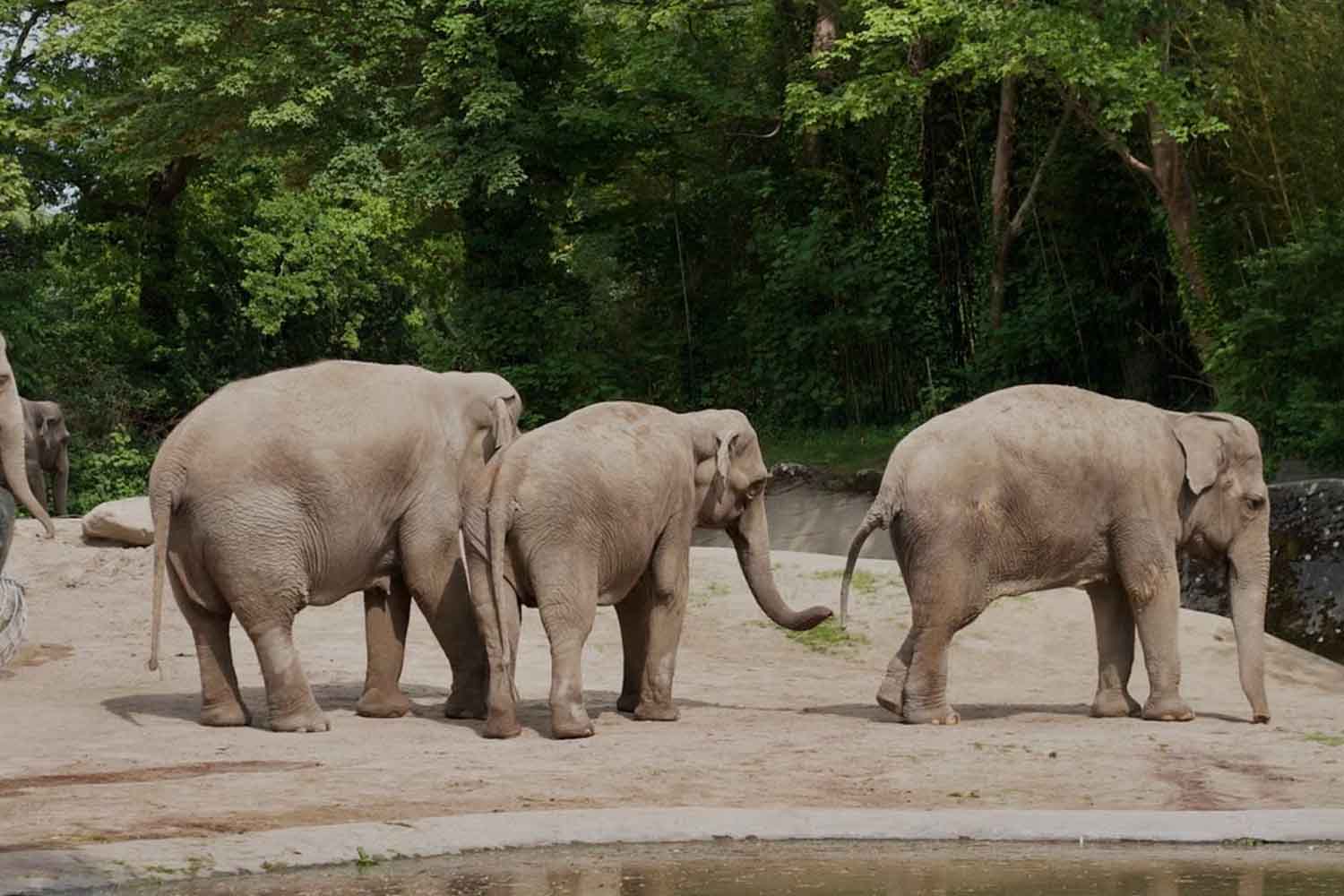
Chikwenya spent approximately 27 years in captivity. Today she is the matriarch of a small herd that moves in a South African reserve, has given birth to a cub and takes care of the younger elephants. No trainer tells her where to go or when to stop. His story is one of eleven analyzed in a study published in PLOS One. The researchers followed African elephants from circuses, tourist facilities and other controlled environments, then reintroduced them into three fenced reserves in South Africa. After years of being commanded by humans, they behaved in many ways like the wild animals used for comparison.
“Free”, in this case, requires a clarification. Elephants move autonomously, forage for food, build relationships and make decisions within designated protected areas. Reserves have fences, tourist flows and management programs. The gate open towards a boundless savannah belongs to documentaries; the research observed something less cinematic and much more measurable.
From the circus to the South African reserves
The eleven elephants had very different stories. Some were born in captivity, others were captured as babies. Bully had worked in a circus; others transported tourists or were employed in commercial establishments. The time spent under human control ranged from a few years to nearly three decades.
Some had been removed from the facilities because they refused to cooperate, came into conflict with other elephants or showed aggression towards trainers. In other cases, the transfer was made for ethical reasons. Before the reintroduction they had followed different paths, built by the individual reserves and not decided by the authors of the study.
Between March 2019 and July 2024, the research team observed them during sessions lasting approximately three weeks, repeated five to eight times in each area. 275 ten-minute videos were analysed, approximately 46 hours in total: 216 recordings concerned the reintroduced elephants and 59 the wild reference population.
In the videos, the scholars counted behaviors related to vigilance, attention to the environment, conflict and gestures directed towards one’s body, such as touching oneself with the trunk. Useful signals to understand how an animal perceives and deals with what happens around it.
They behaved almost like wild elephants
In vigilance, conflict behaviors, and body-facing gestures, the differences between reintroduced and wild elephants were not statistically significant. The result disproved the researchers’ initial hypotheses, who expected more signals associated with life in captivity and greater distrust towards the natural environment.
A distance appeared in attention. Reintroduced adult males and young females stopped less often to listen, smell the air, or examine objects than wild elephants in the same categories.
The authors propose a possible explanation. In controlled structures, the trainers supervise the group, choose the routes and intervene when faced with dangers. The animals may therefore have had fewer opportunities to control the environment independently. In the case of young females, some of this work may be done by the matriarch. Chikwenya, in fact, showed high levels of attention and vigilance compared to the other females observed.
These are interpretations, not a demonstrated cause. Elephants do not emerge from captivity with a one-size-fits-all instruction booklet.
Higher stress in some females, within normal values
To measure the physiological response, the researchers collected stool samples and analyzed glucocorticoid metabolites. These substances allow us to estimate the activation of the organism when faced with challenging situations without having to approach or immobilize the animals.
Reintroduced adult and young females had concentrations on average higher than wild females. However, all values remained within the range observed in free-ranging elephants, with no indications of chronic stress.
Glucocorticoids, moreover, increase for very different reasons: pregnancy, breastfeeding, presence of puppies, scarcity of water and food, social relationships, tourism or management interventions. A high number isolated from context tells little. For this reason the authors combined physiological samples with behavioral observations.
There was no overall difference among males compared to wild animals, although some individuals showed higher concentrations. Bully, the elephant from the circus, had the highest value in his group. The data does not allow us to attribute the cause to the previous circus life: the years spent in captivity, alone, did not explain the differences found.
Each elephant has constructed its own response
One of the most interesting results concerns individual differences. Elephants with similar experiences, transferred to the same reserve, could react in very different ways. In some, the behavior followed the hormonal values quite faithfully; in others the two measures proceeded without a clear relationship.
According to the authors, personality can help shape these responses. Some animals face a new situation in an active way, others appear more calm or wait-and-see. Previous experience matters, along with age, sex, herd structure, reserve conditions and the route taken during reintroduction.
The sample remains small: eleven elephants. However, it represents more than half of the approximately twenty individuals coming from captivity and reintroduced to South Africa so far. Observations were not evenly distributed across seasons and animals; There was also a lack of sufficient data collected before release, and wild elephants were compared across age groups and sex, rather than individual by individual.
The results therefore offer preliminary indications, useful for designing new routes without transforming the reintroduction into a ready recipe. Some elephants may have physical or behavioral problems that require rehabilitation, space, adequate social bonds and extensive monitoring.
According to the study, there are approximately 88 African elephants still living in South Africa spread across 22 captive facilities. The eleven observed do not guarantee that every animal can be successfully reintroduced. But they show that decades spent among trainers, tourists and tighter enclosures do not necessarily erase the ability to adapt to an independent life.
Reserves still have boundaries. The daily decisions, this time, have passed to the elephants.
