
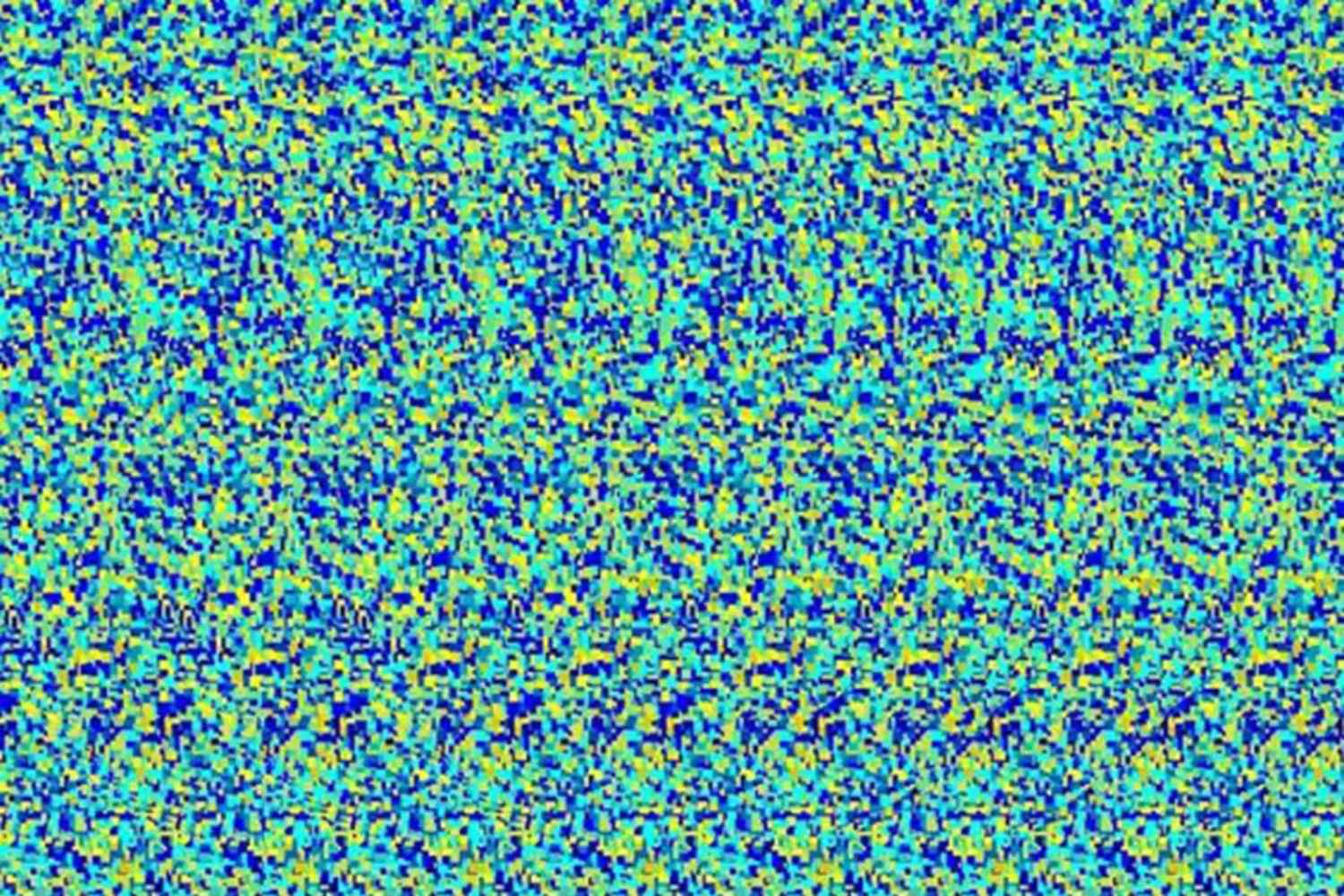
A new visual challenge is making Tiktok users crazy: a psychedelic image that looks like a painting by Jackson Pollock but hides a secret number. Can you see it?
It might seem like a digitized painting by Jackson Pollock, but hidden in this fog of colors there is a figure that only some lucky ones manage to identify. The last optical illusion that is depopulating on social media has divided the web between those who can see the hidden number and those who instead see nothing but a kaleidoscope of colors.
The challenge that the web is going around
The psychedelic image was shared by the user Tiktok @seethatmagic, unleashing thousands of comments and attempts by users. The instructions are apparently simple:
“Set the center of the screen, bring the nose closer to the screen and slowly move away”,
Starts the writing that accompanies the image. But the crucial question remains:
“What number do you see?”
The results were surprisingly different. Some users have commented to have seen “350”, others have sworn to see a “5”, while many admitted that they could not see any number in the swirling dance of colors.
@seethatmagic What’s the number? #eyemagic #magic #wow #crazy #eye #test #challenge
♬ Numb / Encore-Jay-Z & Linkin Park
Science behind the illusion
The number that should emerge from the image is zero, a result that is based on a fascinating visual phenomenon called autostereogram. This technique deceives our eyes and our brain creating the illusion of a three -dimensional image starting from a two -dimensional surface.
Autostereograms exploit the ability of our visual system to develop binocular disparities – the small differences between what sees the right and left eye. When we observe the image following the specific instructions, the brain tries to merge the information from the two eyes, creating the perception of depth and bringing out hidden shapes.
A phenomenon that has the roots in history
Optical illusions based on autostereograms are not new in the digital world. In the 90s, the famous “Magic Eye” conquered libraries and magazines from all over the world, challenging people to “relax” the view to discover three -dimensional images hidden in apparently random patterns.
The technique requires patience and practice: not everyone manages to immediately master the particular way of looking necessary to bring out the hidden image. Some must approach the face to the image and then gradually move away, others must “look through” the image as if they were staring at a very far point.
Other illusions that challenge perception
The world of optical illusions is full of examples that test our senses. Another fascinating phenomenon is the effect of chromatic induction, studied by the Japanese psychologist Akiyoshi Kitooka. In one of his most famous creations, a square that moves through a half -pink background and blue seems to change color, when in reality his pigment remains constant.
This effect occurs when a colored object moves around an identical stationary object, causing a perceptive shift of the color due to the influence of the surrounding background.
Why do optical illusions fascinate us so much?
Optical illusions are not only fun pastimes, but real windows on the mechanisms of our perceptual system. They remind us that what we see is not always a faithful representation of reality, but rather the result of complex brain processing processes.
These images teach us that our brain is constantly committed to interpreting and giving meaning to visual information, often filling the voids and making assumptions based on past experiences and recognized patterns.
The final verdict
If you have not been able to see the number zero in the psychedelic image, do not worry: not everyone has the same ease in perceiving the autostereograms. The ability to see these illusions can depend on several factors, including the conformation of the eyes, the ability to control the eye convergence and simply the experience in looking at this type of images.
Don’t you want to lose our news?
