
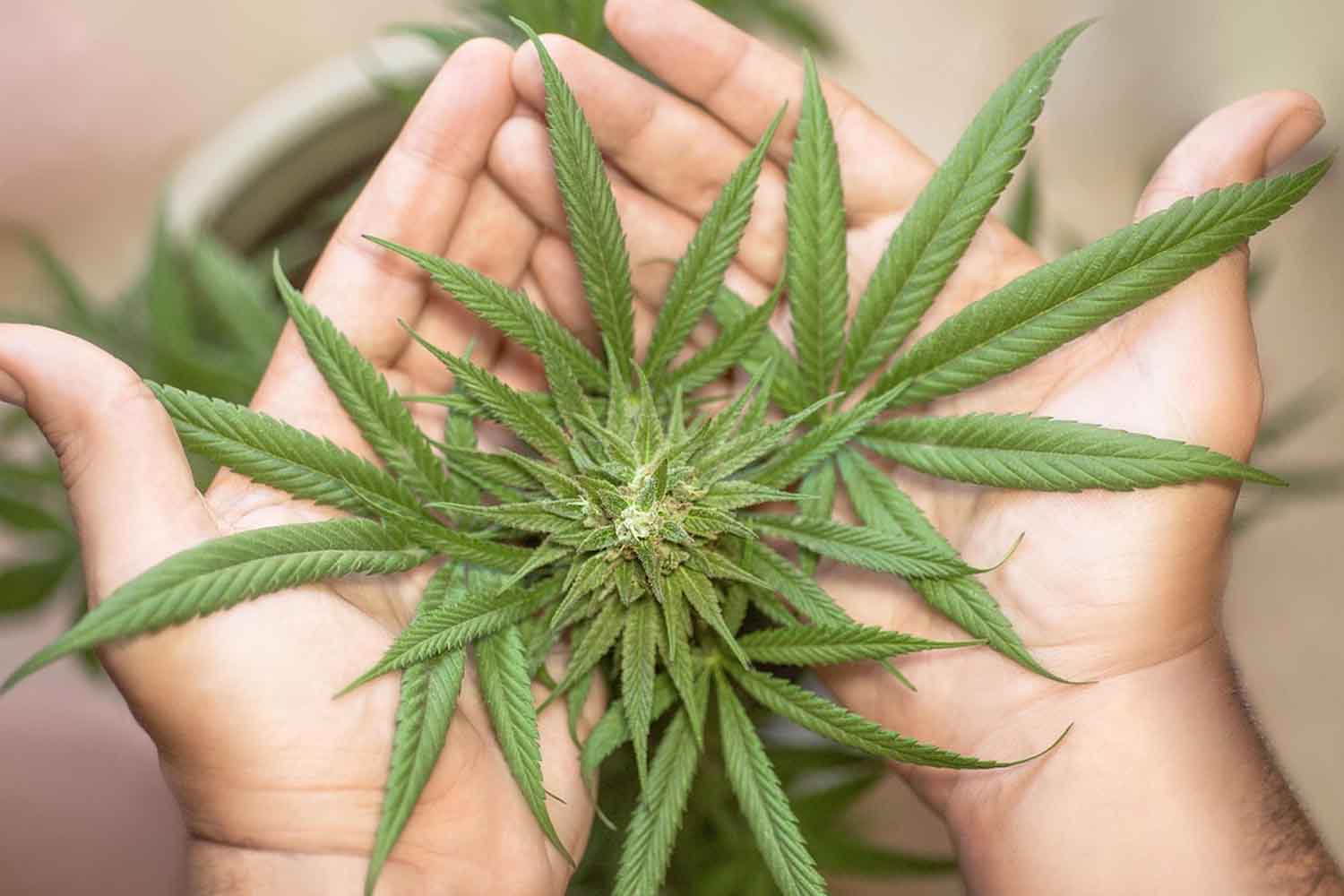
For a long time we took it for granted that cannabis was always a plant capable of producing THC. An almost “natural” characteristic, as if it were written in his DNA from the beginning. Today we know that this was not the case. New scientific research shows that the chemistry of cannabis is the result of a slow journey, made up of successive attempts, adaptations and adjustments. A process that is anything but linear, which tells a lot about how evolution works.
The study, published in Plant Biotechnology Journalreconstructs for the first time in an experimental way how cannabis learned to produce the best-known cannabinoids, such as THC, CBD and CBC. And it does so by bringing very ancient enzymes back to life, dating back millions of years ago, when the plant had not yet “decided” which chemical path to take.
In today’s cannabis plants, cannabinoid production is quite orderly. Each enzyme has its own task and works on a single molecule. One leads to the formation of THC, another to CBD, yet another to CBC. It is a precise, efficient, almost industrial system.
But in the beginning it wasn’t like that at all. The researchers discovered that the first enzyme typical of cannabis was not specialized. It was, so to speak, an “undecided” enzyme. Starting from the same basic molecule, CBGA, it managed to produce several different cannabinoids at the same time. A sort of chemical mixture, light years away from the precision we see today.
Only with the passage of time, thanks to repeated copies of the same gene and small mutations, did these enzymes begin to specialize. Some have favored the THC route, others that of CBD. This is how cannabis built its chemical identity, step by step.
Enzymes brought back to life to tell the story of the plant’s past
To arrive at these conclusions, scientists used a fascinating technique: the reconstruction of ancestral sequences. In practice they compared the genes of cannabis with those of related plants, such as hops, to trace the shape that the enzymes must have had millions of years ago.
Once reconstructed, these “ancient” enzymes were synthesized in the laboratory and inserted into yeast. So the researchers could directly observe how they worked. The result was clear: before cannabis, no enzyme was capable of transforming CBGA. With the appearance of the first plant-specific enzyme, however, the production of cannabinoids began, albeit in a confusing and unselective way. It is a typical dynamic of evolution. First you experiment, then you refine. Nature proceeds by trial and error, not by perfect plans.
Duplicate genes to invent new chemistry
A key element of this story is gene duplication. When a gene copies itself, one version continues to do its job, while the other is free to change. Sometimes nothing interesting happens. Other times new functions arise.
Cannabis seems to have exploited precisely this mechanism. From a single ancestral enzyme, increasingly specialized enzymes were born, each oriented towards a specific cannabinoid. This also calls into question a widespread idea that CBD-like compounds appeared before psychoactive ones. In reality, the precursors of THC were already present in the initial stages, even if not yet “optimized”.
For the plant, obviously, THC wasn’t meant to get anyone high. It is much more likely that these compounds had a role in defense, stress response or protection from microorganisms. Having varied chemistry is often an advantage, especially in unpredictable environments.
However, there is a detail that makes this research particularly interesting even outside the laboratories. Ancestral enzymes, when tested, proved more robust and easier to use than modern ones. They work better, are less “delicate” and adapt with greater flexibility.
This is a crucial aspect for the production of medical cannabinoids. Growing cannabis requires time, space and controlled conditions, while production using microorganisms promises greater stability and less impact. In this context, ancient enzymes could become valuable tools.
The case of CBC and the cannabinoids that we still know little about
Among the cannabinoids analyzed, one stands out more than the others: CBC. Studied for its possible anti-inflammatory and analgesic effects, it is present only in minimal quantities in most cannabis plants. According to the researchers, this rarity is a direct consequence of enzymatic specialization, which favored other chemical pathways.
In the laboratory, however, it has been possible to create intermediate versions of the enzymes capable of producing CBC much more efficiently. This opens the way to both new cannabis varieties and alternative production systems, based on microorganisms, with potential applications in the medical field.
What does this discovery teach us
Some gray areas still remain, linked to the lack of complete genetic data on plants similar to cannabis. It is not possible to establish with absolute certainty when, exactly, the production of the first cannabinoids began. But one thing is clear: the evolution of cannabis is no longer just a theory.
THC, now at the center of cultural, social and scientific debates, is the result of millions of years of trial, error and adaptation. And perhaps, by looking at that imperfect past, we could find the most interesting solutions for the future.
You might also be interested in:
