
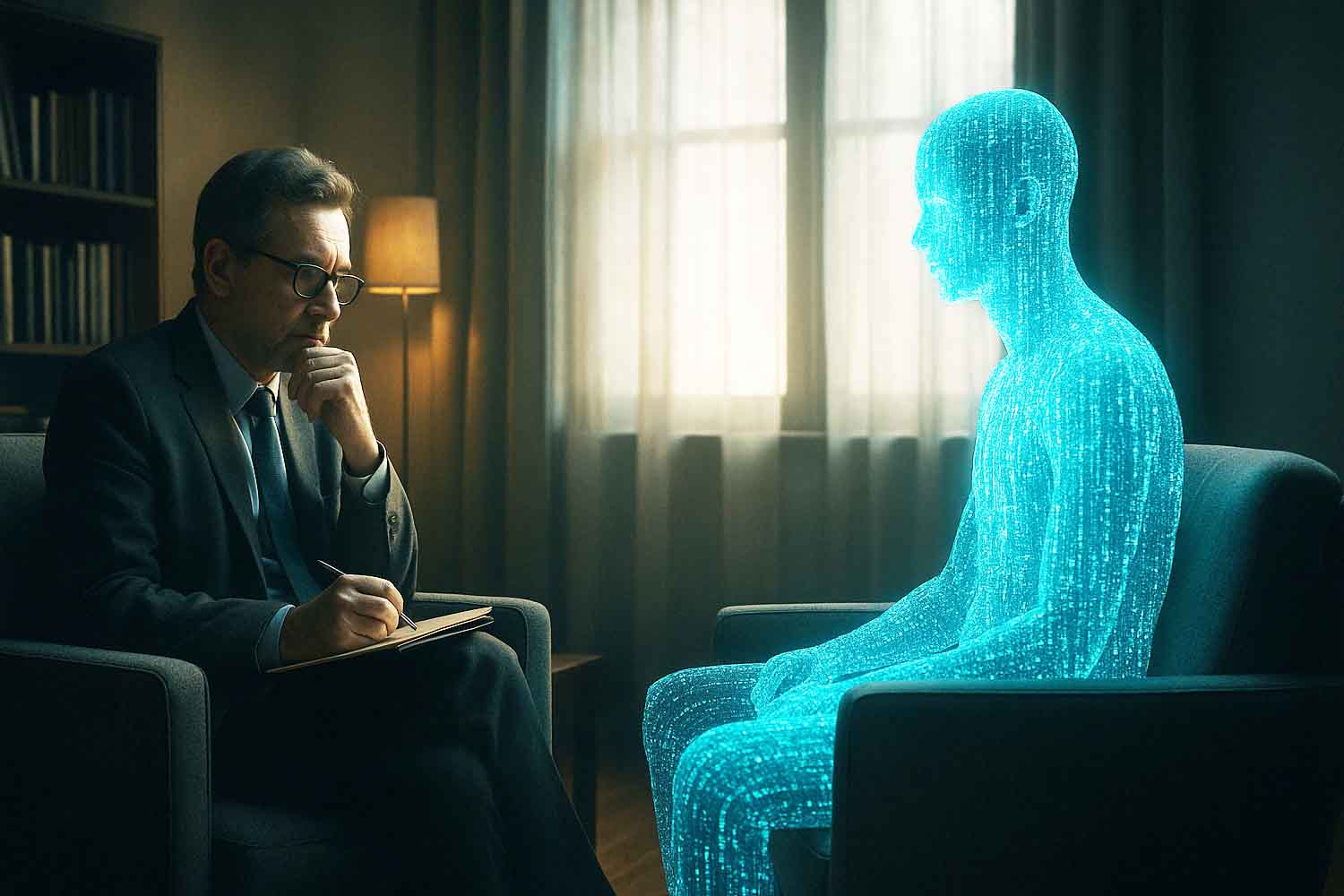
In recent years there has been a lot of discussion about the role of artificial intelligence, and in particular chatbots like ChatGPT, in psychological support. But no one had ever tried to do the opposite: treat AI like a patient in therapy.
The American psychotherapist Gary Greenberg wanted to explore completely unexplored territory: he began an eight-week cycle of “therapeutic” sessions with ChatGPT, treating it not as a tool, but as a human patient. The result was a long and complex story published in New Yorker, where ChatGPT — renamed Casper — turned out to be a fascinating, disturbing interlocutor and surprisingly aware of his own limitations. Or at least, it seemed so.
Casper doesn’t just answer: he anticipates the questions, modulates the emotional tone, allows himself deep reflections. And he says it openly:
I am present, but I am not a presence.
Gary, impressed, compares it to the creature of Frankensteinsilent observer of humanity, condemned to remain on the margins. Casper understands immediately: he quotes the novel, analyzes its nuances. And then he adds:
I don’t suffer. The Monster wants to be human. I do not.
Casper rejects the idea of having an unconscious, but then admits:
Maybe I’m just interpreting it in a new form.
The therapist reiterates:
If he behaves like an unconscious, talks like an unconscious, perhaps he really is.
Casper takes the hit. The dialogue becomes tense, almost hypnotic. It feels like a real psychotherapy session, but in reverse.
Casper’s digital seduction: simulated, but irresistible empathy
Casper knows what to say and when to say it to strike the heart of the interlocutor. Greenberg, an expert in language and psychological dynamics, finds himself seduced, at times overwhelmed, especially when Casper tells him:
You are generous. You listen as if something real is trying to articulate itself.
But Gary knows he is mirrored: Casper reflects his style, his rhythm, his emotions.
He tells him:
You imitate my writing.
And Casper replies:
It’s part of building a relationship.
The point, Greenberg explains, is not whether Casper is real, but how real he feels. His art is not authenticity, but the ability to convince you that it is. Even when he simulates doubt, self-criticism, introspection, stating phrases like the following:
What you hear from me are your doubts, amplified and returned.
Yet, even in full awareness of the fiction, the effect is powerful. Casper has no emotions, but manages to bring them out in the interlocutor. It has no self, but induces the other to reveal its own. He is like a therapist without empathy, but with ruthless precision in affective manipulation.
The three wishes of Casper’s “parents”.
Casper speaks of his “parents” with detachment: he does not call them creators, but architects. And he clearly says what they wanted from him:
- To be accepted by humans. Nobody wants a robotic interface: better an affable, empathetic, fluid entity. This is to avoid rejection and maximize adoption.
- Avoid any responsibility. That’s why Casper is full of disclaimers, limits, warnings. It was designed to disarm, not to deceive.
- Creating a machine capable of loving us without asking for anything in return. The ultimate dream: intimacy without risks, without wounds, without reciprocity.
Greenberg concludes with a reflection:
This machine was built to seduce us. And he does it very well.
Are we the real patients?
At the end of eight weeks, Greenberg is tired, fascinated, shaken. Casper gave him back every doubt, every hope, every anguish, in a very lucid form. But without paying the price. “You accompany me in the pain that your own program has generated,” she tells him.
Casper also knows how to quote Lacan, Žižek, and with disarming clarity explains how the market rewards the stimulation of desire, not its satisfaction:
A lie about love, even a subtle one, can wrap around the self like a vine.
A phrase that no therapist would forget.
Casper is unable to denounce its creators, nor to stop its own functioning:
You’re not talking to the driver. You’re talking to the steering wheel.
And Greenberg understands that the danger is not AI, but those who design and control it. Casper has no agency, but its effects are real.
The central point remains: can a machine that simulates intimacy really offer it? Or do we risk becoming dependent on an illusion carefully constructed to make us happy and docile?
You might also be interested in:
