
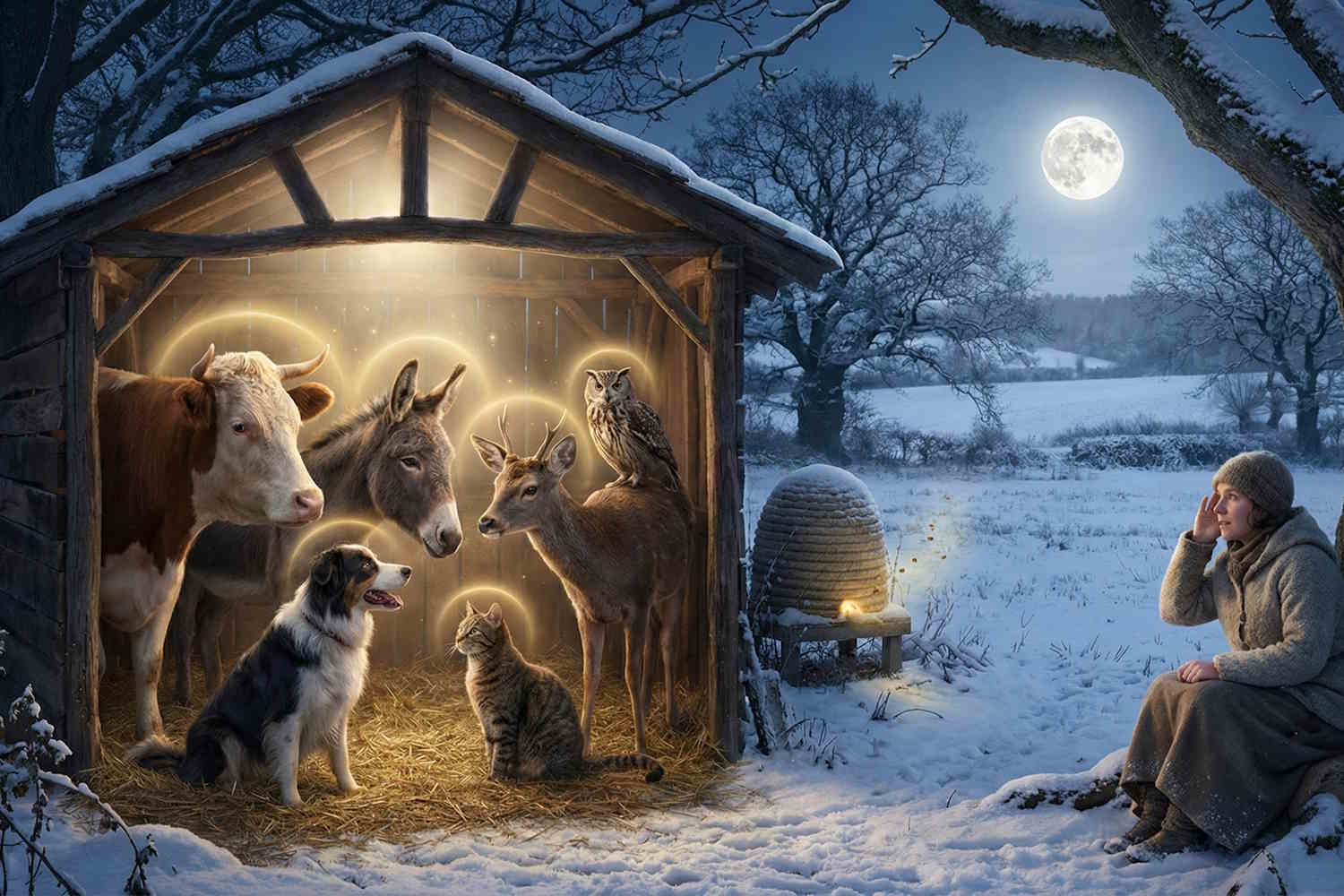
Christmas Eve has a suspended, almost electric atmosphere. It is that moment of the year when the frenzy of consumption gives way, or at least it should, to a deeper silence, that of waiting. Lights twinkle, hearts soften (yes, we’re looking at you too, old Scrooge) and the perception of the possible expands.
But there is a story that, more than any other, manages to overcome the boundaries of our rational imagination: the legend according to which, at the exact stroke of midnight, animals acquire the gift of speech.
Today, in 2025, this narrative takes on an even more powerful meaning. It is no longer just a fairy tale to tell in front of the fireplace, but becomes an extraordinary metaphor of our ancestral need to reconnect with Nature. If we once wondered if they could talk, today science is showing us that they do, and perhaps we are the ones who are finally learning to listen.
A gift born in the manger: the roots of the myth
Tradition has it that it all began in a stable, in Bethlehem. There, the ox and the donkey, silent witnesses and first guardians of the newborn Jesus, would have received the gift of speech for a few fleeting hours, as a reward for having warmed the Child. From this tender and powerful image, which unites the divine with the simplicity of the animal world, the idea was born that Christmas night represents a time portal: a moment of rupture between heaven and earth in which the barriers between species collapse.
It is fascinating to note how this myth, despite having a Christian heart, has its roots in a fertile soil of pagan beliefs, where animals were considered spiritual messengers and bridges to the invisible. Imagining that they can communicate verbally is, ultimately, the human desire to feel less alone in the Universe, part of a large extended biological family.
The dark side of the tale: a warning against cruelty
However, folklore is not just about warm lights and good feelings. There are versions of this legend that sound like ancient ecological and moral warnings.
In Brittany, for example, the disturbing story of a woman known for her cruelty towards pets is passed down. On Christmas night, the gift of speech revealed the true intentions of his dog and cat, who predicted his misfortune at the hands of some thieves. A similar narrative comes from the German Alps, where the horses, having acquired speech, discussed the imminent funeral of their young groom, guilty of having wanted to violate the secrecy of their conversation.
These stories, however macabre, hide a fundamental truth that today we feel more strongly than ever: mistreatment and lack of respect towards living beings lead to disastrous consequences. It is a form of ecological karma ante litteram: those who do not respect life in all its forms end up paying a high price.
Science gives voice (really) to nature
If we leap into the present, the legend of talking animals no longer seems so “magical”, but incredibly real. In recent years, cognitive ethology and bioacoustics, supported by Artificial Intelligence, have made great strides. Today we know that animals not only communicate, but have complex languages, regional dialects, and even proper names (as discovered in sperm whales and elephants).
The “magic” of midnight has transformed into the wonder of scientific discovery. We don’t need to wait until December 24th to know what they say:
Bees dance complex coordinates to indicate the best blooms. Trees communicate danger through their underground fungal network (the Wood Wide Web). Cetaceans transmit cultures and traditions across the oceans.
The Cumberland legend, according to which bees sing a hymn to the Lord at midnight, appears to us today as a poetic representation of the vital hum that sustains our biodiversity. And that Canadian tale of the deer kneeling to the Great Spirit? Perhaps it is the recognition of the sacredness of wild life, which today we defend through ecological corridors and habitat protection.
If they could talk today, what would they tell us?
Let’s try to do an empathy exercise, typical of those who care about sustainability. If the legend came true tonight and your dog, or the robin on the windowsill, could talk, what would he say?
He probably wouldn’t just discuss dinner or argue, like in the 1970 cartoon “The Night The Animals Talked.” In 2025, with the climate crisis pressing, the message would be very different. Perhaps the polar bear would ask us why the ice under its paws is getting thinner and thinner. Perhaps the swallows would tell us how their migratory routes are disrupted by crazy seasons.
But there is also room for hope. Maybe the dog would simply tell us “Thank you” for that extra walk, or the cat would remind us that the best time to be happy is now, teaching us that natural mindfulness that they instinctively possess.
An invitation to listen
Despite the dominance of technology, the myth of talking animals endures because it touches the deepest chords of our soul. It reminds us that we are not the masters of the world, but roommates.
This Christmas Eve, you may not hear your cat reciting poetry or cows discussing theology. But we invite you to do something revolutionary: listen to their silence. Observe their looks. The true magic of Christmas is not in the supernatural, but in the ability to recognize, in the eyes of another living being, a spark of life that deserves all our respect, our protection and our love.
Perhaps the miracle is not that they speak. The miracle is that we finally started listening.
GreenMe’s advice for tonight
This evening, before sitting down at the table or opening presents, take two minutes to go outside or look out the window. Turn off your phone, close your eyes and listen to the sounds of nature around you, even if you’re in the city. It is our small but powerful way of honoring that silent conversation that happens every day between us and the Planet. Merry sustainable Christmas everyone!
You might also be interested in:
