
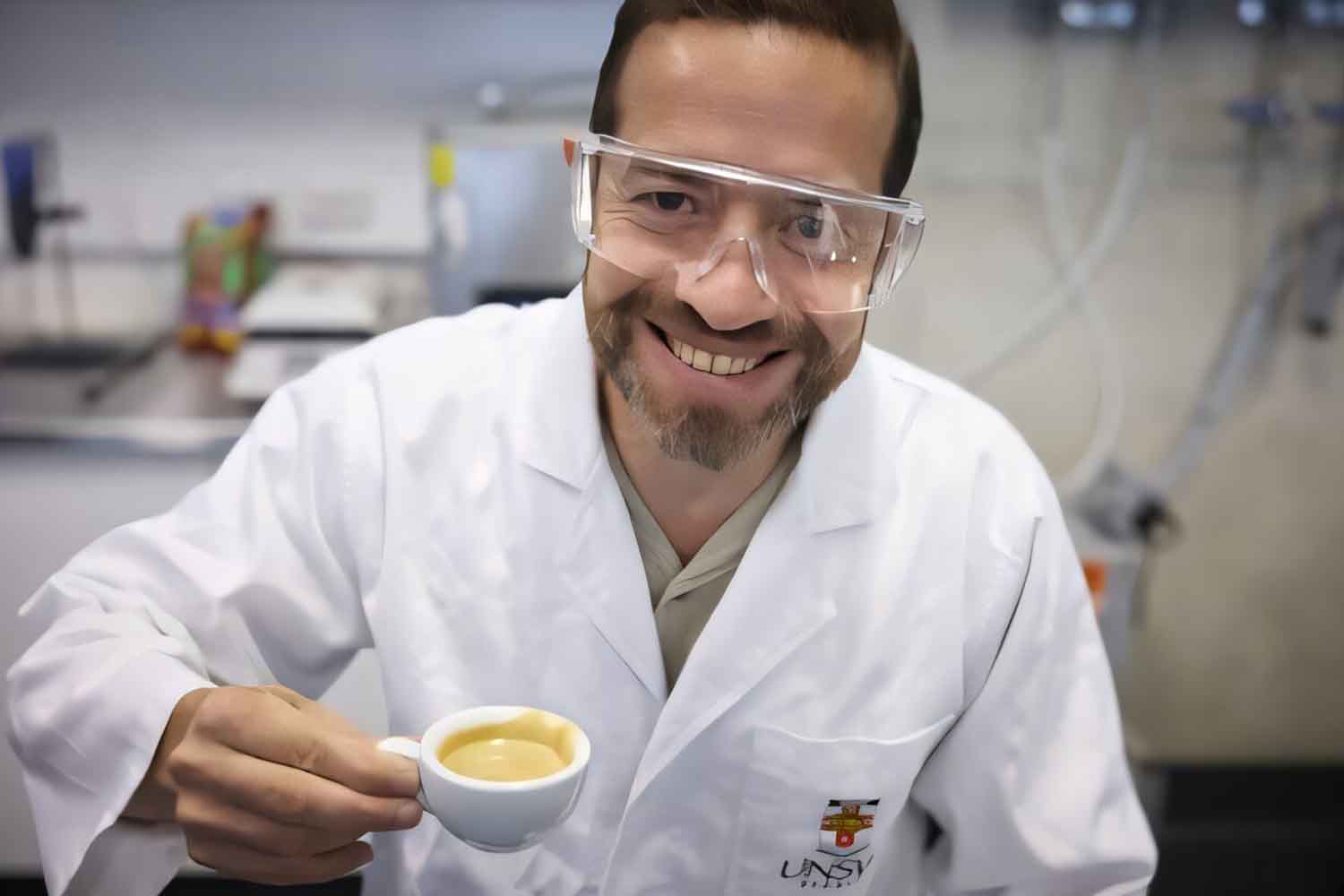
Preparing an espresso seems like a matter that has been resolved a long time ago: machine on, very hot water, pressure, finely ground powder, cup underneath. The gesture is so everyday that it almost disappears. And instead right there, inside that small and nervous ritual, a group of researchers inserted a very concrete deviation: to use ultrasonic sound waves and water at room temperature to obtain a coffee with the body, intensity and caffeine of an espresso, cutting the energy consumption up to 75%. The most curious part is that the result, in blind tests, was judged practically indistinguishable from a traditional espresso.
In practice they created a real one expressed by ultrasound. It sounds a bit like a laboratory, and in fact it comes from there: the system uses high-frequency sounds, above the threshold perceptible to the human ear, to extract aromas, oils, flavor compounds and caffeine from coffee grounds. The temperature stops doing all the dirty work. In its place comes a very rapid vibration, capable of accelerating what normally requires heat and pressure.
The heat comes out of the recipe
In the classic method, espresso is created by the forced passage of hot water through the ground coffee. Here the filter is transformed into a kind of small ultrasonic reactor. The heart of the system is a transducer, a metal device that generates ultrasound as it presses against the basket that contains the powder. The basket vibrates, the vibration passes through the water and coffee, and the extraction speeds up.
The technical phenomenon is called acoustic cavitation. In practice, tiny bubbles form and collapse in the liquid. When these microbubbles implode near the coffee particles, they act like very small jets or invisible brushes: they affect, fracture and open the surface of the grains. From there flavours, oils and caffeine pass into the water much faster than with a normal low temperature extraction. The result is a concentrated, aromatic coffee, with a structure comparable to that of espresso, but prepared with water at room temperature and with much less energy.
The work starts from an already interesting precedent: the same group had developed a patented system for preparing cold brew in about three minutesinstead of the classic 12-24 hours. That coffee, however, belongs to another sensorial family: softer, more diluted, rounder, with a concentration of caffeine indicated as approximately one fifth compared to espresso. The new research tries to do something different: take the speed of the ultrasound method and push it towards the density of the Italian cup.
Three minutes, fine grain and right proportions
The machine alone is not enough. The researchers worked on different parameters, because coffee has this wonderful and unnerving ability to depend on tiny details. The first element is the ratio between water and coffee: too much water and the drink becomes long, too little and the balance risks being thrown off. Then comes the grinding. A finer grain facilitates rapid extraction, because it offers more surface area for the action of water and vibrations. Finally there is time: between two and a half minutes and three minutes it seems to be the most stable point for obtaining a balanced cup.
The sensory verification was constructed with some attention. The researchers prepared four drinks: traditional espresso, ultrasonic espresso, traditional filter coffee and ultrasonic filter coffee. All samples were prepared fresh, cooled to the same temperature, served in identical and coded glasses, then presented in random order. Approximately attended 100 regular coffee drinkersordinary consumers, people who drink coffee at least once a week, without training from professional tasters. Each sample was rated on a nine-point scale for aroma, flavor, bitterness and overall liking.
For espressos, significant differences were absent: aroma, taste, bitterness and overall pleasure obtained overlapping ratings. Most participants struggled to distinguish the ultrasound version from the traditional one, and neither method garnered a clear preference. On filter coffee, however, the ultrasonic version fared even better: participants preferred it overall and judged its bitterness to be more pleasant.
The cup is just the beginning
The most immediate image is that of the kitchen machine of the future, perhaps with a small ultrasound module next to the usual filter holder. The researchers point to this path as possible, even with a relatively simple development towards an automatic machine for home use. The biggest game, however, seems to be elsewhere: in the coffee-based drinks industry, that of ready-made products, cold bottles, concentrates to be diluted, and packaged milk coffees.
There, energy saving is much more important than in the cup at home. Heating water on an industrial scale is expensive, time consuming and energy consuming. A process capable of producing an espresso concentrate in just a few minutes, with water at room temperature, opens up an interesting avenue for those who prepare large volumes. That concentrate could be used directly in ready-to-drink products, or shipped and diluted later into cold brew, milk drinks and other formats.
Prudence remains necessary. A well-controlled experimental system is one thing, a stable, economical, safe, replicable industrial supply chain with machines to produce, clean, maintain, certify and sell is another. Even for domestic use it will be necessary to understand price, size, duration, noise, maintenance, yield with different mixtures and behavior over time. Coffee, then, is a touchy material: it changes with the roasting, the grinding, the water, the humidity, the hand of the person preparing it. Ultrasound adds a new variable, useful only if it remains manageable.
The concrete thing, for now, is this: theexpressed by ultrasound shows that heat may lose its monopoly on intense extraction. For a country like Italy, where coffee is almost an extension of the national personality and every variation is looked at with a raised eyebrow, the idea may seem like a small technical heresy. Yet the proof remains all there, in the cup: if the body holds up, the aroma arrives and the caffeine does its job, the method becomes less strange than it seems. A basket vibrates, the water remains at room temperature, the coffee still comes out thick. The rest will be decided by the first sip.
