
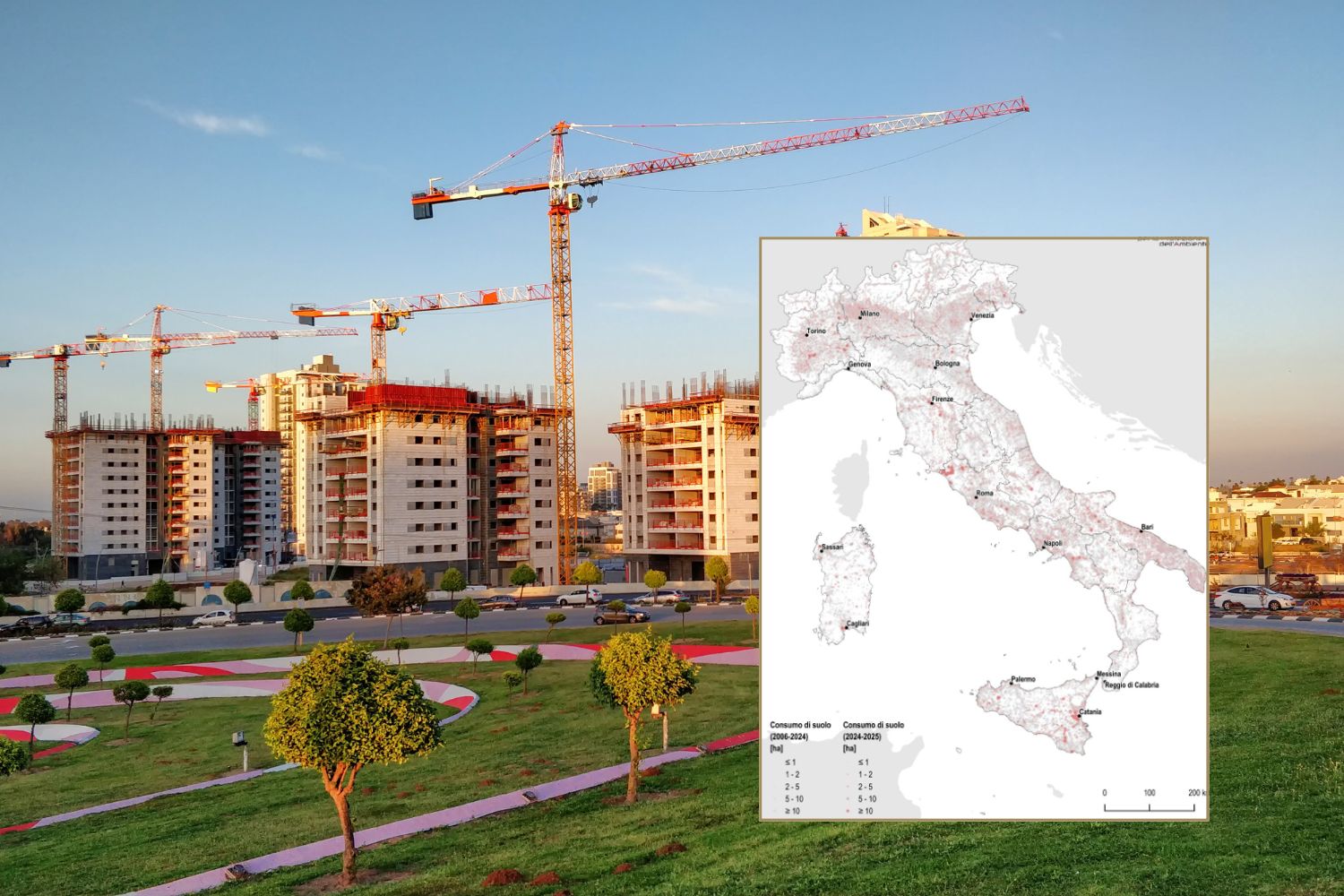
Three square meters of soil every second. Over 280 thousand square meters per day. It is as if, as we read these lines, another piece of Italy disappears under concrete, asphalt, construction sites and infrastructures.
And it shows no signs of stopping, on the contrary: in 2025 land consumption accelerated again, marking an increase of 22.4% compared to the previous year. In twelve months we have transformed 102.4 square kilometers of territory into new artificial surfaces, an extension equivalent to over 14 thousand football pitches.
This is told in the new report Soil consumption, urban ecosystems and state of the territory – 2026 Edition, produced by the Higher Institute for Environmental Protection and Research (ISPRA) and the National System for Environmental Protection (SNPA). A less than reassuring picture, especially in a country that already has to deal with floods, landslides, droughts and heat waves that are increasingly difficult to manage.
The ISPRA numbers
Italy now has 21,644 square kilometers of surface covered by buildings, infrastructures, squares and other artificial works, equal to 7.19% of the national territory. In 2025, 10,240 hectares of land were consumed, while the surfaces recovered and brought back to non-artificial conditions stopped at 746 hectares, equal to approximately 7.5 square kilometers. The result is a net consumption of almost 9,500 hectares, or approximately 95 square kilometers: the highest value recorded since the start of annual surveys in 2012.
The difference between gross and net consumption is important: the former measures all the territory that is transformed into an artificial surface; the second also considers the areas that, in the same period, are restored.
@ISPRA
And today recovery proceeds at a decidedly slower speed than overbuilding.
The worst regions
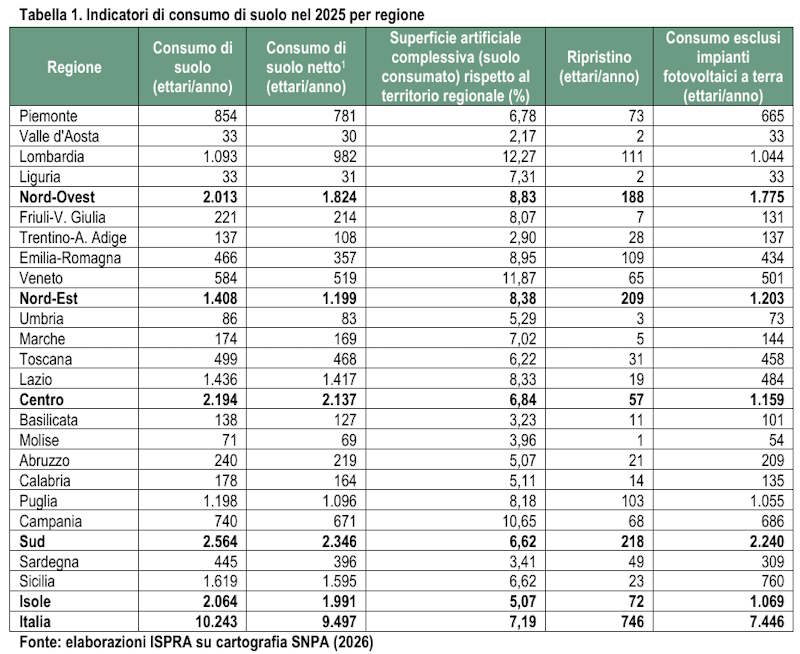
The region that consumed the most land in 2025 is Sicily, with 1,619 hectares transformed into new artificial surfaces. Followed by Lazio with 1,436 hectares, Puglia with 1,198 and Lombardy with 1,093. But, if we look at the overall percentage of territory already occupied by buildings and infrastructures, the ranking changes.
Lombardy remains the most artificialized region in Italy, with 12.27% of the territory consumed, followed by Veneto (11.87%) and Campania (10.65%).
In any case, the phenomenon now concerns almost the entire country: since 2006 new artificial roofs have been recorded in 96% of Italian municipalities, while overbuilding continues to advance even in the areas most exposed to natural dangers. According to ISPRA, in 2025 alone, another 1,106 hectares of land were consumed in flood risk areas and 707 hectares in landslide risk areas.
@ISPRA
And our greenery?
Obviously, the first consequence of land consumption is the increase in temperatures. The new ISPRA report shows that over two thirds of territorial transformations are concentrated in urban areas. In 2025 alone, 4,231 hectares of green areas and 320 hectares of tree cover disappeared.
Fewer trees and more impervious surfaces also mean less shade, less evapotranspiration and more heat storage. In the most sealed areas, ground temperatures can exceed those of the surrounding rural areas by more than 10°C, with differences reaching 12°C locally. Where the presence of trees is greater, however, temperatures up to 1.6 °C lower are recorded.
These are data that show how important urban greenery is for the quality of life, especially during summer heat waves: a tree, permeable soil or a small park are not simply decorative elements. They help cool the environment, promote the absorption of rainwater and provide habitat for numerous animal and plant species. Yet, we continue to sacrifice them to make room for new artificial surfaces.
What is consuming Italian soil?
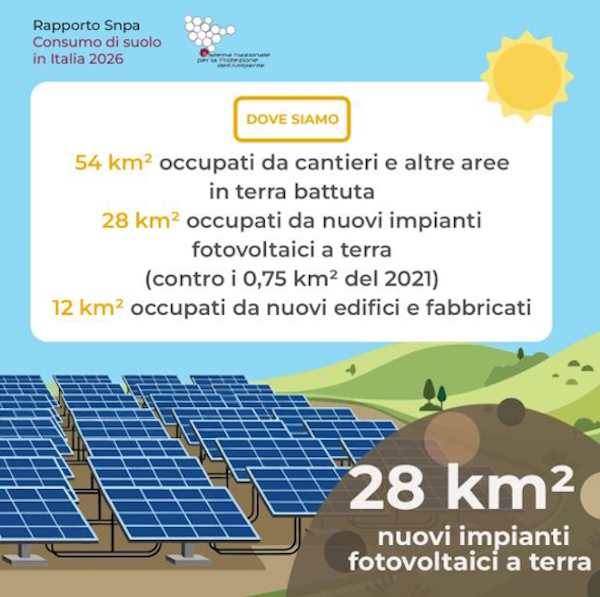
The construction sites weigh most heavily on the new transformations, which in 2025 affected 5,387 hectares, equal to 52.6% of the new land consumption. But the phenomenon also includes new buildings, infrastructures, yards, extractive activities and production facilities. Among the growing sectors is logistics, which has occupied a further 390 hectares, especially in Piedmont and Lazio.
@ISPRA
Another significant data concerns the plants for the production of renewable energy. In 2025, ground-mounted photovoltaics affected another 2,798 hectares, an extension almost forty times greater than that recorded in 2021. Wind power plants, including connected infrastructures, instead involved 118 hectares.
This does not mean that renewable energies are the problem (on the contrary, the fact remains that their diffusion is essential to reduce climate-altering emissions), but that the energy transition should be accompanied by careful planning, which favors, where possible, already existing roofs and compromised surfaces rather than subtracting further agricultural or natural land.
The first map of alternatives to concrete
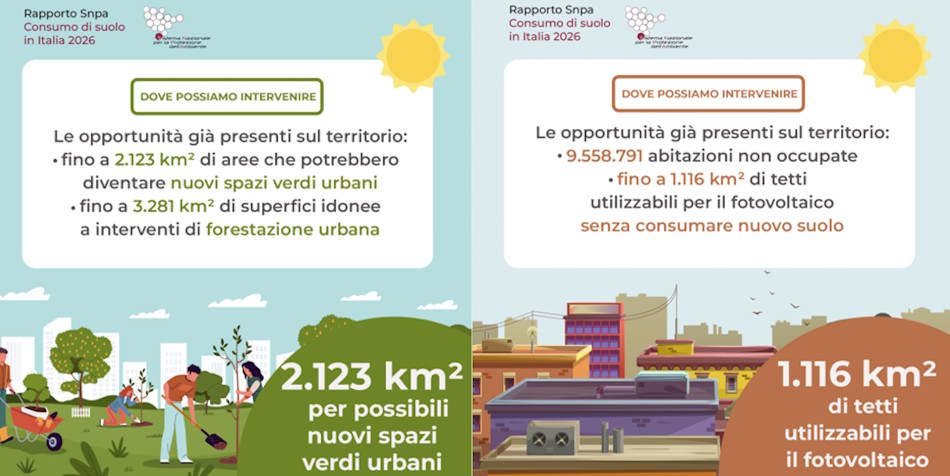
For the first time, the ISPRA report does not simply measure how much soil we are losing, but also identifies where we could intervene to recover it. The novelty of the 2026 edition is in fact a first national mapping of potentially recoverable surfaces, which identifies over 2,100 square kilometers of territory on which to evaluate restoration and regeneration interventions.
It means being able to remove unused flooring, restore permeability to the land, create new green spaces and recover degraded areas, avoiding occupying still vacant land. The opportunities identified also include 3,281 square kilometers of surfaces potentially usable for urban forestry and 1,116 square kilometers of roofs on which photovoltaic panels could be installed.
@ISPRA
Added to these are almost 9.6 million unoccupied homes, a building stock that could be at least partly recovered and reused, naturally taking into account the conditions of the properties and the actual housing needs.
The urban public areas alone potentially suitable for restoration exceed 35 thousand hectares, with the largest extensions in Lazio, Lombardy and Veneto. Among the municipalities, Rome stands out. These are potentials to be evaluated on a case-by-case basis, not surfaces automatically available for new interventions, but mapping finally offers a concrete tool to guide urban planning choices.
The ISPRA report thus gives us two photographs of Italy. On the one hand, a country that recorded a new negative record in 2025, losing soil at a speed of 3.2 square meters per second. On the other, a territory that already has thousands of square kilometers on which to plan a different future, made of recovery, renaturalization and reuse.
The choice does not only concern the landscape that we will leave to future generations, but the safety and liveability of our cities.
HERE you can find the complete ISPRA report.
