
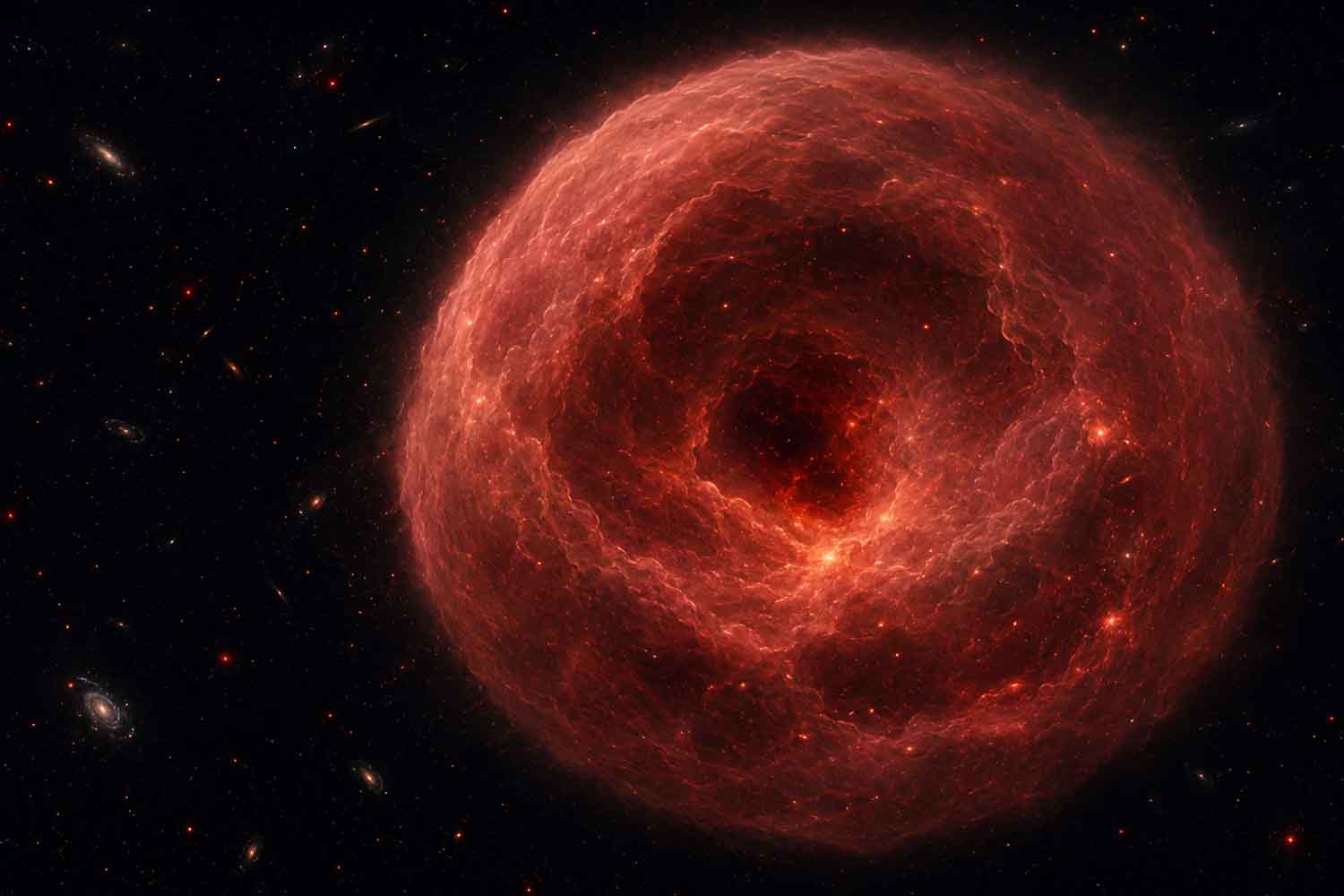
In the James Webb images it is little more than a red dot. Then the astronomers looked at its light piece by piece and that dot began to behave in a decidedly strange way: It looks like a huge star, about the size of our solar system, but it produces too much energy to be a star.
The group led by Rohan Naidu, a researcher at MIT, proposes a new explanation: at the center there could be a black hole surrounded by a gigantic and very dense envelope of gas. Scientists called this possible configuration “black hole star”, black hole star. The study was published on Nature with the title A Gas Enshrouded and Gas Reddened Black Hole at Cosmic Dawn.
The object, called MoM-BH*-1dates back to when the Universe was just a few hundred million years old. If the interpretation is confirmed, it could also help to understand what the mysterious many are little red dotsthe small red dots that the space telescope continues to find in images of the most distant Universe.
A star the size of the Solar System, with a black hole at the center
The name “black hole star” is effective, but requires a clarification. Astronomers aren’t describing an ordinary star with a black hole stuck inside as a surprise Easter egg.
The proposed model is different. At the center of MoM-BH*-1 would be a black hole about 100 thousand times more massive than the Sun. An enormous envelope of hydrogen would extend around it, so dense that, observed from afar, it behaves almost like the atmosphere of a gigantic star.
The source of the energy would be the material falling towards the black hole. As the gas is attracted and heated, it releases enormous amounts of radiation. It’s a much more powerful mechanism than the nuclear fusion that powers stars like the Sun.
And it is precisely the brightness of MoM-BH*-1 that blew up the first explanation. According to the MIT team, the object produces an energy about 100 billion times higher than what a known star could physically generate. For a normal star it would be an impossible calculation. For a black hole that is swallowing matter, much less.
Its light made astronomers suspicious
MoM-BH*-1 had been detected during an observation program called Mirage or Miraclecreated to search for some of the first galaxies formed after the Big Bang. Among the sources observed there was a particularly red and bright one. The color may have appeared to be due to cosmic dust, which absorbs some wavelengths and makes objects appear redder. The specter, however, told a different story. At certain wavelengths the light dropped sharply.
Astronomers call this phenomenon Balmer’s jump: it can appear when hydrogen absorbs a precise part of the radiation and is also observed in the atmospheres of some stars. Here, however, the signal was exceptionally deep, as Naidu explains in the material released by MIT:
It is the deepest jump ever observed in any object.
Ordinary stars, according to the group, were not enough to produce something like this. Then there was another detail: in the light of MoM-BH*-1 the astronomers found it almost only hydrogen and heliumwith very few traces of the heavier elements that astronomers generically call “metals”.
The portrait therefore became more and more curious: an enormously bright source, surrounded by very dense gas, with a spectrum similar in some aspects to that of a stellar atmosphere and an energy more compatible with a black hole.
The simulations have built a kind of cosmic cocoon
To understand what could produce that light, the researchers tried several computer simulations. One of the questions was very simple: Can such a red object be obtained using mainly hydrogen, without having to hide it behind enormous quantities of dust?
The answer obtained from the models was yes. However, an extremely dense hydrogen envelope would be needed, very different from the light clouds of gas normally present between stars.
By inserting an active black hole into the center of the model and modifying its mass and other characteristics, the team was able to reproduce the brightness observed by James Webb quite well. This is where the black hole star hypothesis arises: a powerful central black hole hidden inside a huge cocoon of gas.
However, the researchers themselves continue to talk about an interpretation. MoM-BH*-1 was observed; its light and spectrum are real data. The structure with the central black hole and the stellar envelope derives from the model that, at the moment, best explains those observations.
It could explain the mysterious “little red dots” of the James Webb
The story becomes even more interesting because MoM-BH*-1 is not the only red dot that appeared in front of the James Webb instruments. Since the telescope began observing the deep Universe, astronomers have found numerous little red dots: very compact and red sources present mainly in the young Universe and much rarer in subsequent eras.
Figuring out what they are has become one of the little puzzles of the JWST era. According to Naidu and colleagues, many of these objects could contain structures similar to the black hole star: young black holes surrounded by enormous amounts of gas. MoM-BH*-1 would be a particularly clear case because the central source is so bright that it almost overshadows its host galaxy.
This could also help solve a larger problem. Astronomers have already found huge black holes when the Universe was still very young and are trying to understand how they managed to grow so quickly. A black hole immersed in an environment rich in gas would have a lot of material available. A sort of cosmic buffet opened a few hundred million years after the Big Bang.
For now, MoM-BH*-1 remains an object with an interpretation to be tested through new observations. James Webb, however, has already done enough: he took one of the many red dots of the primordial Universe and found something inside that the categories used so far struggle to contain. A possible star as large as the Solar System, powered by a black hole.
