
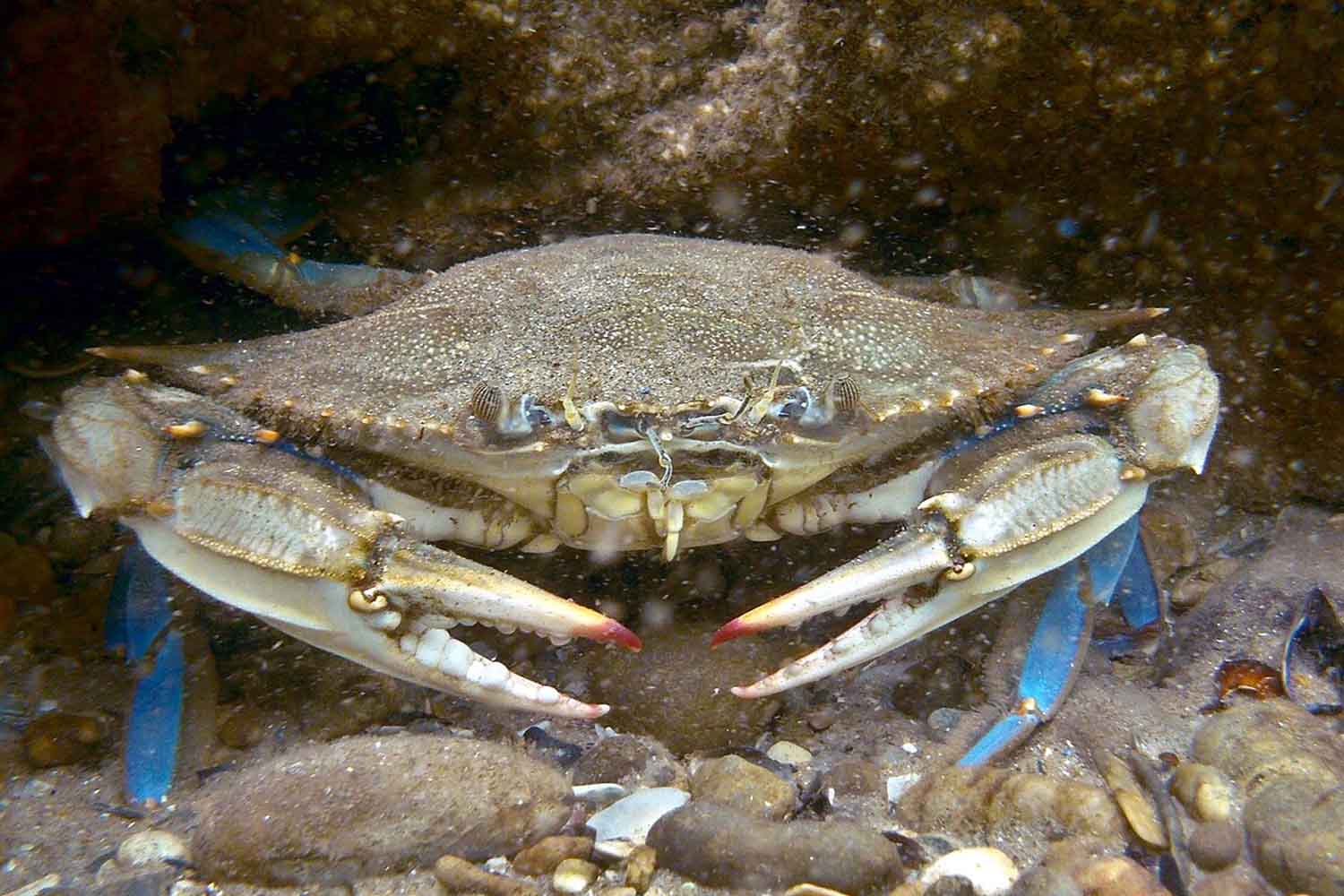
The sea is entering the Po and the blue crab takes advantage of this to push further inland. In the height of summer, while the Great River continues to lose water, the alien species that has become the nightmare of Adriatic clam farmers is reported from the Delta to the plain. A presence that is surprising only up to a certain point: this crustacean can live even with very little salt and has already demonstrated that it can travel up the river for over 160 kilometres.
To make the journey particularly easy in recent weeks there is a Po reduced to a minimum. On August 12, just 233 cubic meters of water per second passed through the Pontelagoscuro station. The threshold considered critical for saline intrusion is 450. In short, the river is bringing towards the Adriatic almost half of the water needed to keep the sea in its place. This is certified by the Po River District Basin Authority, which on 13 August classified most sections of the river in severe drought, with Cremona and Borgoforte already in extreme drought.
The Po retreats and the salt rises from the sea
The phenomenon has an almost innocuous name, salt wedge, and much less peaceful consequences. When the Po flow rate drops enough, the fresh water no longer exerts the same pressure towards the mouth and the sea water manages to penetrate the branches of the Delta.
It happens every summer, within certain limits. This year those limits are getting pretty loose. The Basin Authority has been reporting persistent saltwater intrusion into the Delta for weeks, with points where water withdrawals have become difficult or impossible. The water severity for the district has been raised to the “high” level and several municipalities are facing supply problems.
Within this changing environment, the blue crab is off to a strong start. Callinectes sapidusnative to the American Atlantic coasts, is now massively present in the Mediterranean and especially in the Adriatic, between lagoons and estuaries, as ISPRA reminds us. It is also a euryhaline species: it tolerates very wide variations in salinity and is therefore able to move between sea, brackish water and fresh water.
The sea advancing into the Delta therefore offers it a favorable environment, while heat, drought and low flows are simultaneously transforming the river. And the crab has already shown that it can make do very well with the available material.
The blue crab can reach more than 160 kilometers from the coast
@Wikimedia Commons
We discovered with some precision this year how far it can go. A study published in Scientific Reports reconstructed the presence of the blue crab in the Po through 50 georeferenced and validated reports collected between 2022 and 2025 together with the fishermen.
In 2023 some specimens were found more than 160 kilometers from the sea, in the Mantua area. An enormous distance for a species that we continue to instinctively associate with lagoons and coasts. In the more internal stretches they were mainly adult males, while the females remained mainly in the brackish and marine areas, more suitable for reproduction.
The natural barrier to the race upstream arrives shortly after: the Isola Serafini dam, over 180 kilometers from the Delta, represents the first unsurmountable obstacle along the river. Between Mantua and the dam, at least during the period studied, fishermen had not reported blue crabs.
2022 then offers a rather eloquent precedent. It was the year of the great drought on the Po, with high water temperatures, exceptionally low flows and a very strong saline intrusion. Just then the researchers recorded the first crabs in the freshwaters analyzed, up to 146 kilometers from the coast. The following year they went even further.
Scientists maintain a caution: comparing the few years available, a simple relationship between the distance reached and a single variable such as temperature, flow or salinity does not yet emerge. The same authors, however, underline that the influence of exceptional events such as heat waves, droughts and saline intrusions cannot be excluded and that similar conditions are known to favor the success of the species in Mediterranean systems.
More than just one cause, therefore, several things work together here: an extremely adaptable crab, now enormous populations near the Delta and a river subjected to extreme conditions.
From clams to freshwater, the invasion is now changing ground
So far the best known face of the invasion has been that of the Upper Adriatic. Since 2023, the proliferation of the blue crab has heavily affected the lagoons of the Po Delta and the main shellfish farming areas of Veneto and Emilia-Romagna, with damage so serious that it led to the establishment of a national extraordinary commissioner for the emergency. ISPRA speaks of an exceptional diffusion capable of compromising aquaculture production and the balance of lagoon ecosystems.
The ascent along the Po now also shifts attention to fresh waters. Here we still know little about how large the populations really are and the effects they could have on river fauna. The study published on Scientific Reports it signals possible interactions with fish and other bottom organisms and indicates the European eel as one of the species to be observed with greater attention, especially in the early stages of life.
Near the Delta, however, the numbers already give a measure of the crustacean’s ability to proliferate: in the branches of the Po di Volano and the Po di Goro, between 2023 and 2024, researchers recorded catches of up to 150 kilograms of blue crabs in a single sampling. The further we moved away from the mouth, the more the catches decreased. But someone kept moving forward.
And here we are in summer 2026. The Po is in severe drought, in Pontelagoscuro it travels well below the critical threshold for the salt wedge and sea water continues to gain ground in the Delta. The blue crab, in the meantime, has already shown that it can do much better than the sea: it has covered more than 160 kilometers towards the plain.
