
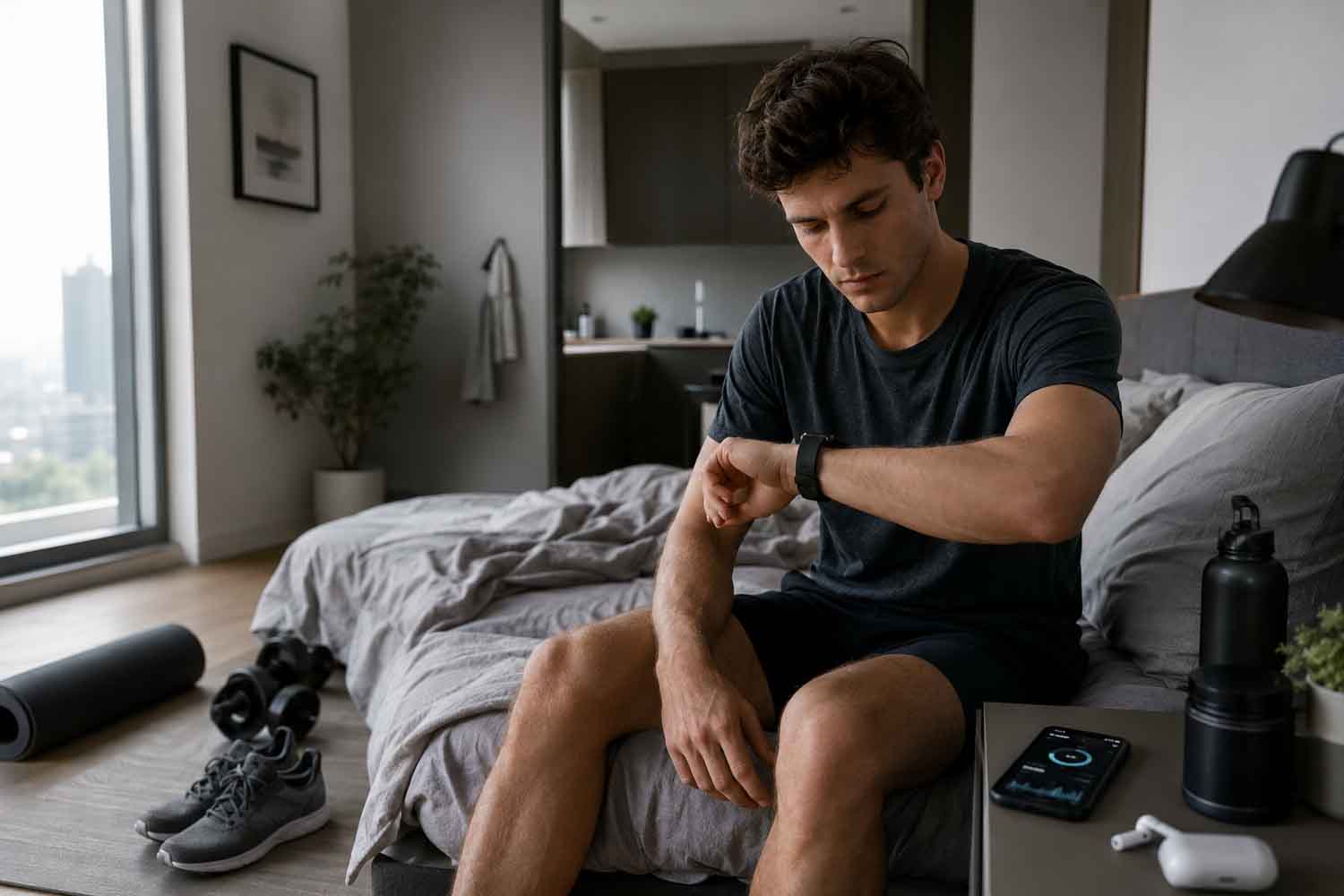
Ten thousand steps: done. Eight hours of sleep: almost, but the smartwatch gave it an 82 and therefore, evidently, there is still room for improvement. Training completed, supplements taken, proteins counted, holiday photographed from the right side. The day can be said to have been optimised. One rather cumbersome detail remains: we may not have had even a bit of fun.
Michèle Mendelssohn and Charlie Tyson gave a surprisingly precise name to this sensation: joyless decadenceor “joyless decadence”. The Faculty of English at the University of Oxford, where Mendelssohn teaches English and American literature, presents the concept as the paradox of an era full of distractions, consumption and possibilities that still manages to produce a widespread feeling of emptiness. It is a cultural formula, not a psychological diagnosis. And that’s perhaps why it works so well: it doesn’t claim to cure us, it simply describes the room we’ve put ourselves in.
When even feeling good becomes a job
The culture of optimization has taken perfectly sensible activities – moving, getting enough sleep, eating well, taking care of our bodies – and added an increasing amount of numbers. Steps, calories, heart rate variability, deep sleep minutes, productivity, followers, body fat percentage. Even rest can come in the morning in the form of a report card.
The problem appears when the measure stops accompanying the experience and begins to govern it. A walk becomes incomplete if the pedometer stops at 9,684. Sleep may feel like you’re getting insufficient sleep because a device gave it a poor rating, even after you wake up refreshed. And on social media the competition has a practically infinite archive: better trained bodies, tidier homes, more exotic trips, more photogenic breakfasts and people who, for some mysterious reason, always seem to have a clean kitchen.
There is some data on this last mechanism. A study published in 2025 on Frontiers in Psychology analyzed two samples of young adults: 139 people in the first study and 413 in the second. Exposure to the so-called upward comparisonsthat is, comparison with people perceived as better than us, mediated the association between use of social media and lower self-esteem; in the second sample it was also linked to greater depressive symptoms.
However, the same researchers invite them to keep their feet on the ground, possibly without checking how many steps they have taken: the effects observed were modest and the models explained approximately 6-9% of the variability of the outcomes studied. Instagram and Facebook, therefore, do not automatically transform those who use them into an unhappy creature curled up on the sofa. Rather, the work identifies one of the mechanisms through which certain modes of use can weigh on well-being: continually comparing oneself with the best version of other people’s lives.
When even sleeping well must get a good rating
Sleep offers perhaps the most curious example of the whole affair. Wearable devices allow us to collect useful information and have made many people more attentive to their habits. Then a word even appeared to describe the opposite extreme: orthosomnia, the excessive worry of getting “perfect” sleep according to the data produced by one’s tracker.
In 2024 a cross-sectional study published in Brain Sciences involved 523 adults between 18 and 70 years old. Among them, 176 regularly used sleep monitoring devices. Applying an algorithm constructed by researchers with scales for insomnia, anxiety and rest-related worry, the share of cases compatible with orthosomnia ranged from 3% to 14% depending on the threshold used. Numbers that must be handled with caution: the study was cross-sectional, it used a new classification system and the authors themselves define the results as a first estimate of the phenomenon.
Here too, demonizing the clock would be all too convenient. A small 2023 study of 26 patients with insomnia, for example, found no significant worsening of sleep concerns in the group who used a Fitbit compared to those who kept a paper diary. Trackers can be tools. Obsession with data is another matter, and research is still trying to understand where exactly that line lies.
There joyless decadence intercepts precisely this strange mutation: even pleasure can transform into a performance. We train to feel good and immediately afterwards we check if we have done enough. We sleep and when we wake up we ask an algorithm how it went. We eat something good while photographing the dish, checking the nutritional values and perhaps observing how much better the one at the next table is. A certain efficiency, it must be acknowledged, has been achieved: we have managed to fit a performance evaluation into free time too.
The part of life that the wearable measures rather poorly
Then there are reports, much less tidy than a dashboard and decidedly more difficult to transform into a graph. The Harvard Study of Adult Development, which began in 1938 and continued for generations, became famous for following real people throughout much of their lives. The original sample was far from representative of all humanity: it included 268 male Harvard students; subsequently 456 men from Boston’s working-class neighborhoods were added and, over the years, wives and descendants.
Within these limits, one of the most persistent findings concerns the quality of ties. In the groups studied, satisfying relationships with partners, family, friends and community were closely associated with well-being and healthier aging. Relationship satisfaction at age 50 even predicted some health outcomes at age 80 better than cholesterol levels measured in middle age.
This does not deliver a universal recipe for happiness, and the old Harvard study has a sample history that calls for caution. However, it offers a curious counterweight to life quantified up to the last REM phase. We can buy increasingly precise instruments to measure the body; the quality of the people we spend time with continues to escape the wrist sensor quite well.
“Joyless decadence” therefore has an above all linguistic merit: it brings together two things that seemed difficult to coexist. We have more tools to chase well-being and we can turn that same pursuit into another source of comparison, control and dissatisfaction. It happens when every activity must produce a result and each result must be better than the previous one, possibly even that of its neighbor.
The smartwatch can tell us how many hours we slept, how many steps we took and how fast our heart was beating. For now he still can’t tell us if we liked that day.
