

The galaxies of our immense universe have one preferential rotation direction: about two thirds of them revolve clockwise, while the other third anti -erally. This applies at least for the galaxies observed in these three years of activity the James Webb Space Telescope (JWST), the Webb spatial telescope. And these observations, according to the scientists of the Kansas State University (USA, they would indicate that We could all be inside a black hole.
The JWST really revolutionized the observation and study of the deep space, managing to dig galaxies before him unthinkable to find, the last few months ago, the Jades-Js-Z-14-0, The most distant galaxy currently knownat “Solo” two hundred and ninety million years after the big Bang.
A preferential rotation direction
In a random universe, scientists would in fact expect to find 50% of the galaxies that rotate in one way, and the other 50% in the opposite direction. But apparently it is not so: Webb’s new observations suggest that there is one Favorite direction for galactic rotation.
In the images of the deep universe taken on 263 galaxies from James Webb Space Telescope Advanced Deep Extragalactic Survey (Jedes) It is seen that about two thirds of the galaxies rotate clockwise, while about a third of the galaxies in an anti -eral sense.
The analysis of the galaxies was made through quantitative analysis of their forms, but The difference is so obvious that anyone who looks at the image can see it – explains the author of the work Lior Shamir – There is no need for special skills or knowledge to see that the numbers are different. With the power of the James Webb spatial telescope, anyone can see it
What causes this “preference”? Are we really all inside an immense black hole?
It is not yet clear what this causes this, but there are two possible main explanations: the phenomenon can be explained if it is admitted that theUniverse was born by rotating. This explanation agrees with theories such as the cosmology of black holes, which postulates how the entire universe is located Inside a black hole. But if the universe actually was born by rotating, it means that the theories existing on the cosmos are incomplete
The earth rotates, in fact, too Around the center of the Milky Way And the researchers expect the light from galaxies that revolve in the opposite direction to the terrestrial rotation is generally brighter.
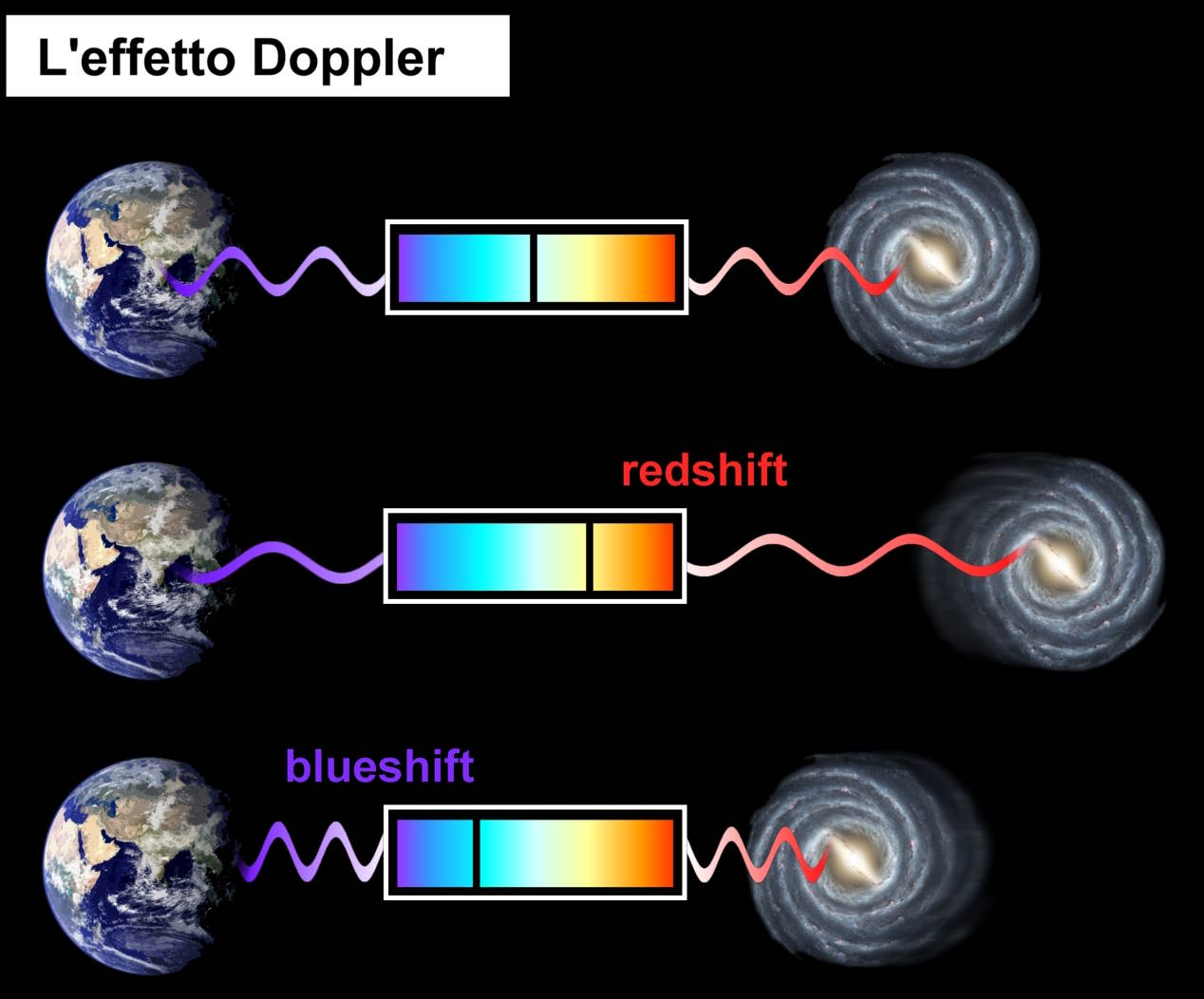
This because of theDoppler effectphenomenon for which, compared to a firm observer, the wavelength of the light emitted by a moving source increases or decreases depending on whether the source moves away or approaches.
The effect applies to any type of wave, and, in daily life we often observe it with sound waves, for example when you are about to bring an ambulance closer to us. But it also applies to the bright waves, and it is in fact fundamental for astronomical studies.
This, in reality, could explain why the galaxies that rotate in the opposite sense are overpressive in the telescope observations, emitting more light “in Webb’s eyes”. But at this point the astronomers should reconsider the effect of the rotation speed of the Milky Waytraditionally considered too slow and negligible compared to other galaxies, on their measurements.

If so, we will have to recalibrate our distance measurements for the deep universe – concludes Shamir – the recalibration of distance measurements can also Explain several other unresolved issues in cosmologylike the differences in the expansion rates of the universe and the great galaxies which, according to the measurements of the existing distance, are expected to be older than the universe itself
The study was published on Monthly Notices of the Royal Astronomical Society.
Sources: Kansas State University / Monthly Notices of the Royal Astronomical Society
