
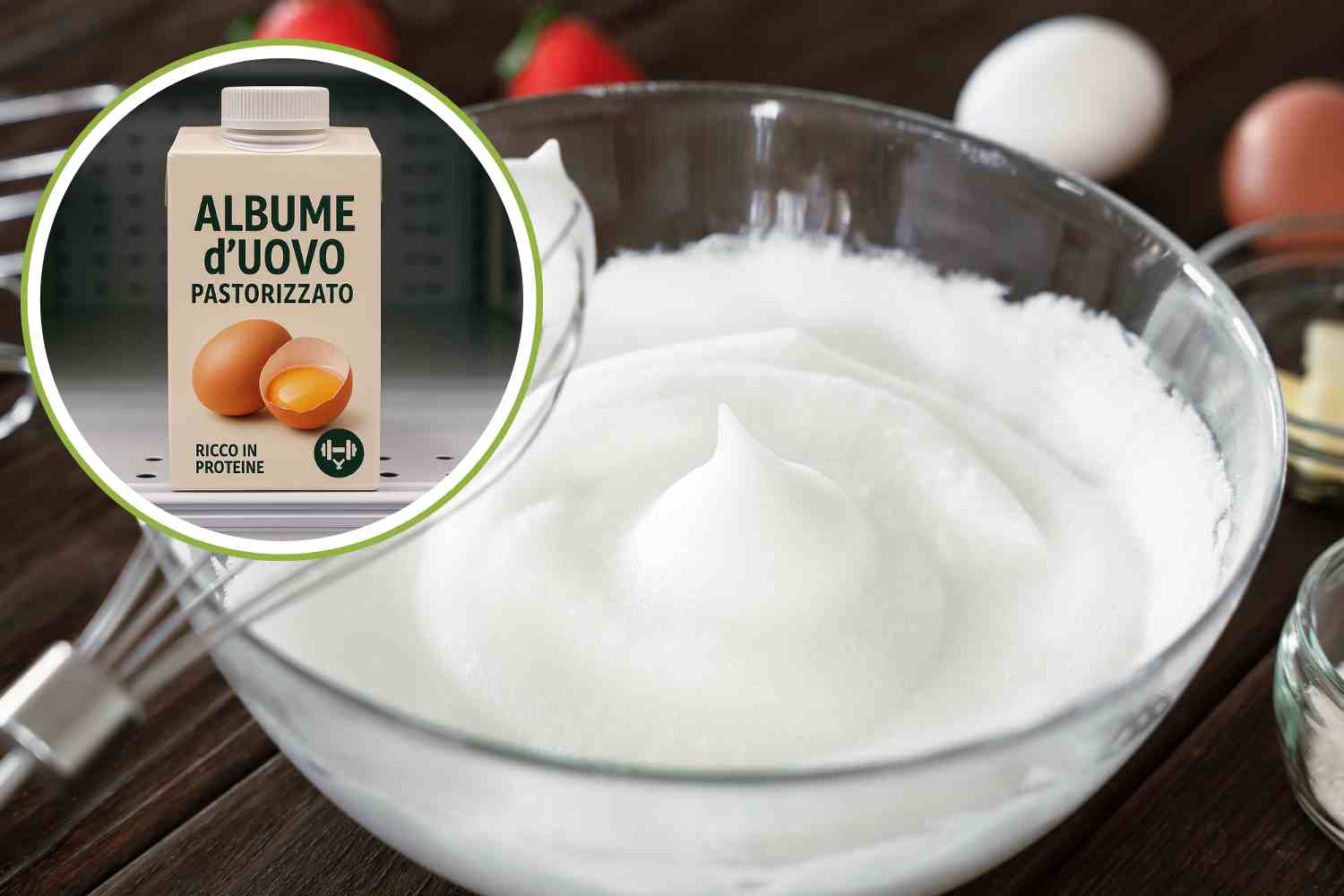
In the fridge, right next to the milk and juice, there is that white, odorless container ready to pour. It’s pasteurized egg white. A product that until a few years ago was only known to professional chefs and bodybuilders, but today it is also used by those who cook at home and want something quick, light or rich in proteins. But how is it obtained and where does it come from? It is certainly not born liquid as we see it.
How it is produced
The egg in nature has shell, yolk and white. Clearly not in industry: there are systems that automatically break thousands of eggs every day. The machines separate yolk and white without contact between the parts. The egg white is filtered, checked and then pasteurized, that is, heated for a precise time at moderate temperatures (around 57-58 °C), so as to eliminate bacteria – such as Salmonella – without ruining the proteins. The product remains liquid, but safe to cook.
Which eggs does it come from?
They come from industrial farms, with continuous production. Some of the eggs are never sold whole but destined directly for processing: they are born to be broken. The egg white goes into bricks, the yolk often ends up in other sectors such as fresh pasta, packaged desserts, sauces such as mayonnaise. We are talking about thousands of specimens processed every day.
Because brick egg white is increasingly used
In recent years the demand has risen significantly, not only for food fashion but also for practicality. In a one liter pack there are more or less 30 egg whites: pure proteins, without fat and without cholesterol. Athletes and those following high-protein diets make extensive use of it because it allows you to increase your protein intake without adding the yolk, which is more caloric. Open, pour and cook: no waste, no shells to eliminate.
Is it the same as fresh egg white?
From a nutritional point of view, yes, it contains the same amino acids and protein values. Per 100 grams we are talking about 43-47 kcal, 9-11 grams of proteins, carbohydrates under 1% and practically no fats. Pasteurization can make it slightly more uniform and less effective in whipping. Many pastry chefs still prefer fresh for the perfect meringue, others appreciate the consistency of the industrial product.
What’s inside the brick
Brick egg whites fall into the category of egg products. They undergo:
The best-selling packs are 500 g or 1 liter (approximately 15 or 30 egg whites). If the brick is unopened, it lasts between 30 and 45 days. Once opened, it should be consumed within 24-48 hours.
Manufacturers often declare the absence of additives and preservatives and that they come from free-range hens. Better to choose those without the use of antibiotics.
How to use them
Shake the brick before pouring and always cook. Never consume raw: avidin makes egg whites difficult to digest if not treated by heat. In the kitchen it is suitable for light omelettes, protein rolls, fit pancakes, cakes, muffins, meringues (if you accept a less “firm” whipping). In mixology it is also used for some cocktails, for example the Vodka sour.
The liquid egg white in brick comes from a precise industrial supply chain: eggs selected for processing, automated processes, controls, pasteurization and conservation. It is practical, quick, safe, meets modern needs for nutrition and quick preparation. Knowing how it is made simply helps us understand what we are pouring into the pan.
Laying hens in the egg white supply chain
Behind every brick of egg white there are laying hens who live on industrial farms where the main objective is to guarantee production continuity. A hen can lay almost one egg a day, and a significant part of this production is never intended for consumption in shell: it is already created to be broken, separated and transformed. Even when the wording “free range” appears, one must not imagine pastures or freedom of movement: they are often closed sheds, with high densities, artificial lighting and established rhythms to maximize yield. The feed is standardized, the conditions monitored, but the approach remains oriented towards numbers rather than welfare. In practice, the chicken is treated as a productive gear rather than an animal. And it is an aspect that is rarely perceived when purchasing a simple brick in the fridge.
