

The microplastics are invisible fragments that unfortunately over the past decades have spread everywhere: in the air that we breathe, in the foods that we bring to the table and also in the water we drink every day. Not all sources, however, are the same, and recent studies have highlighted how some common choices can significantly increase exposure.
In particular, those who choose mineral water in the bottle, often perceived as safer than that of the tap, are exposed to significantly greater quantities of microplastics: on average, those who consume it habitually ingests up to 90 thousand more plastic particles every year. This shocking data emerges from the revision conducted by a team of researchers from the Concordia University of Montrealpublished in the scientific journal Journal of Hazardous Materials.
It is not a new experimental analysis, but a critical synthesis of about 140 scientific articles published between 2016 and 2024, with particular attention to 16 studies dedicated specifically to microplastics contained in the bottles of disposable water. The aim of the revision was twofold: to provide a clear overview of the extent of the problem and at the same time highlight the methodological gaps, underlining the need for shared protocols to evaluate the risks for health in a more accurate way.
The studies analyzed took into consideration from 8 to 280 bottles at a time, from 16 countries including Italy, France, Germany, the United States, India, Brazil and China. The types of water were very different: natural mineral, purified, distilled, source and even desalized.
Analyzing the data, a constant has clearly emerged: the plastic bottles are not neutral containers. Micro and nanoplastics are released due to friction, exposure to the sun, openings and repeated closures, compression. Even the cap, especially if in high density polyethylene, it contributes to contamination.
The review data show that an individual who drinks water exclusively from the tap in reveals on average 39,000-52,000 microplastic particles per year, while those who regularly consume bottle water reaches about 90,000 more particles every year. And considering that many people drink mineral water for decades, potential accumulation in the body becomes significant and worrying.
The most contaminated mineral waters
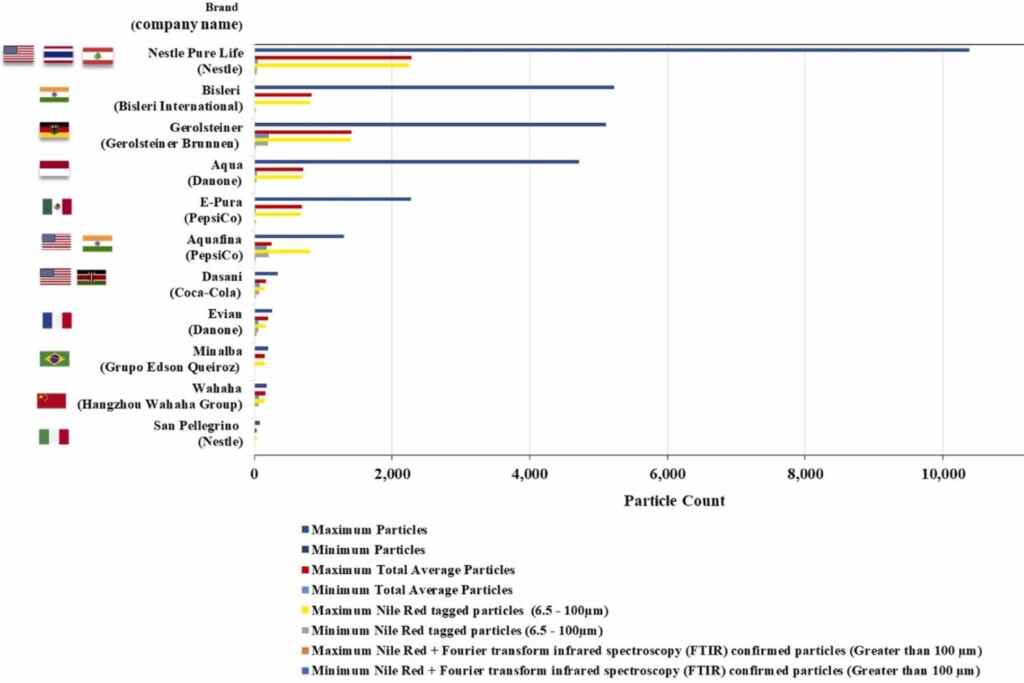
A particularly interesting aspect concerns the variability between the Marche. According to the data extracted from the study, some mineral waters have much higher concentrations than microplastics. In the first place is Nestlé Life, with over 10,000 particles per liter, followed with a certain detachment from Bisleri (Indian), which contains less than 6000.
Within the same Nestlé group, however, there are significant differences: the San Pellegrino water produced in Italy contains much less than other brands. This highlights how much the quality of packaging and production processes can affect water contamination.
Other major global brands-Danone, Pepsico and Coca-Cola-show variable values, as you can see from the infographic below.
The risks to health
Micro and nanoplastics can have important effects on the body. Scientific studies connect them to respiratory disorders, reproductive problems, neurotoxicity, chronic inflammation, alterations of the intestinal microbiota and even an increase in oncological risk. Nanoplastics, being thousands of times smaller times, represent an even greater danger, can in fact penetrate the red blood cells, lymph nodes and various tissues, gradually accumulating.
An important problem highlighted by the review is that there are still no common rules and methods to analyze microplastics: the workshops use very different techniques, which makes it difficult to compare the results. The authors therefore underline the urgency of shared procedures and studies made in collaboration on a wider scale, so as to have more reliable data.
Towards clearer rules
From a regulatory point of view, the review highlights the need to establish clear contamination limits, reduce the use of disposable plastic and choose safer materials for bottles. In Europe, for example, the bottles must contain at least 25% of recycled plastic, but this does not completely solve the problem of the release of particles, which remains significant.
Don’t you want to lose our news?
You may also be interested in:
