
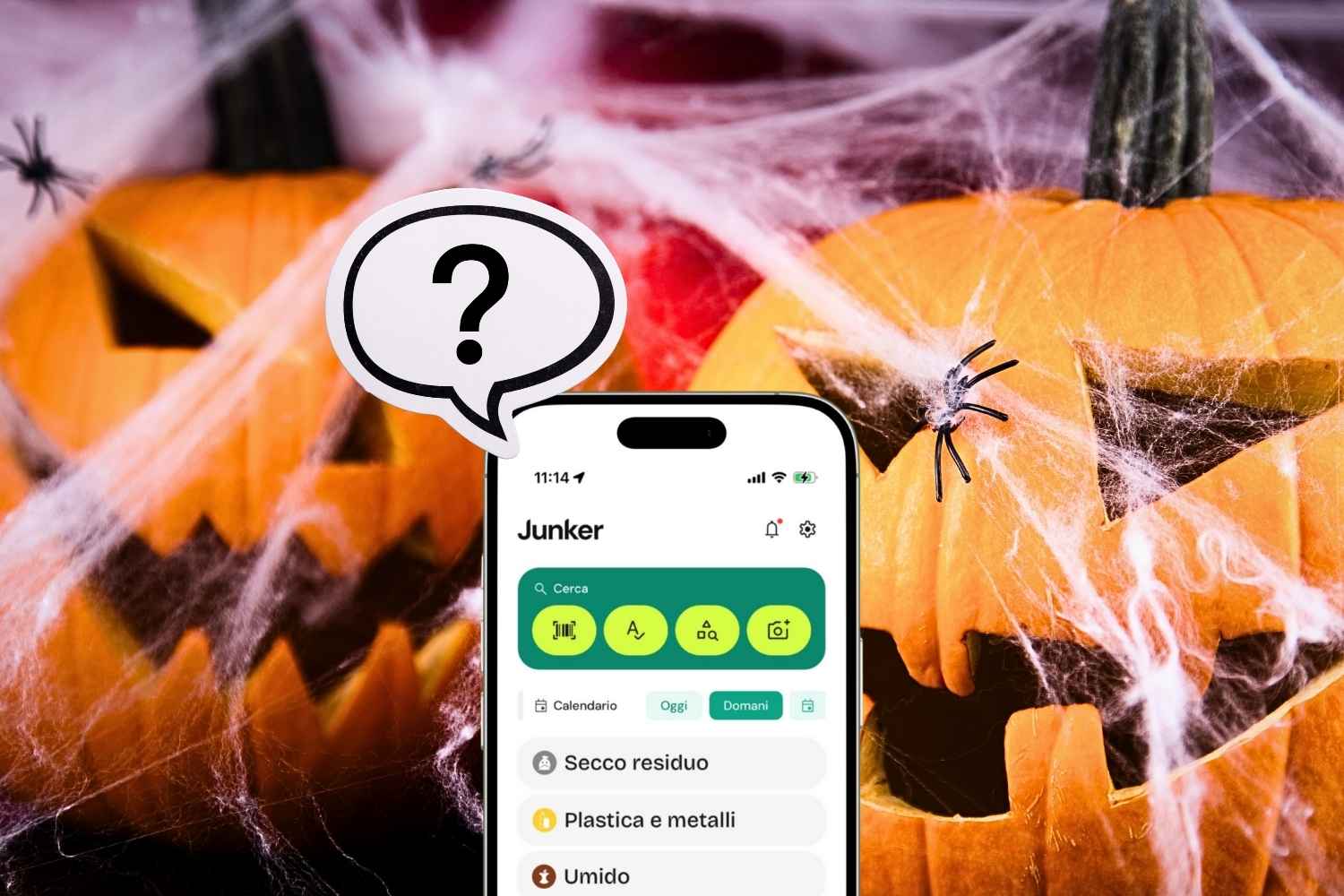
Decorating your house for Halloween, transforming it into a horror movie setting, and dressing up as witches and ghosts can be a lot of fun (and not just for children). But when the party ends, the least pleasant moment arrives: putting everything back in order and understanding where to allocate the decorations and objects that we will no longer use. The problem is that many of the typical Halloween wastes are more difficult to differentiate than we imagine. Does a synthetic spider web really go into plastic? Can a carved pumpkin always end up in the dumpster? And what happens to the little LED lights that no longer work?
Here is a practical guide to avoid the most common mistakes and prevent recycling from turning into a nightmare after the scariest night of the year. Just use Junker, the app (downloadable for free) that makes separate waste collection easy, smart and sustainable, and the fear goes away!
View this post on Instagram
Halloween costumes: why throw them away when they can have a second life?
Every year it’s the same story: we buy a costume for a party, we wear it for a few hours and then it ends up forgotten in the back of the wardrobe. Then, the following year, maybe we don’t like it anymore, it doesn’t fit or we simply want to dress up as something else. But a costume that we no longer use is not necessarily a waste. If it is still in good condition, the best choice is to prolong its life. In fact, we can give it as a gift to friends or relatives, donate it to a school or an object library or organize a swap party with an aperitif among friends. A simple way to avoid new purchases and reduce waste.
What if they are no longer usable? For fabric costumes it is necessary to check the methods of collection in the textile collection of our municipality. To locate the containers dedicated to used clothes in our city, we can use the Junker app map. Be careful, however: masks, rigid accessories and electronic components should not automatically be given together with the clothes. It is important to distinguish the different materials.
Fake cobwebs: Don’t make this common mistake
Fake spider webs are among the cheapest and most used decorations at Halloween. It only takes a few minutes to decorate a door, a balcony or a living room and create a house with a haunted atmosphere. But where do artificial cobwebs end up when we decide to eliminate them? Here lies one of the most frequent mistakes: you risk throwing them in the plastic container because they are made with synthetic fibres. In reality, in domestic plastic collection we only collect packaging, not all objects made with this material. Synthetic decorative cobwebs, therefore, must be disposed of in unsorted waste.
And when we don’t know how to recognize the material of a decoration? With Junker we can search for the product in a few moments, scan the barcode of the package, if present, or take a photo to obtain geolocalized information on the correct disposal. A small trick that can resolve many doubts, not just on Halloween!
LED lanterns and light decorations: they don’t go in the undifferentiated
Ghost and pumpkin fairy lights, glowing skulls and LED lanterns make the Halloween atmosphere even more mysterious. The problem is when they stop working. How to proceed? If they are not repairable, we should not treat them like ordinary plastic decorations. Decorations that run on batteries or electricity are electronic equipment and, when they become waste, fall into the category of WEEE, i.e. Waste from Electrical and Electronic Equipment. In this case, the first thing to do is remove the batteries, when they can be safely removed, and place them in the appropriate containers for used batteries. The device, however, must be taken to the nearest eco-centre. But not everyone knows that there is a second possibility, perhaps even more convenient, that is to deliver small WEEE, less than 25 centimeters in size, free of charge to large electronics stores with at least 400 square meters of dedicated sales area, without the obligation to purchase a new product. To find out where to go, just consult the Junker map which allows you to locate eco-centres and collection points nearby.
Carved pumpkins: where do they go?
The pumpkin is undoubtedly the most recognizable symbol of Halloween. As is now tradition, many families empty it, carve it creating eyes, nose and mouth and place it on the windowsill with a light inside. But after a few days the pumpkin inevitably begins to deteriorate. So where should it be thrown away? If it is a natural pumpkin, free of synthetic glues, paints, glitter and other substances, it can be disposed of in the organic waste collection, after having cut it into pieces.
First, however, you must remove any candles, LED lights, supports and accessories used to decorate it, placing them separately. And there is another possibility to reduce waste: the carved pumpkin can temporarily transform into a feeder for birds that visit the garden or balcony of your home. The important thing is that it is not rotten or moldy and that it is free of paint, glue or other artificial decorations. Simply cut it in half, fill the inside with pumpkin or sunflower seeds and leave it on a windowsill or secure it with sturdy ropes, hanging it in a spot sheltered from the rain (and away from cats or other wild animals). To avoid forgetting the deteriorated pumpkin on the balcony for days, it is possible to activate the notifications of the Junker collection calendar, in the municipalities where the service is available. The app will remind us the evening before when to expose the waste container.
@Canva-Junker
The waste that still scares us (and sends us into a tailspin)
We don’t need ghosts and monsters to make us pale: sometimes it’s enough to find yourself in front of the recycling bins with waste in your hand and not having the slightest idea of where to throw it. But what are the objects that most often send us haywire? This was revealed by the data collected by Junker over the last ten years through research by users of the app. In first place we find plastic and packaging, with over 519 thousand searches which reach 17% of total searches. The most confusing material is Styrofoam, but rigid plastic items that aren’t packaging are also a problem. The reason? We tend to think that everything made of plastic must end up in the same container, but this is not the case.
This is followed by paper and cardboard, with 12.8% of searches on Junker. Here the doubt mainly concerns dirty or treated objects: just think of the pizza box, or baking paper and thermal receipts. In short, we know how to recognize paper, but we don’t always know when it can be recycled.
And there’s a surprise: the single most searched waste on Junker in the last decade is used clothes. The entire clothing and textiles category represents 6.5% of consultations, demonstrating how unclear it is still how to properly get rid of clothes and other textiles that we no longer use.
Finally there is WEEE, electronic waste, which represents 4.2% of searches. It is not so much large household appliances that create greater uncertainty, but smaller devices. The reason is intuitive, if you think about it. The old refrigerator is disposed of once every ten years: you inform yourself, call the recycling center or wait for the new one to be collected. Chargers, remote controls, electric razors and other accessories, however, often end up forgotten in drawers, also because we don’t know where to take them. These data show that we are not always wrong because we don’t want to separate waste collection, but because in many cases the rules are less intuitive than they seem. And this is precisely why having clear and specific information available for each waste – such as that provided by Junker – can really make the difference and help us differentiate correctly.
