
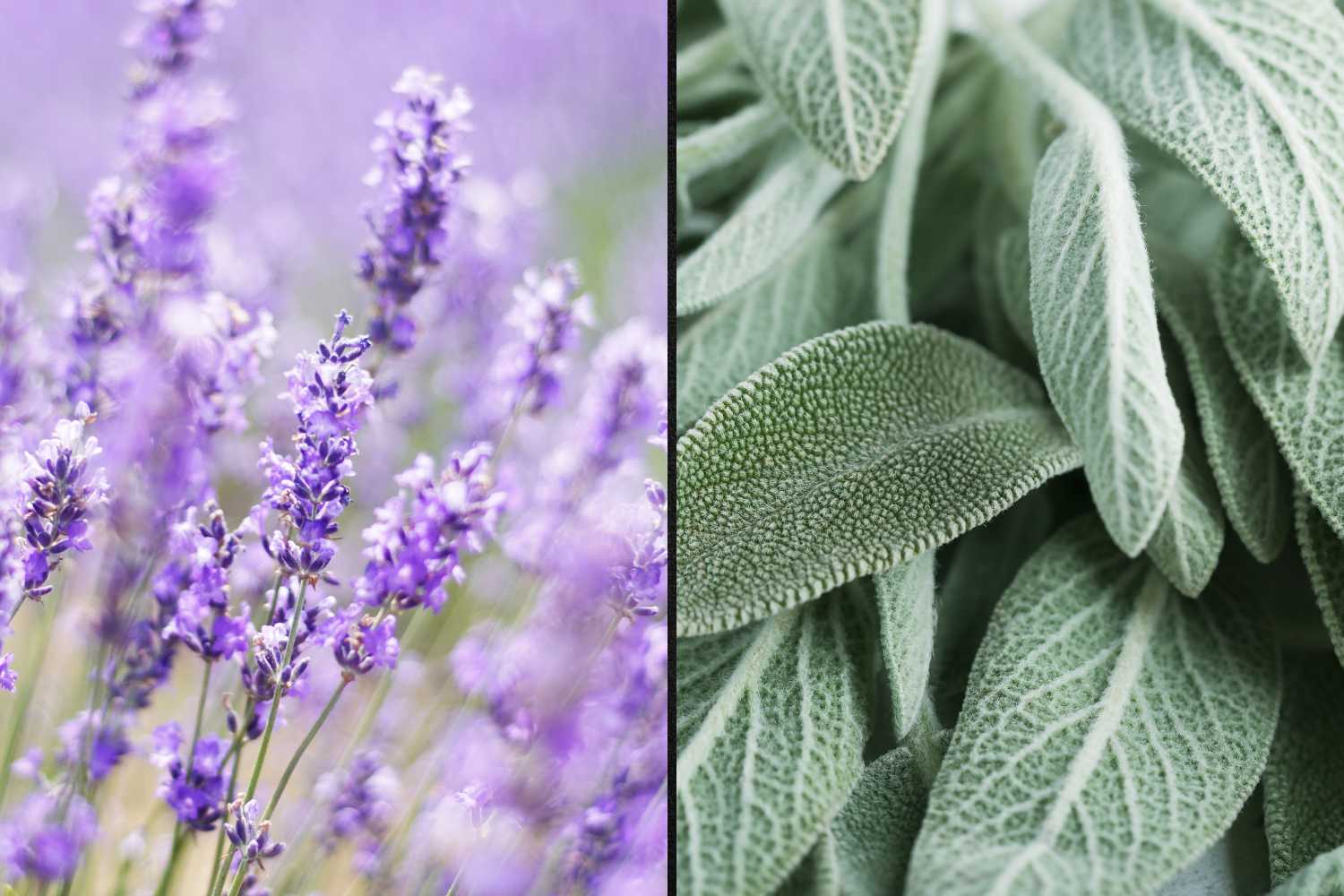
If you have sage and lavender plants at home you will surely know that particular characteristic of the leaves, a silvery veil that looks like a sort of metallic powder. To the touch they are velvety, soft, almost waxy: the patina that covers them is not a defect at all, but rather one of the most effective strategies that plants have developed to survive in the most hostile environments.
A fluff with incredible functions
The silvery surface that covers the leaves and stems of sage and lavender is made up of microscopic structures called trichomes, small hairs that develop from epidermal cells. Trichomes can be of two types: glandular, which produce essential oils and other chemicals, and non-glandular, which act primarily as a physical barrier.
In the case of sage, the leaves have a slightly tomentose upper surface and a white lower surface covered with thick down. Lavender exhibits a similar covering: the grey-green leaves are covered in tiny star-shaped hairs, and between these are glands that produce the fragrant oil rich in linalool.
A battle against drought
Mediterranean plants face a particular challenge: long, hot and dry summers. In this context, trichomes reduce water loss by creating a layer of still air on the leaf surface, which acts as an insulating barrier minimizing transpiration). It is a simple but effective mechanism: the air trapped between the hairs forms a sort of cushion that slows the movement of water vapor from the leaf towards the atmosphere.
Research has shown that trichome density is associated with greater water use efficiency. As conditions become drier, many Mediterranean plants increase the production of these protective hairs. Studies on various species have shown that the density of trichomes increases when the availability of water in the soil decreases, as well as acting as a defense against climbing plants.
Reflect light to survive
The silver patina has another very important function, namely to reflect sunlight. The dense trichomes on the leaves reflect more light, helping to regulate leaf temperature. This mechanism is particularly important in the Mediterranean climate, where the intensity of solar radiation can reach extreme levels during the summer.
Plants grown under water-poor conditions exhibit leaves that reflect up to 46% more photosynthetically active radiation than well-watered plants. Blue and red light, in particular, are significantly reflected by the trichomes, reducing the heat load on the leaf. Lower temperatures mean less transpiration and therefore less water loss.
A barrier against invisible enemies
Trichomes aren’t just for managing water and temperature. These hairs also provide a physical defense against herbivores, making it difficult for insects to reach the surface of the plant. For a small insect, crossing a trichome forest is equivalent to moving through a field full of obstacles.
In the case of glandular trichomes, the protection also becomes chemical. Lavender produces essential oils composed of monoterpenes and sesquiterpenes that are synthesized and secreted by two types of glandular trichomes: peltate and capitate. These substances have repellent and antimicrobial properties, capable of discouraging parasites and pathogens.
Phenolic compounds present in trichomes can be washed away by water and create an adverse chemical environment against the entry and spread of pathogens within the leaf. This is a preventative defense that acts before the attack even occurs.
Flexible adaptations to change
Another fascinating characteristic of trichomes is plasticity: the density of trichomes changes both genetically, through evolutionary adaptation, and in response to immediate environmental conditions. This means that the same plant can change the amount of trichomes it produces based on the conditions it encounters.
The negative correlation between trichome density and epidermal cell size suggests that cell expansion may control trichome density: when conditions are drier and cells expand less, trichomes are closer together, increasing protection.
The elegance of necessity
As noted, the silvery patina of sage and lavender represents much more than an aesthetic feature. It is the result of millions of years of evolution in harsh environments, where every drop of water counts and every degree of temperature can make the difference between life and death.
In the Mediterranean climate, plants have acquired morphological characteristics in response to periods of severe drought, including high trichome density. These apparently simple structures contain an extraordinary functional complexity: they regulate temperature, limit water loss, repel enemies and protect from ultraviolet rays.
When we look at the velvety leaves of a sage plant or the silver foliage of lavender, we are looking at an engineering solution perfected by natural selection. A solution that allows these plants to thrive where others would fail, transforming the aridity of the Mediterranean into an opportunity rather than a limit.
The next time you touch a sage leaf, stop for a moment and think about the extraordinary nature of that silver veil that you feel under your fingers: it is not a random detail, but the living testimony of how life always finds a way to adapt, resist and flourish.
