
In the middle of winter, how many times have you felt a breath of cold air near a closed window? Behind that annoying sensation there is almost always a draft, that is, a micro-crack through which external air enters and heat is dispersed.
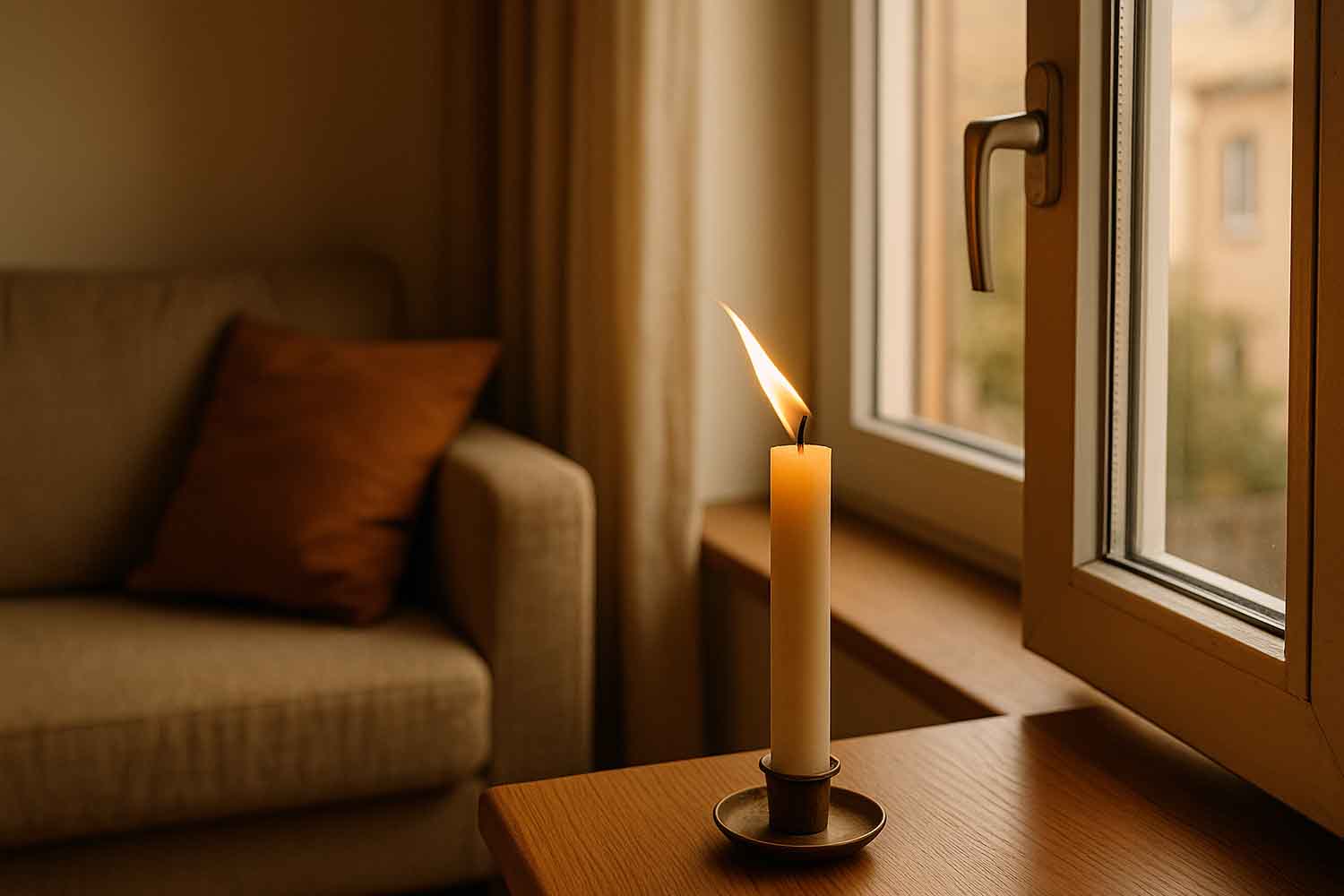
To notice this, you don’t need an expensive tool: the candle test is a little trick that can reveal where your home is “breathing” too much. Simply light a candle and slowly run it along the edges of windows, doors or bins. If the flame bends or trembles, it means that air is passing through there.
It is a simple but effective method, which helps to map the critical points and understand where to intervene with new gaskets, sealants or small repairs. It doesn’t measure heat loss in numbers, but it gives a clear picture of the invisible infiltrations which, when added together, increase the bill.
What science says
While it may seem like a home experiment, in reality the issue of the airtightness of buildings is the subject of scientific studies throughout Europe. A group of researchers from the Universidad San Pablo-CEU in Madrid, led by Roberto Alonso González-Lezcano, conducted an analysis on 151 multi-family homes to understand how much air filters through walls and frames.
Their work, published on Frontiers in Built Environmentshowed that the average home analyzed leaks air at a rate of approximately 5.8 air changes per hour. Translated: the internal air volume is completely “replaced” almost six times every hour, simply due to lack of sealing.
According to the authors, as construction materials become more insulating, losses due to drafts weigh more and more on the overall energy balance. Not only do they increase consumption, but they reduce comfort, worsen the quality of indoor air and encourage the entry of dust and noise.
In short, even the best thermal insulation is of little use if air passes freely through the joints between the wall and the window.
How to do the candle test (without risk and with clear results)
To put the candle test into practice all it takes is a few minutes and a little attention. Here’s how to do it:
- Close everything. Doors, windows, vents and chimneys: the goal is to create an environment that is as isolated as possible.
- Light the candle. Place it on a stable support, away from curtains or flammable surfaces.
- Move it slowly. Pass the flame near the edges of the window frames, the shutter box, the thresholds and the corners of the rooms.
- Observe the behavior of the flame. If it stays still, everything is ok. If it tilts, moves or goes off, there is a draft there.
- Write down the critical points. They will be used to decide where to intervene.
A little trick: you can replace the candle with an incense stick. Smoke makes the air currents visible even more clearly.
How to intervene after the test: from do-it-yourself remedies to lasting solutions
Once the drafts have been discovered, taking action is simple. Worn gaskets can be replaced with new rubber or silicone ones; the cracks in the joints are sealed with specific foams or silicones; while more obvious leaks may require the intervention of a technician.
Those who want a more precise check can ask for a blower door test, a professional analysis that measures how much air enters or leaves the home. It is the “scientific” version of the candle test, also used to certify high-efficiency buildings.
Because it’s worth doing
Reducing air loss means saving energy, improving comfort and contributing to a more sustainable use of resources. There is no need to invest huge amounts: small targeted interventions are often enough.
And, as the Spanish study reminds us, the true efficiency of a house does not depend only on how insulated it is, but on how airtight it is. Start with a candle: you may find that your home can “breathe better,” without losing heat.
You might also be interested in:
