
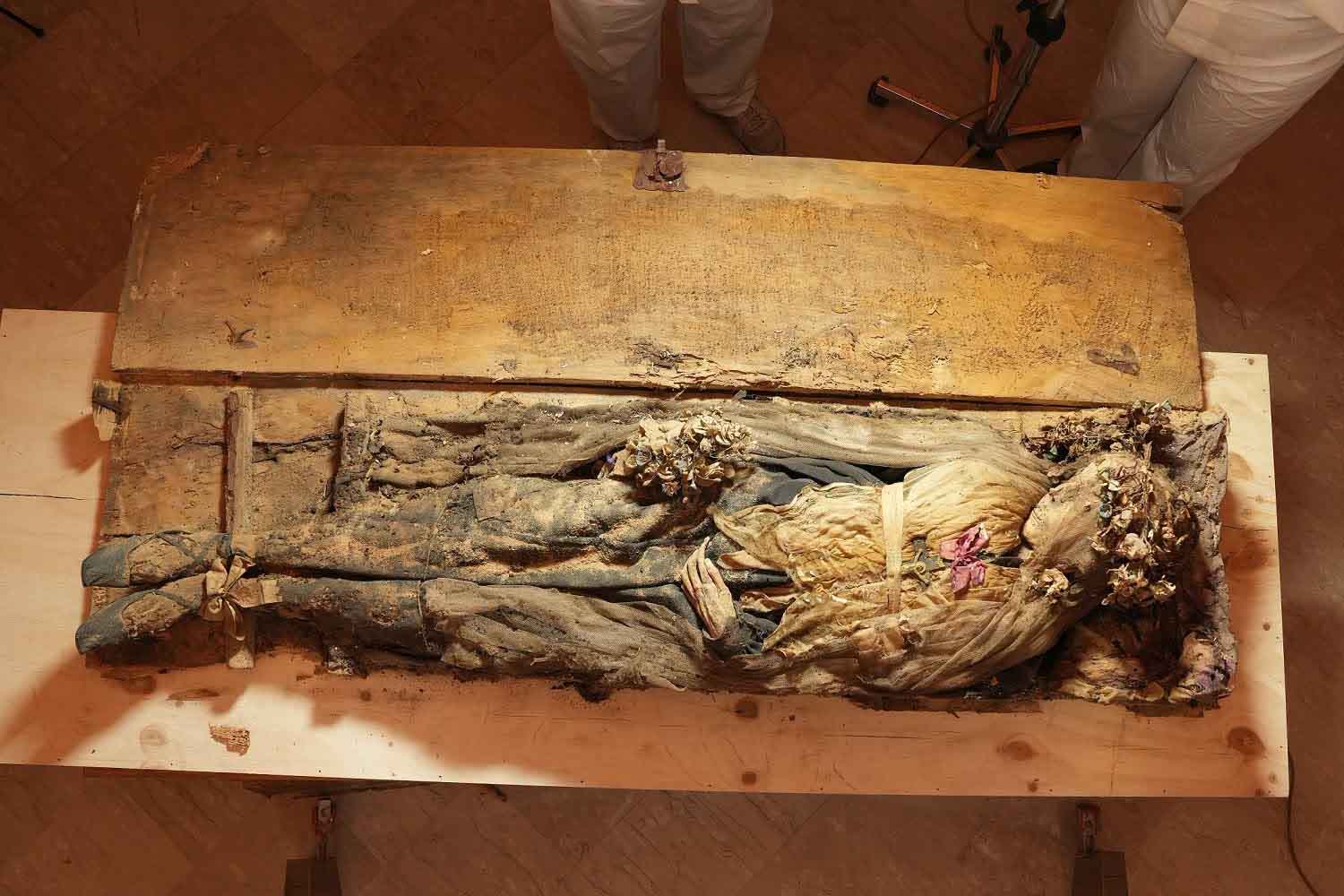
First came the construction site, the checks, the obligatory prudence when working on a church damaged by time. Then, under the altar area of the church of the Immaculate Conception, a Prata di Principato Ultrain the Irpinia area of Avellino, a presence has re-emerged that the town had guarded for almost two centuries: the mummified body of Maria Macrina Grilloyoung noblewoman who died on 22 April 1843, aged just 26. The discovery occurred during anti-seismic adaptation works financed with Pnrr funds; the remains were described as being in an exceptional state of preservation.
©Superintendence of archaeological heritage Salerno and Avellino
An epigraph placed next to the tomb gave her a name. A few engraved words, enough to reopen a story that remained beneath the surface, physically and in local memory. From that text the archaeologist Albina Moscariellocommissioned by Costructura Consulting sc, reconstructed the profile of the deceased: Maria Macrina Grillo belonged to a noble and influential family in the area, she was a figure of social and religious rank, linked to a form of lay consecration lived in a family environment.
A life of devotion, penance and charity, without formal monastic seclusion. A kind of domestic vocation, so to speak, very nineteenth-century and very rooted in that world in which home, church, lineage and community were held together like threads of the same embroidery.
A young woman returned from the church underground
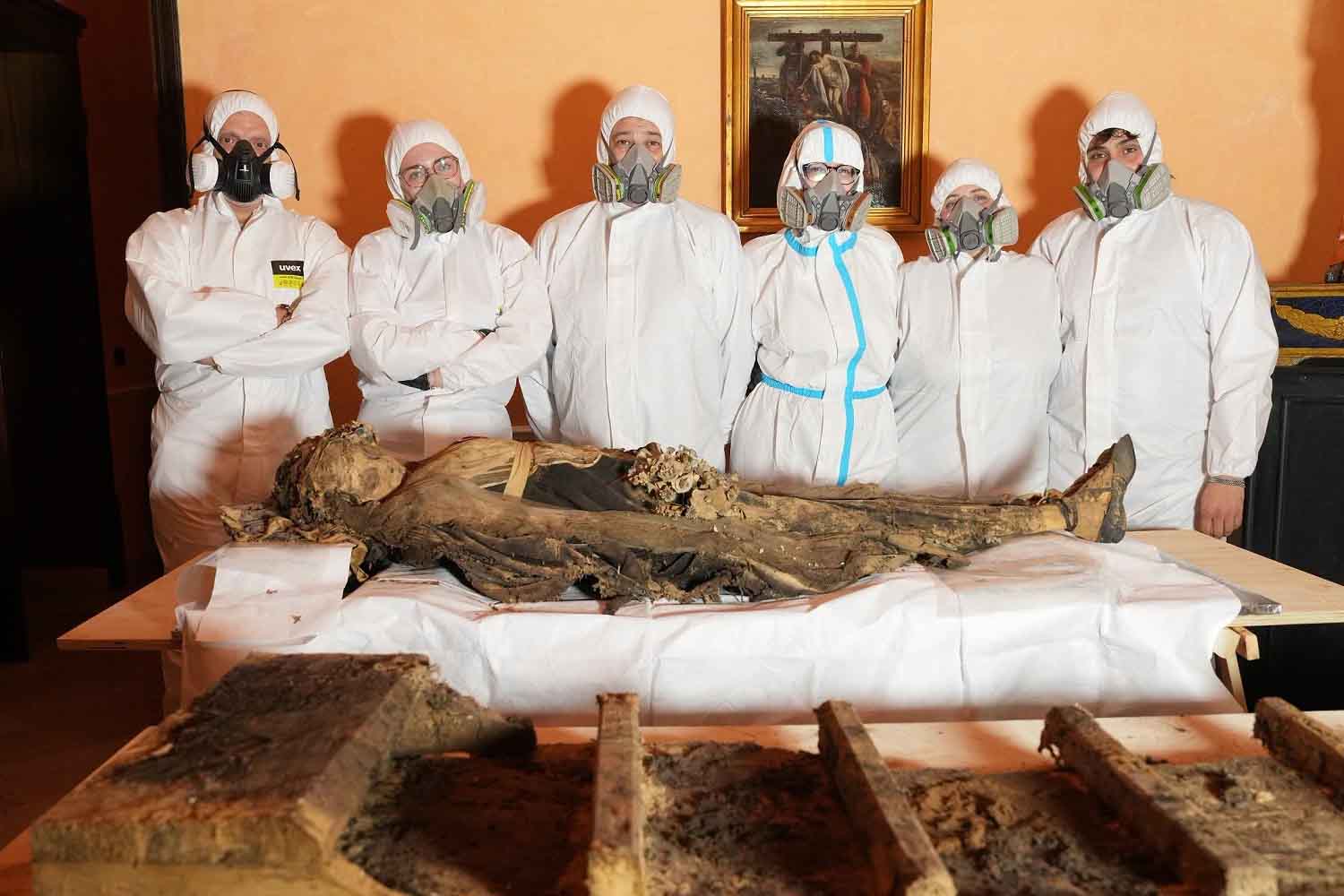
The discovery of the mummy in Irpinia immediately required a coordinated intervention. The Superintendency of Archaeology, Fine Arts and Landscape of Salerno and Avellino followed the recovery with its officials: the art historian Paola Apuzzathe architect Annarita Graziato and archaeologists Elena Russo And Anna Nenna. The transfer of the remains to an environment more suitable for conservation took place with the support of Pheliana srl and DI.GI. LAVORI srl, while the Diocese of Avellino has made the necessary spaces available, thanks to the interest of the bishop Arturo Aiello and Monsignor Pasquale Iannuzzovicar general.
©Superintendence of archaeological heritage Salerno and Avellino
The passage was among the most delicate. A body that has remained preserved for almost two centuries inside a church may appear stable, almost intact, and for this reason it requires extreme caution. It is enough to modify the surrounding environment – temperature, humidity, air circulation, contact with the outside – for such fragile organic materials to begin to deteriorate. Hence the need to treat the discovery with laboratory instruments, rather than with the simple emotion of the discovery: protect the tissues, control changes, reduce biological risks, monitor every variation.
For this reason the Superintendence involved theEurac Research – Institute for Mummy Studies of Bolzano, with Dr Marco Samadellispecialized in the conservation of mummified remains. The experts provided instructions for securing the body, checking its state of conservation and also starting a disinfestation treatment.
Tailor-made protection for Maria Macrina
The conservation work now passes through a system designed specifically for such delicate remains: the Conservation Soft Boxalso indicated by the acronym CSB. The Diocese of Avellino, through the engineer Pellegrino Borriellohas started a collaboration with Eurac Research to study and create protection suitable for the remains of Maria Macrina Grillo.
Samadelli, together with the restorers of Pheliana srl and to the SABAP restoration official Rachele Ianniellocarried out the reconditioning of the humidity of organic tissues, analyzing the water content and its activity. These are technical details, of course, but they are decisive: in a mummified human artefact the balance of humidity can make the difference between conservation and degradation.
The Conservation Soft Box it works as a kind of protected and controlled environment. It serves to maintain more stable conditions around the remains, limiting changes and reducing the risk of contamination. Inside, materials and filters designed to regulate humidity and slow down chemical, physical and microbiological processes that could damage the body are used.
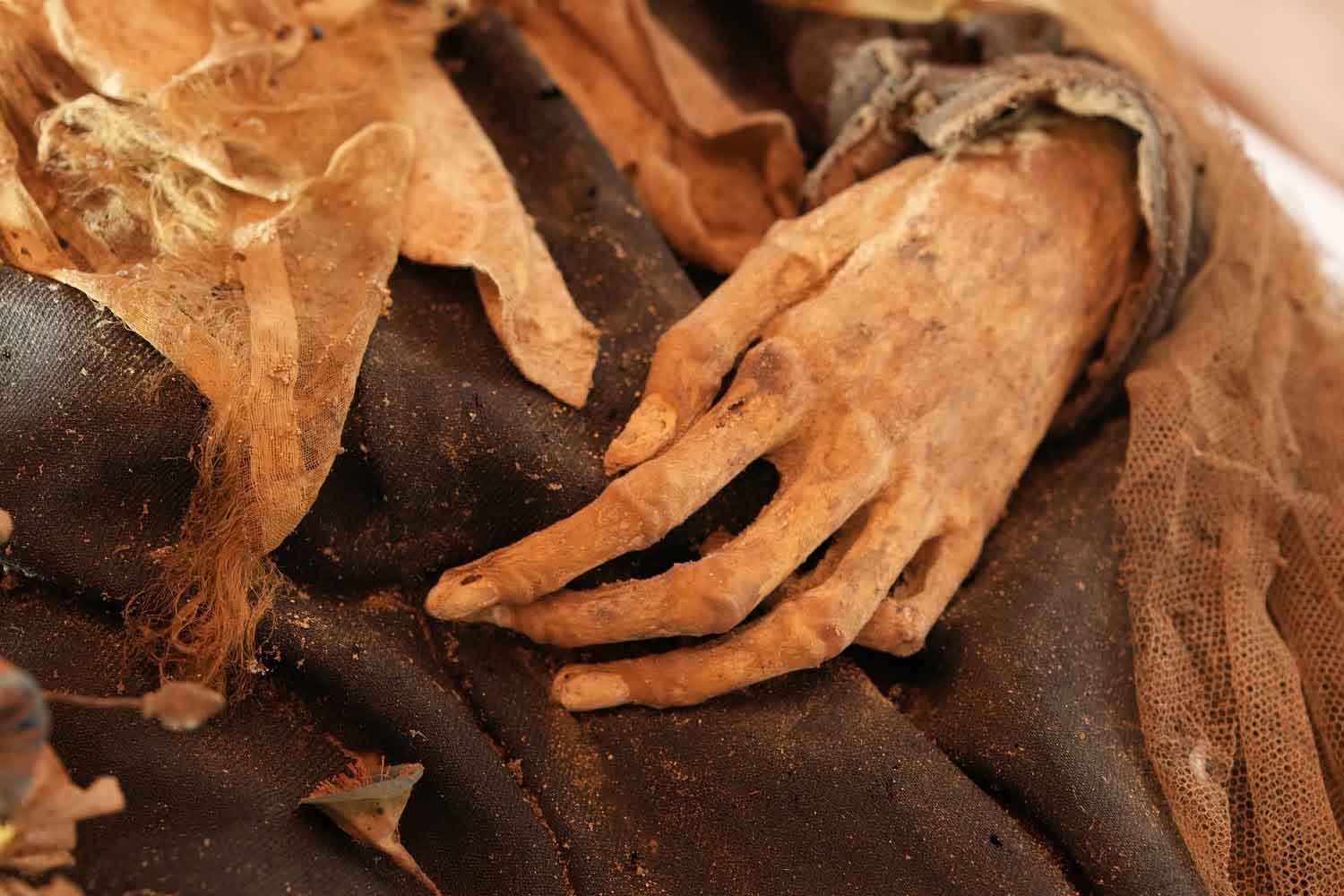
©Superintendency of Archaeological Heritage Salerno and AvellinoIn the case of the noblewoman found in Prata di Principato Ultra, monitoring of the thermo-hygrometric parameters has already started, both inside the CSB and in the surrounding environment. A continuous, silent, unspectacular control. Exactly what is needed when the past re-emerges in such rare conditions and asks, first of all, to be preserved.
The Superintendence also involved theCentral Institute for Intangible Heritage of the Ministry of Culture, precisely because of the weight that the discovery has within the community. Because here the theme surpasses the finding. Maria Macrina Grillo was a person, she belonged to a family, to a country, to a specific social landscape. His burial near the altar tells of a position, a recognized devotion, a role that went beyond simple registration.
Thanks to the Prefectural Commissioner Antonio Incollingoat the secretariat and registry office of the Municipality of Prata di Principato Ultra, the Superintendence also managed to get in touch with the direct relatives of the young noblewoman. His remains will be relocated to the apse area of the church of the Immaculate when the works are completed. In the meantime they remain in an environment more suitable for preservation, under control, waiting for the restoration of the building to allow their return.
©Superintendence of archaeological heritage Salerno and Avellino
Now Maria Macrina Grillo is once again part of a readable story. Studies will say more about her body, the conditions that allowed its conservation, the context of the burial and the relationship between that young noblewoman and the community that still recognizes her name today. For now this almost rough image remains: a church that needs to be made safe, the subsoil that gives life back, the experts who measure the humidity as if they were measuring the breath of the past. And a 26 year old girl who, after 183 years of silence, once again has a room full of people around her.
