
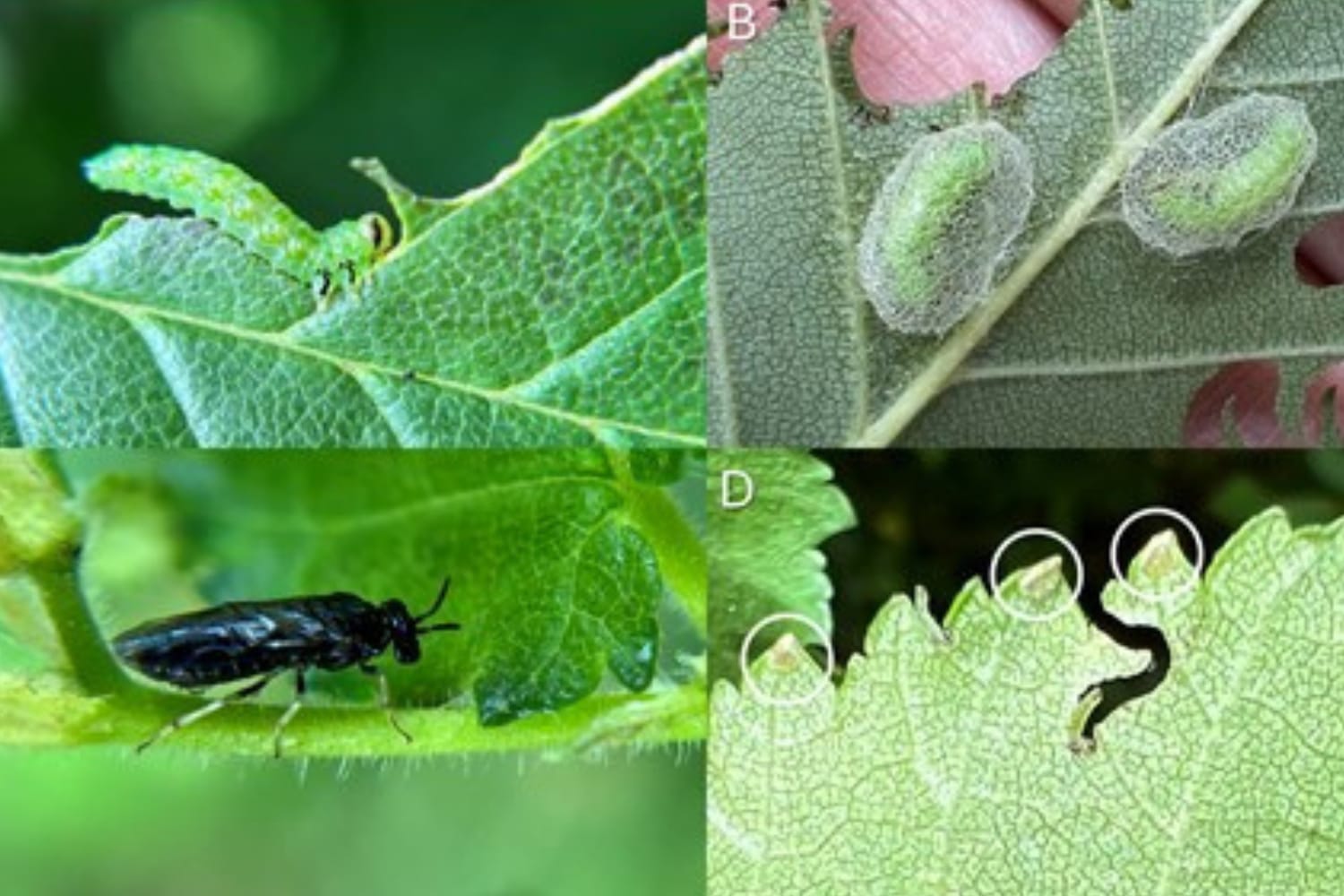
There is a tiny insect, little known to the general public, which is rewriting some rules of biology and, at the same time, is seriously putting elm trees in difficulty. It is called elm argide and is also known as the “zigzag wasp”, a name that already tells a lot about its behavior and the signs it leaves behind.
The argid of the elm and that zigzag mark on the leaves
The elm argide is a defoliant hymenoptera that mainly affects elm trees, cutting the leaves with a sinuous, almost decorative path, which is actually the first sign of a serious problem. The larvae, while feeding, dig a meandering furrow which progressively reduces the plant’s ability to carry out photosynthesis. When the infestation is intense, the tree weakens to the point of becoming more vulnerable to diseases such as graphosis, with consequences that can even lead to the death of the elm.
What makes this species particularly fearsome is not only the effectiveness with which it spreads, but also its way of reproducing. In the elm loam, males simply do not exist. All individuals are females and reproduce through telithogenesis, a natural mechanism that allows unfertilized eggs to develop anyway, giving rise to new females genetically identical to the mother. Even just one egg laid in the right place, even on firewood or walking surfaces, is enough to start a new infestation.
From Asia to Europe, up to the United States
The original range of the elm argid is located in eastern Asia, but the insect has long since crossed natural boundaries. It has been present in Europe for several years and in Italy infestations have been reported since 2003, particularly in regions such as Emilia-Romagna and Friuli Venezia Giulia. In the United States, however, its appearance is relatively recent but very rapid: since the first discovery in 2020, the species has spread to at least 15 states in just a few years, attracting the attention of scholars from the Entomological Society of America, who openly speak of an alarming spread.
In this case, the insect’s true ally is the human being. Pupae cocoons can easily stick to trucks, wheel wells, rear-view mirrors or be carried into the soil of ornamental plants. Thus, without realizing it, man becomes the main vector of a parasite that takes advantage of global mobility to colonize new environments.
Telitocus parthenogenesis
The reproductive system of the elm argid fascinates researchers because it represents one of the most extreme examples of asexual reproduction. Telitocus parthenogenesis allows the birth of individuals who are, in effect, clones of the mother. However, this is not an absolute exception in the animal kingdom. Similar mechanisms have also been observed in aphids, the common “plant lice”, and in Daphnia, small freshwater crustaceans that reproduce without males only when environmental conditions are favourable.
There are even more surprising cases, such as some species of lizards of the Aspidoscelis genus, in which the males have long since disappeared and the females maintain mating behavior despite having no reproductive function. Even the marine world has given rise to episodes that have caused discussion, such as the birth of baby sharks from mothers isolated in aquariums, which occurred even in the presence of males, as documented at the Shedd Aquarium.
In the case of elm argid, however, this reproductive strategy represents a concrete problem for urban and natural ecosystems, because it accelerates the spread of the parasite and makes infestation control more difficult.
You might also be interested in:
